After an implant-free rhinoplasty the nose usually feels blocked and pressured, with little sharp pain, and the discomfort is well controlled. Most people asking whether it hurts want to know whether it will be bearable and what exactly they are signing up for. This is surgery, so there is discomfort. The one thing many patients overlook is that an implant-free nose has a second area to heal, behind the ear.
The short answer
Implant-free rhinoplasty is performed under sedation or general anaesthesia, so you feel nothing during the operation itself.
Afterwards, most people describe pressure, blockage and a dull ache, typically well managed with simple medication.
Because the dorsum is built from your own ear cartilage, there is a second, smaller donor site behind the ear that has its own mild soreness.
Nose sutures are usually removed around day 7 and the ear donor site around day 10, after which discomfort settles quickly.
What anaesthesia is used for implant-free rhinoplasty
An implant-free rhinoplasty at Garnet is done with the nasal dorsum rebuilt from your own ear cartilage and the tip refined with septal cartilage, with no artificial implant. Because it involves harvesting cartilage as well as reshaping the nose, it is performed under either deep sedation or general anaesthesia; local anaesthetic alone is not used. The choice depends on how much work the case needs, your medical history and your own preference, and you settle it with the surgeon at your assessment, well before the day.
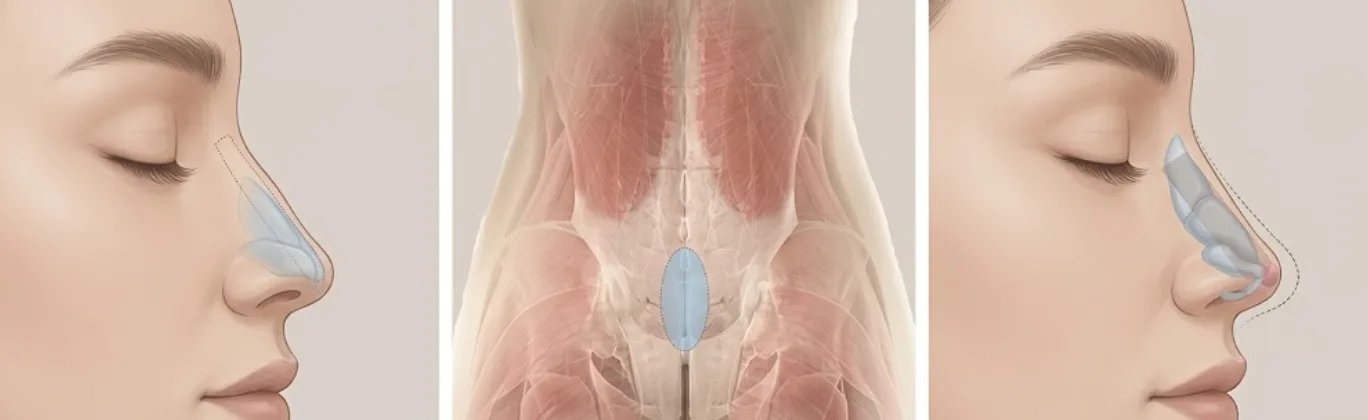
Illustration: instead of an implant, the bridge and tip are built from the patient's own tissue, shaped into the nasal framework (blue). The dashed line shows the original contour.
Under sedation you are in a deeply relaxed, sleep-like state and aware of nothing; under general anaesthesia you are fully asleep. In both cases the goal is the same: you feel nothing during the operation, your airway and vital signs are monitored throughout, and you wake gently afterwards. If you want to understand the wider procedure first, the parent overview at implant-free rhinoplasty explains the technique and why your own cartilage is used instead of an implant.
It is worth asking, at consultation, who administers and monitors the anaesthesia and how recovery from it is managed. A clinic that runs an unhurried schedule, without back-to-back cases, has more time to bring you round calmly and watch you afterwards. That is part of why the pain experience differs between clinics even for the same operation.
During surgery
What you feel during the operation
During the surgery itself, you feel nothing. You are asleep or deeply sedated from before the first incision until the dressings are in place, so the parts that sound most uncomfortable (harvesting the ear cartilage, refining the septal tip, shaping the dorsum) happen entirely outside your awareness. People are often surprised that the operation, the part they dread most, is the part they remember least.
What you do notice begins as the anaesthesia wears off. The most common first sensations are a blocked, stuffy nose, a feeling of pressure across the bridge, and mild grogginess. There may be a splint or tape on the nose and a small dressing behind the ear. None of this is usually described as severe; the dominant feeling for most patients in the first hour is simply waking up and being unable to breathe easily through the nose.
Because there is no implant being placed under tension, many patients who have researched implant-based noses expect more dramatic discomfort than they actually experience. The trade-off is the opposite one: the comfort question for an implant-free nose is less about the bridge and more about the small donor site behind the ear, which is covered next.
Ear donor site
The ear donor site: the part most people forget
An implant-free rhinoplasty has two healing areas. Alongside the nose, a small piece of cartilage is taken from behind the ear (the conchal cartilage) to rebuild the dorsum, leaving a discreet incision and donor site there. This is the detail most patients overlook when they picture recovery, and it is the real difference from an implant nose: there is a second, smaller site to look after.
The good news is that the ear donor site is generally a mild ache. Most people describe it as tenderness when they lie on that side or touch the area, similar to a bruise, with nothing sharp. The incision sits in a natural crease behind the ear and is designed to be hard to see once healed. At Garnet the ear sutures are typically removed around day 10, a few days after the nose sutures at around day 7, because the ear simply takes a little longer to settle.
Practical comfort tips follow from this: sleep on your back, off the donor-side ear, for the first week or so, and be gentle with glasses, earphones and face masks that press on the area. If you want the full week-by-week picture of how both sites settle, the sibling page on implant-free rhinoplasty recovery walks through it day by day.
First days
What the first few days actually feel like
The first 48 to 72 hours are usually the peak of discomfort, and even then most patients describe it as congestion and pressure. Your nose will feel blocked because of internal swelling and dressings, so you will breathe through your mouth, which can make your throat and lips dry. There is often a dull, heavy feeling across the bridge and around the eyes, and some bruising or puffiness, particularly in the morning. Sharp pain that medication does not touch is not the normal pattern and is worth reporting.
From around day three to day five, the worst of the pressure typically eases. Swelling starts to come down, the heavy feeling lifts, and most people find they need little or no pain relief by this point. Discomfort becomes more of a background awareness than something that dominates the day. The ear donor site is usually quietly healing in the background, tender only when touched or leaned on.
The two milestones that mark the real turning point are suture removal at roughly day 7 for the nose and day 10 for the ear. Once the splint and sutures are out, many patients say the nose feels noticeably lighter and freer, even though deeper swelling continues to settle over the following weeks. None of these early sensations should be confused with the final result; the nose is still healing, and judging it now only causes unnecessary worry.
Managing discomfort
How discomfort is managed and reduced
Discomfort after an implant-free rhinoplasty is controlled with simple, well-established measures. You will normally be given oral pain relief and a short course of medication to limit swelling and reduce infection risk, with clear instructions on how and when to take them. Most patients step down from regular pain relief within a few days. Sleeping propped up on two pillows, using cold compresses around (not on) the nose in the first days, and avoiding bending, heavy lifting and hot environments all genuinely reduce throbbing and pressure.
Some practical habits make a real difference to comfort: keep your head elevated, stay hydrated to ease the mouth-breathing dryness, avoid blowing your nose, and do not wear anything that presses on the bridge or the ear donor site. Smoking and alcohol both slow healing and tend to make swelling, and therefore the pressure feeling, worse, so they are best avoided in the early weeks. Your coordinator will give you a written aftercare plan so you are not guessing.
The single biggest factor in how the recovery feels, though, is who is overseeing it. When the same surgeon who operated also reviews your healing, small worries such as a sutured area that feels tight, asymmetric swelling or a question about medication get answered quickly and correctly. You can raise all of these concerns before you ever travel through an online consultation, and continue to reach the clinic after you return home.
At Garnet
How Garnet keeps an implant-free rhinoplasty comfortable
Garnet is a single-surgeon clinic in Apgujeong, Seoul, where Dr. In-Soo Baek, a board-certified plastic surgeon (Korean medical licence no. 77407), is the only operating doctor. He consults, performs the operation himself and reviews every follow-up, and the clinic deliberately caps the day at two surgeries, one patient at a time. That unhurried pace matters for comfort: there is time to plan the anaesthesia carefully, to wake you gently, and to watch you afterwards before the next case begins.
Because your own ear and septal cartilage are used instead of an implant, the comfort plan is built around both the nose and the ear donor site, with structured follow-up at 1, 3 and 6 months to make sure both heal cleanly. The same surgeon who took the cartilage is the one checking how the donor site settles, which removes the uncertainty of being handed between staff during recovery.
Garnet is registered with Korea's foreign-patient programme, so international patients can plan the whole journey (assessment, surgery, suture removal and remote follow-up) around realistic comfort and recovery times. If you are weighing this against an implant-based nose specifically on comfort and healing, the comparison at implant vs implant-free rhinoplasty lays out the trade-offs.
Dr. In-Soo Baek
Director & sole operating surgeon
Korean medical licence no. 77407
Operate on what you came for. Trained at Korea University Medical Center. Every case planned, performed and reviewed by the same hands.
1Operating surgeon
~2Surgeries per day
7Registered techniques
Board-certified plastic surgeon
Plastic surgery training at Korea University College of Medicine & graduate school
Korean Society of Plastic and Reconstructive Surgeons member, in its facial-contour, eye & rhinoplasty groups
Consults, operates and follows up each case himself
Peer-reviewed papers behind the facts on this page. Each describes findings in its own study group — not results at Garnet — and none predicts your own outcome.
Malone M et al. Dorsal Augmentation in Rhinoplasty: A Survey and Review. Facial Plastic Surgery. 2015. doi:10.1055/s-0035-1555616
Sajjadian A et al. Current Status of Grafts and Implants in Rhinoplasty: Part I. Autologous Grafts. Plastic and Reconstructive Surgery. 2010. doi:10.1097/prs.0b013e3181c82f12
Bohler F et al. Fresh Frozen vs Autologous Costal Cartilage in Rhinoplasty: A Meta-Analysis of Complication Rates. Aesthetic Surgery Journal Open Forum. 2026. doi:10.1093/asjof/ojag072
FAQ
Common questions
Is implant-free rhinoplasty painful?
It is surgery, so there is discomfort, but most patients describe pressure, congestion and a dull ache, with little sharp pain. You feel nothing during the operation because it is done under sedation or general anaesthesia, and the discomfort afterwards is usually well controlled with simple medication, easing noticeably after the first few days.
What anaesthesia is used for implant-free rhinoplasty?
Because cartilage is harvested as well as the nose reshaped, it is performed under deep sedation or general anaesthesia; local anaesthetic alone is not used. In both cases you are unaware of the operation and your vital signs are monitored throughout. The choice is decided with the surgeon at your assessment based on the case and your history.
Does the ear hurt after implant-free rhinoplasty?
There is a small donor site behind the ear where cartilage is taken to rebuild the bridge, and it has its own mild soreness, usually a tenderness like a bruise when you lie on that side or touch it. The ear sutures are typically removed around day 10, a few days after the nose at around day 7.
How long does the pain last after implant-free rhinoplasty?
The first 48 to 72 hours are usually the peak, felt mostly as pressure and blockage. From around day three to five the worst eases and most people need little pain relief. After suture removal at roughly day 7 for the nose and day 10 for the ear, discomfort settles quickly, though deeper swelling continues to fade over weeks.
Is implant-free rhinoplasty more painful than an implant nose?
Not necessarily more painful, but it heals differently: an implant-free nose has a second, smaller site behind the ear to look after, while an implant nose has only the nose. Many patients find the bridge itself more comfortable without an implant under tension. The real difference is the ear donor site; overall pain is not greater.
How is the discomfort managed after surgery?
With oral pain relief and a short course of anti-swelling and anti-infection medication, plus simple measures: sleeping propped up, cold compresses around the nose in the early days, and avoiding bending, heat and pressure on the nose or ear. Most patients step down from regular pain relief within a few days.
Will I be able to breathe through my nose afterwards?
Not easily at first. Internal swelling and dressings block the nose for the early days, so you breathe through your mouth, which can dry your throat and lips. This is normal and temporary; nasal breathing improves steadily as the swelling comes down and the dressings are removed.
When can I judge how my nose feels and looks?
Not in the first weeks. Early swelling, congestion and the heavy pressure feeling are part of healing and do not show the final result. The nose feels lighter after suture removal, but deeper swelling settles over months. Garnet's follow-ups at 1, 3 and 6 months are designed to track this properly so you are not left to guess.
Can I ask about pain and anaesthesia before travelling to Korea?
Yes. You can discuss the anaesthesia plan, what recovery will feel like and how discomfort is managed in an online consultation before you book, and send photos for a pre-assessment. The same surgeon who would operate can answer these questions, so there are no surprises on the day.
My mom recently had a brow lift and lower blepharoplasty with Dr. Baek, and our experience has been wonderful so far. The Garnet team was incredibly kind and welcoming, with Kelly assisting us as our English consultant—she made everything…
I’m so happy I chose this clinic for my lower blepharoplasty. I was traveling from abroad by myself, so I was a little nervous, but from the beginning I felt comfortable and truly cared for. Everyone was kind, patient, and professional…
Came in for an in-person consult and ended up choosing Garnet and Dr.Baek for my non-incisional DES and tiplasty/alarplasty. I communicated with Kelly (English consultant) from the start till now (3 weeks post-op). She really help me feel…
My under-eyes have been sagging and folding for years... I tried to cover it up with makeup, but it actually got stuck in the wrinkles and made it stand out even more. While going for consultations, I noticed that the bigger the hospital…
Worried about pain or anaesthesia for an implant-free rhinoplasty? Send photos for a no-obligation pre-assessment and ask the surgeon directly before you plan a trip.
Send photos and your question before you travel. An English-speaking coordinator reviews every enquiry and replies with guidance on whether surgery is appropriate, the likely plan and timing.
✓ Reviewed by the clinic coordinator, not a bot
✓ Photo-based pre-assessment before you fly
✓ Foreign-patient scheduling & after-care
✓ One surgeon for consultation, surgery and follow-up
Prefer to chat now? Reach the coordinator directly:









 T S7 months ago



