Revision lateral canthoplasty is one of the more demanding eye procedures, because it works on tissue that has already been operated on, scarred and healed. Not every outcome can be fully reversed. Many specific problems, from an outer corner that has relapsed to one that looks overdone, can still be improved after a careful, individual assessment.
The short answer
Revision works on previously operated, scarred tissue, so it is more complex than a first-time lateral canthoplasty and the realistic goal is improvement. A guaranteed reset is not on offer.
Common reasons include overcorrection, relapse back toward the original shape, canthal webbing, a rounded or pulled-down corner, asymmetry and visible scarring.
Timing matters: scar tissue needs to mature, so revision is usually considered several months after the first surgery.
A clear assessment of what can and cannot be corrected is the most important step. At Garnet the same board-certified surgeon assesses, operates and follows up.
People look into revising a previous lateral canthoplasty for several distinct reasons, and naming yours precisely matters because each points to a different approach. The most common is overcorrection: the outer corner opened too far, leaving the eye looking unnaturally elongated, the corner exposed, or the lower lid pulled down. The opposite problem is relapse: over the months after a first surgery, the corner gradually drifts back toward its original shape, so the change has partly or fully reversed.
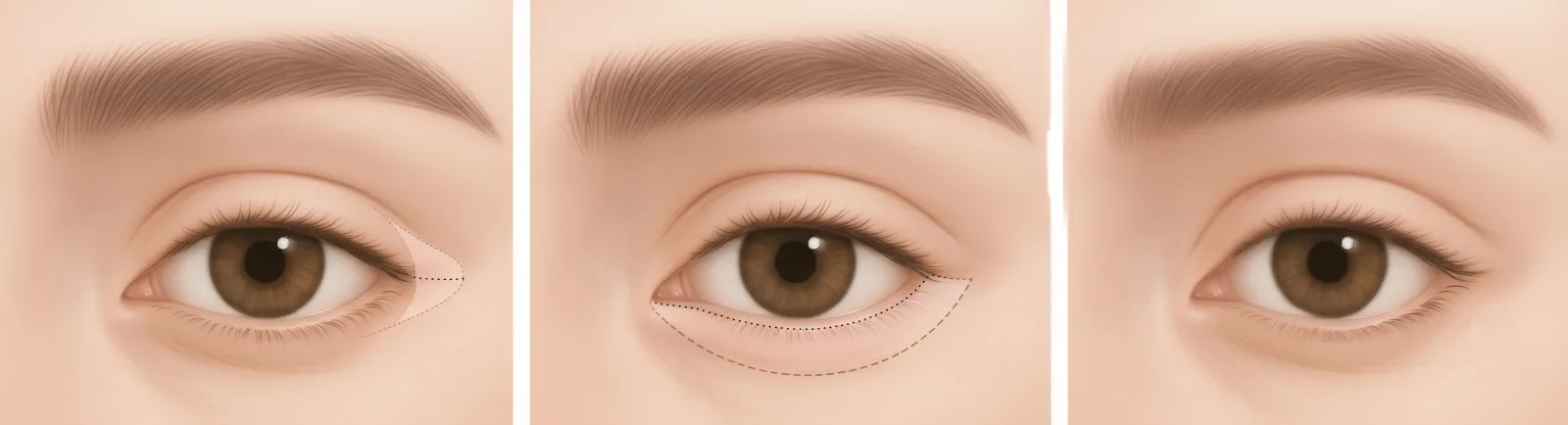
Illustration: the outer corner is extended and the lower-lid line gently lowered along the dotted lines, softening the angle of the eye.
Others are unhappy with the shape more than the amount: a corner that looks rounded, downturned or pulled when it was meant to look sharper, or noticeable asymmetry between the two eyes. Some are bothered by a visible scar or by canthal webbing, a small fold or band at the corner. A few have functional concerns such as the corner not closing comfortably. These are different problems, and a revision plan starts by separating them instead of treating 'I don't like it' as one issue.
If the original surgery was done as part of a wider eye reshaping, the picture can involve neighbouring procedures too. A corner issue sometimes interacts with the inner corner (see the related epicanthoplasty revision page), and a sound revision assessment looks at the eye as a whole as well as the one corner.
What's possible
What revision can and cannot do
What is realistic depends entirely on which problem you have and how much healthy tissue remains. Relapse, a corner that has drifted back, can often be re-opened and re-secured, and this is among the more straightforward revisions because the goal is to redo, more durably, what was intended. Overcorrection is generally harder: bringing an over-opened or pulled-down corner back toward a natural position may require releasing scar tissue and, in some cases, reconstructive techniques, and full reversal cannot always be achieved.
Canthal webbing and a rounded corner can frequently be improved by revising the scar and reshaping the corner, though results depend on how the tissue has healed. Asymmetry is usually approached by adjusting only the side that needs it. Across all of these, the controlling factor is that revision works with what previous surgery and healing have left behind. The realistic aim is improvement toward a more natural, balanced corner; recreating an un-operated eye cannot be promised.
This is why revision is best understood case by case. The starting overview is still the lateral canthoplasty procedure page, which explains the conjunctival-incision technique and the lower-canthal opening used in a first operation, context that helps you understand what a revision is adjusting.
Scarring
Scarring and the limits of re-operated tissue
The single biggest difference between a first lateral canthoplasty and a revision is scar tissue. Once the corner has been operated on, the area heals with internal scarring that is firmer and less forgiving than virgin tissue, and that scarring both causes some of the problems people want fixed and constrains what a second operation can achieve. Releasing and reshaping scar tissue is a careful business, and over-aggressive revision can add new scarring.
Healing after a revision can also be less predictable than after a first surgery, because the blood supply and tissue quality at a re-operated corner are not the same. This is why a conservative, well-judged plan usually serves patients better than an attempt to force a dramatic change in one step. Sometimes the wisest advice is to wait, to do less, or occasionally that further surgery is unlikely to improve things meaningfully.
Scar maturity is also why timing is a core part of the plan. A corner that still looks wrong in the early weeks may settle considerably as swelling resolves and the scar softens, as the next section explains.
Timing
When to consider revision
The strong general rule is to wait. After a first lateral canthoplasty, swelling, tightness and an unsettled corner shape are normal for weeks, and the tissue continues to soften and the scar to mature for many months. Judging a result too early and rushing into revision risks operating on a corner that would have settled acceptably on its own, and risks working on scar tissue that has not yet matured enough to be revised safely.
For these reasons, revision is usually considered months after the original surgery, once the scar has matured and the final shape is clear. Genuine functional problems are the exception and may need earlier attention, but cosmetic dissatisfaction is almost always best reassessed after full healing. If your first surgery is recent, the most useful step is often to track how it settles. The recovery timeline sets out what a normal healing course looks like.
If you are travelling from abroad for a revision, timing also has a practical layer: you need the original site to be ready, and you need to plan a stay that allows for sutures and early review. That logistical side is covered on the international-patient page.
Assessment
Why a careful revision assessment comes first
Revision is the area where a careful assessment matters most, because patient and clinic alike are tempted to expect a clean fix. A careful surgeon will examine the corner, ask exactly what bothers you, look at the eye as a whole including the inner corner and lower lid, and tell you plainly what is improvable, what is partly improvable, and what is best left alone. Hearing that a particular outcome cannot be fully reversed is disappointing, but it is far better than a second surgery that does not deliver.
A sales-led consultation rarely gives this kind of answer. It is much easier to trust when the person assessing you is the person who will operate and then follow you through recovery: there is no hand-off, and no incentive to over-promise to secure a booking. A good revision consultation often ends with a clear, modest plan, or sometimes with the advice to wait longer before deciding.
You do not have to fly to Korea to begin this. You can send photos of the current result and a description of your concern for an online pre-assessment, and find out whether revision is realistic before you commit to any travel.
At Garnet
How Garnet approaches revision
Garnet is a single-surgeon clinic in Apgujeong, Seoul. Dr. In-Soo Baek is a board-certified plastic surgeon (Korean medical licence no. 77407) and the only operating doctor; he personally assesses the previous result, plans the revision, performs it himself and reviews your recovery. For revision work, where judgment about scarred tissue and realistic limits is everything, that continuity removes the uncertainty of being assessed by one person and operated on by another.
The clinic caps the day at two surgeries, so a revision, which can be more detailed and less predictable than a first-time corner procedure, has unhurried time. Structured follow-ups at one, three and six months matter especially after a revision, because re-operated tissue is judged over months. Garnet is registered with Korea's foreign-patient programme, and the overview of the underlying procedure is on the lateral canthoplasty page.
If you have had a previous lateral canthoplasty elsewhere and are unsure whether anything can be done, the first step costs nothing. Send photos for a candid pre-assessment of what is and is not realistically correctable.
Dr. In-Soo Baek
Director & sole operating surgeon
Korean medical licence no. 77407
Operate on what you came for. Trained at Korea University Medical Center. Every case planned, performed and reviewed by the same hands.
1Operating surgeon
~2Surgeries per day
7Registered techniques
Board-certified plastic surgeon
Plastic surgery training at Korea University College of Medicine & graduate school
Korean Society of Plastic and Reconstructive Surgeons member, in its facial-contour, eye & rhinoplasty groups
Consults, operates and follows up each case himself
Peer-reviewed papers behind the facts on this page. Each describes findings in its own study group — not results at Garnet — and none predicts your own outcome.
Juniat V et al. Canthoplasty repair for canthal rounding. Eye. 2021. doi:10.1038/s41433-021-01497-y
Cho YK et al. The Effective Fixation Level for Cosmetic Lateral Canthoplasty. Journal of Craniofacial Surgery. 2019. doi:10.1097/scs.0000000000005378
Chung S et al. Lowering Lateral Canthoplasty and Orbital Rim Shaving: An Ignored but Necessary Procedure for Maximizing the Effect of Reduction Malarplasty in Asians. Aesthetic Plastic Surgery. 2019. doi:10.1007/s00266-019-01342-4
FAQ
Common questions
Can a previous lateral canthoplasty be corrected?
Often, yes, but how much depends on the specific problem and how the tissue has healed. Relapse toward the original shape is frequently improvable; overcorrection and a pulled-down corner are harder and may not be fully reversible. The realistic goal of revision is improvement toward a more natural corner.
What does lateral canthoplasty revision involve?
It depends on the issue. It may mean re-opening and re-securing a corner that has relapsed, releasing and reshaping scar tissue in an overcorrected or webbed corner, or adjusting one side for asymmetry. Because it works on previously operated, scarred tissue, it is generally more complex than a first lateral canthoplasty.
When should I consider lateral canthoplasty revision?
Usually several months after the original surgery. Swelling and an unsettled shape are normal early on, and scar tissue needs to mature before it can be revised safely. A result that looks wrong in the first weeks may still settle, so cosmetic revision is best assessed after full healing.
Why is revision harder than the first surgery?
Because it works on scarred, previously operated tissue with a less predictable blood supply and healing pattern. Scarring both causes some problems people want fixed and limits what a second operation can achieve. Over-aggressive revision can create new scarring, so a conservative, well-judged plan usually serves patients best.
Can overcorrection be reversed?
Sometimes it can be improved by releasing scar tissue and reshaping or, in some cases, reconstructive techniques, but full reversal cannot always be achieved. Careful assessment is essential, because bringing an over-opened or pulled-down corner back toward a natural position is one of the harder things revision is asked to do.
Can canthal webbing be fixed?
Canthal webbing, a small fold or band at the corner, can frequently be improved by revising the scar and reshaping the corner, although the result depends on how the area has healed. It should be assessed alongside the rest of the corner.
Should I wait before having revision?
In most cosmetic cases, yes. Waiting until the corner has settled and the scar has matured, usually several months, gives a clearer picture and safer tissue to work with. Genuine functional problems may be an exception and should be reviewed sooner. Tracking the recovery timeline helps you judge.
Can I be assessed for revision from abroad?
Yes. You can send photos of the current result and describe your concern for an online pre-assessment, and find out whether revision is realistic before planning any travel to Korea.
Will the same surgeon assess and perform my revision?
At Garnet, yes. Dr. In-Soo Baek, a board-certified plastic surgeon, personally assesses, performs and follows up every case. For revision, where judgment about scarred tissue and realistic limits matters most, that continuity removes the hand-off between the person who assesses you and the person who operates.
My mom recently had a brow lift and lower blepharoplasty with Dr. Baek, and our experience has been wonderful so far. The Garnet team was incredibly kind and welcoming, with Kelly assisting us as our English consultant—she made everything…
I’m so happy I chose this clinic for my lower blepharoplasty. I was traveling from abroad by myself, so I was a little nervous, but from the beginning I felt comfortable and truly cared for. Everyone was kind, patient, and professional…
Came in for an in-person consult and ended up choosing Garnet and Dr.Baek for my non-incisional DES and tiplasty/alarplasty. I communicated with Kelly (English consultant) from the start till now (3 weeks post-op). She really help me feel…
My under-eyes have been sagging and folding for years... I tried to cover it up with makeup, but it actually got stuck in the wrinkles and made it stand out even more. While going for consultations, I noticed that the bigger the hospital…
If you are unhappy with a previous lateral canthoplasty, send photos for a no-obligation pre-assessment of what can and cannot realistically be corrected.
Send photos and your question before you travel. An English-speaking coordinator reviews every enquiry and replies with guidance on whether surgery is appropriate, the likely plan and timing.
✓ Reviewed by the clinic coordinator, not a bot
✓ Photo-based pre-assessment before you fly
✓ Foreign-patient scheduling & after-care
✓ One surgeon for consultation, surgery and follow-up
Prefer to chat now? Reach the coordinator directly:









 T S7 months ago



