Lateral canthoplasty is one of the more travel-friendly procedures to have in Korea, because it is a precise operation on the outer eye corner and not a major surgery. It still needs planning around the 7-day suture point and a realistic stay. This guide covers the practical questions international patients ask: how long to be in Seoul, what happens at each visit, and how the same surgeon can follow your recovery after you return home.
The short answer
Plan your stay around the suture-removal point: sutures typically come out at around day seven, so a stay of roughly seven to ten days is the usual frame.
Lateral canthoplasty is often combined with epicanthoplasty or other eye work in one sitting, which means one recovery and one trip.
You can start entirely from home with an online consultation and photo pre-assessment before committing to any travel.
After you fly home, the same board-certified surgeon who operated can review your recovery remotely, with clear guidance on what to watch for.
You do not need to fly to Korea to find out whether lateral canthoplasty is right for you. The sensible first step is an online consultation: you send clear photos of your eyes (typically straight on, looking up and down, and from the side) and describe what you would like to change at the outer corner. From that, the surgeon can give a pre-assessment of whether the procedure suits you, what is realistic, and how it might be planned, all before you spend anything on travel.
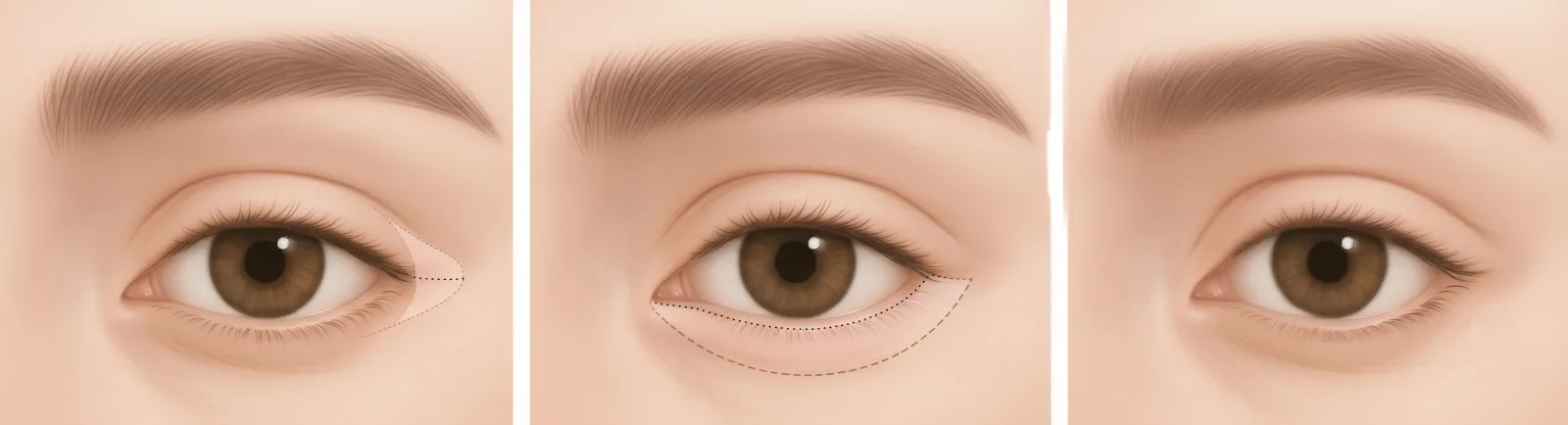
Illustration: the outer corner is extended and the lower-lid line gently lowered along the dotted lines, softening the angle of the eye.
This matters more for an eye-corner procedure than people expect, because suitability depends on your specific anatomy: the shape of the corner, the lower lid, and how the inner and outer corners relate. The online assessment can also tell you if lateral canthoplasty alone will not achieve what you want, or if it is better combined with another step. You can read how this works on the online consultation guide.
Starting online also lets you settle the practical questions in advance: likely stay length, what the visits involve, and how follow-up will work once you are home. By the time you book a flight, the plan is already clear and nothing has to be improvised on arrival. The procedure itself is explained in full on the lateral canthoplasty page.
Stay length
How long to stay in Korea
The anchor for your trip is the suture-removal point. For lateral canthoplasty the sutures typically come out at around day 7, so you need to be in Korea long enough to have the surgery, recover through the early swelling, and return for suture removal and a check before flying home. In practice that usually means a stay in the region of 7 to 10 days, with a buffer either side. Avoid booking your flight for the exact day the sutures come out.
A useful way to plan it: arrive with a day or two before surgery for the in-person consultation and any pre-operative checks, have the procedure, recover locally for about a week, then attend the suture-removal and review visit before departure. Building in a small buffer protects you against the normal variability of healing and against changing a flight at short notice. The general principles of timing a surgery trip are covered in the how long to stay guide.
Bear in mind that early swelling and bruising at the corner are normal and will still be present when you fly home. The stay is built around the medical milestone of suture removal; looking fully settled takes longer. If your case is a revision or combined with other procedures, the surgeon may advise a slightly longer stay.
In Seoul
What your visits in Seoul involve
Your time in Seoul has a clear shape. The first in-person visit is the consultation and examination, where the surgeon confirms in person what was discussed online, examines the corner and surrounding lid, and finalises the plan. This is also where you confirm who will perform the operation and ask any remaining questions. Surgery itself is short, performed under local anaesthesia usually with light sedation, and you go back to your accommodation the same day to begin recovery.
Over the following days the priority is rest, cold compresses, head elevation and following the eye-care instructions while the early swelling settles. The key return visit is suture removal at around day seven, combined with a review of how the corner is healing. If anything needs watching, this is when it is picked up in person before you travel. Knowing this rhythm in advance (consult, operate, recover, sutures out, review) makes the trip far less stressful.
Because lateral canthoplasty is precise, eye-corner work, the quality of those few visits matters more than their number. At a clinic where the same surgeon handles each one, there is no repeating your history to different staff. What the operation and early recovery feel like is covered on the pain and anaesthesia page, in more detail.
Combining
Why it is often combined with epicanthoplasty
Many international patients have lateral canthoplasty combined with other eye procedures in a single sitting, and the most common pairing is with epicanthoplasty, which opens the inner corner. The two are natural partners: lateral canthoplasty widens the outer corner while epicanthoplasty addresses the inner corner, and together they reshape the eye more harmoniously than either alone. It is also frequently combined with double-eyelid surgery.
For someone travelling from abroad, combining has a real practical advantage: one anaesthesia session, one recovery, one trip, and one set of sutures coming out together. Two separate journeys to Korea are avoided. It also lets the surgeon balance the inner and outer corners against each other in the same operation, which is hard to do across two separate surgeries months apart.
The assessment decides if combining suits your eyes; it is never a default add-on. A careful surgeon will only recommend the steps that serve your goals, and may advise doing less. That is part of why an online assessment of both corners is worthwhile before you plan a combined procedure.
Follow-up
How follow-up works after you fly home
A common worry is what happens once you leave Korea. After suture removal you fly home while the corner is still settling, so after-care does not end at the airport. The surgeon who operated can continue to review your recovery remotely. You send photos at agreed points, describe how the corner feels, and get guidance on what is normal and what is not, along with clear advice on when to seek local care if anything is unusual.
This remote follow-up is most reassuring when it is the operating surgeon reviewing you, because they know exactly what was done at your corner and what your healing should look like. At a single-surgeon clinic that continuity is built in, and is reinforced by structured reviews at 1, 3 and 6 months. These milestones matter for eye-corner work, where the final shape emerges over months. If a concern arises, you are talking to the person who operated.
Knowing this before you travel changes how the whole trip feels. It is also why agreeing the follow-up plan during your online consultation (how you will stay in touch, at what points, and what to do in an emergency at home) is part of good preparation. If you have had previous eye surgery, the same applies to planning a revision.
At Garnet
How Garnet works with international patients
Garnet has one surgeon, works from Apgujeong in Seoul, and is registered with Korea's foreign-patient programme. Dr. In-Soo Baek, a board-certified plastic surgeon (Korean medical licence no. 77407), is that sole operating doctor: he consults, performs the lateral canthoplasty himself and reviews every follow-up. An international patient deals with one surgeon from the first online photo to the final remote check. A dedicated coordinator helps with scheduling and logistics around your visit.
Because the day is capped at two surgeries, your visits are unhurried, and the structured follow-ups at 1, 3 and 6 months continue after you return home. The clinic is a short walk from Apgujeong Station in the Gangnam district (practical orientation is in the getting to Garnet guide), and the underlying procedure, including the conjunctival-incision technique and seven-day suture timing, is set out on the lateral canthoplasty page.
The simplest way to find out whether a trip makes sense for you is to start from home. Send photos for a pre-assessment, and the practical plan (stay length, whether to combine, and how follow-up will work) can be mapped out before you book anything.
Dr. In-Soo Baek
Director & sole operating surgeon
Korean medical licence no. 77407
Operate on what you came for. Trained at Korea University Medical Center. Every case planned, performed and reviewed by the same hands.
1Operating surgeon
~2Surgeries per day
7Registered techniques
Board-certified plastic surgeon
Plastic surgery training at Korea University College of Medicine & graduate school
Korean Society of Plastic and Reconstructive Surgeons member, in its facial-contour, eye & rhinoplasty groups
Consults, operates and follows up each case himself
Peer-reviewed papers behind the facts on this page. Each describes findings in its own study group — not results at Garnet — and none predicts your own outcome.
Cho YK et al. The Effective Fixation Level for Cosmetic Lateral Canthoplasty. Journal of Craniofacial Surgery. 2019. doi:10.1097/scs.0000000000005378
Kraft CT et al. Deep Venous Thrombosis Prophylaxis. Clinics in Plastic Surgery. 2020. doi:10.1016/j.cps.2020.03.002
Chung S et al. Lowering Lateral Canthoplasty and Orbital Rim Shaving: An Ignored but Necessary Procedure for Maximizing the Effect of Reduction Malarplasty in Asians. Aesthetic Plastic Surgery. 2019. doi:10.1007/s00266-019-01342-4
Martin S et al. Cosmetic Tourism in Northern Ireland. Annals of Plastic Surgery. 2019. doi:10.1097/sap.0000000000002081
FAQ
Common questions
How do international patients get lateral canthoplasty in Korea?
Most start with an online consultation, sending photos of their eyes for a pre-assessment before booking. Once a plan is agreed you travel to Seoul for an in-person consultation, the surgery (under local anaesthesia, usually with light sedation), about a week of local recovery, and a suture-removal and review visit before flying home, with remote follow-up afterwards.
How long should I stay in Korea for lateral canthoplasty?
Usually around seven to ten days. The trip is built around suture removal at about day seven, so you need time for the in-person consultation, the surgery, roughly a week of recovery, and the suture-removal review before departure, with a small buffer either side. A revision or combined procedure may need slightly longer.
Can I start with an online consultation for lateral canthoplasty?
Yes. You can send clear photos of your eyes and describe your goals for an online pre-assessment before committing to travel. This confirms whether the procedure suits you, whether to combine it with other steps, and what the practical plan would be.
When do the sutures come out?
For lateral canthoplasty the sutures typically come out at around day 7. This is the anchor point of an international patient's trip: you stay in Korea long enough to have the surgery, recover through the early swelling, and attend the suture-removal and review visit before flying home.
Is lateral canthoplasty often combined with epicanthoplasty?
Yes, it is a common and natural pairing. Lateral canthoplasty opens the outer corner while epicanthoplasty opens the inner corner, and combining them in one sitting means a single anaesthesia, one recovery and one trip. Combining is decided by assessing both corners of your eyes and is never automatic.
Will I still be swollen when I fly home?
Most likely, yes. The stay is planned around the medical milestone of suture removal at around day 7. Looking fully settled comes later. Some swelling and bruising at the corner are normal at that point and continue to resolve over the following weeks once you are home.
How does follow-up work after I return home?
The surgeon who operated can review your recovery remotely. You send photos of the outer corner at agreed points and receive guidance on what is normal and when to seek local care. At a single-surgeon clinic this continuity is built in and reinforced by structured reviews at 1, 3 and 6 months.
Who will perform my surgery?
At Garnet, Dr. In-Soo Baek, a board-certified plastic surgeon, personally consults, operates and follows up. It is the same surgeon from your first online photo to your final remote check. Confirming who actually performs your surgery is worth doing in writing wherever you go.
Where is the clinic and how do I get there?
Garnet is in Apgujeong, in Seoul's Gangnam district, a short walk from Apgujeong Station. Practical directions are in the getting to Garnet guide, and a coordinator helps with scheduling around your visit.
My mom recently had a brow lift and lower blepharoplasty with Dr. Baek, and our experience has been wonderful so far. The Garnet team was incredibly kind and welcoming, with Kelly assisting us as our English consultant—she made everything…
I’m so happy I chose this clinic for my lower blepharoplasty. I was traveling from abroad by myself, so I was a little nervous, but from the beginning I felt comfortable and truly cared for. Everyone was kind, patient, and professional…
Came in for an in-person consult and ended up choosing Garnet and Dr.Baek for my non-incisional DES and tiplasty/alarplasty. I communicated with Kelly (English consultant) from the start till now (3 weeks post-op). She really help me feel…
My under-eyes have been sagging and folding for years... I tried to cover it up with makeup, but it actually got stuck in the wrinkles and made it stand out even more. While going for consultations, I noticed that the bigger the hospital…
If you are thinking about a trip to Korea for lateral canthoplasty, send photos for a no-obligation pre-assessment and a practical plan before you book anything.
Send photos and your question before you travel. An English-speaking coordinator reviews every enquiry and replies with guidance on whether lateral canthoplasty is appropriate for you, the likely plan and timing.
✓ Reviewed by the clinic coordinator, not a bot
✓ Photo-based pre-assessment before you fly
✓ Foreign-patient scheduling & after-care
✓ One surgeon for consultation, surgery and follow-up
Prefer to chat now? Reach the coordinator directly:









 T S7 months ago



