A non-incision double eyelid crease is held by fine buried sutures, so it is durable for many people but can loosen or fade sooner than an incisional crease, which is a fused fold. That makes "How long will it last?" the most important question to ask about the method. Recovery is easier and there is no visible scar, but that trade-off in longevity is the key thing to understand before you choose the method.
The short answer
A non-incision double eyelid forms its crease with fine buried sutures and no full incision. Recovery is lighter and there is no visible scar, but the crease relies on those internal stitches holding.
For many people it stays put for years, but it can loosen or fade sooner than an incisional crease, especially on thicker, heavier or oilier lids where the stitches carry more load.
If a non-incision crease does loosen over time, it does not 'go wrong'. It simply softens back toward the original lid, and can usually be re-done or converted to an incision method.
How long it lasts is very individual: lid thickness, skin type, how the fixation is placed and everyday habits like eye-rubbing all matter.
How long a non-incision double eyelid typically lasts
A non-incision double eyelid can last for many years, and for a lot of people the crease it creates stays crisp and stable for a long time. Its longevity is still less certain than an incisional crease, because a non-incision double eyelid forms the fold using fine buried sutures; there is no fully fused line. Those internal stitches hold the crease, and while they are designed to be permanent, a stitch-based fixation can loosen or fade in a way that a healed incision does not.
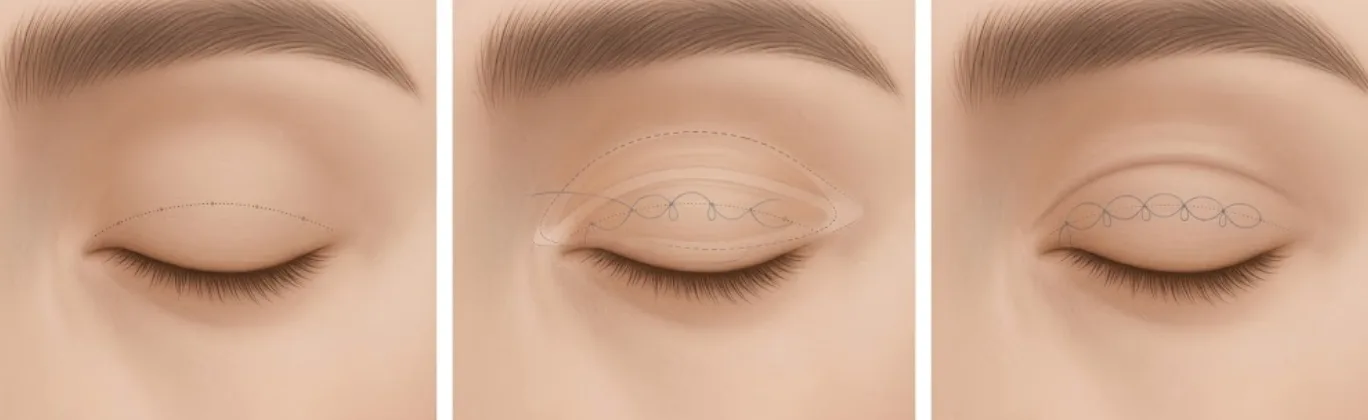
Illustration: a thin buried suture is looped along the planned crease through tiny points, with no skin incision, so the lid folds at the new line.
The trade-off is deliberate and often worthwhile. In return for that slightly less certain longevity, you get a much lighter recovery, less swelling and no visible scar. The result is also reversible and adjustable if it is not quite right. For the right lid, a non-incision crease can hold beautifully for years while keeping all of those advantages.
A fixed lifespan is the wrong picture. It is more accurate to think of a durable crease whose longevity depends heavily on your particular lid. If you are weighing durability against recovery, our guide comparing non-incision and incision double eyelid lays out exactly how the two methods differ on how long they hold.
Why it varies
Why a buried-suture crease can loosen over time
The reason longevity varies comes down to how the crease is held. A non-incision method passes fine sutures through the lid to create an adhesion between the skin and the deeper structure, forming the fold. That adhesion is strong, but it is carried by stitches and has no healed, fused incision line. On some lids the fixation can therefore gradually relax, and the crease softens or partly fades back toward the original eyelid.
This is not the crease 'failing' in a dramatic way. When a buried crease loosens, it typically does so gently over months or years, and the lid simply drifts back toward how it looked before. There is no scar or deformity, just a shallower or less defined fold. That reversibility is actually part of the method's appeal, but it is also why its longevity is inherently less locked-in than an incisional fold.
Because the crease depends on well-placed, secure fixation, careful technique matters a great deal for how long it holds. How many fixation points are used, exactly where they are placed and how the tension is set all influence durability. This is one reason an unhurried, precise approach matters even for a 'simple' non-incision procedure, and part of what the cost of the procedure reflects.
Who it lasts for
Whose lids a non-incision crease lasts well for
Non-incision creases tend to last longest on the lids they suit best: thinner skin, minimal excess fold and not much fat. On that kind of lid the sutures carry relatively little load, the adhesion holds comfortably, and the crease can stay stable for many years. This is why candidacy matters so much to longevity: the method is not equally durable on every eye.
On thicker, heavier or oilier lids, or where there is significant skin excess, the buried stitches have to hold much more tissue, and the crease is more likely to loosen or shallow over time. For those lids an incisional method, which removes tissue and creates a fused fold, is often the more durable choice, even though recovery is longer. A careful surgeon will say so and will not promise that a stitch method will hold on a lid it does not suit.
This is exactly why an in-person or photo assessment of your lid is the real starting point. If your lid is well-suited, a non-incision crease offers a genuinely durable result with an easy recovery; if it is not, being told so protects you from a crease that fades faster than you hoped. Our guide on who a non-incision double eyelid is for goes into this candidacy in detail.
What affects it
What affects how long your result lasts
The biggest factor is your lid itself: thickness, skin type, fat and how much excess fold there is. Thinner, lighter lids hold a buried crease far longer than thick or oily ones. Age and skin quality play a part too, and, as with any eyelid procedure, the whole area continues to age gently around the crease over the years.
Everyday habits matter more here than with an incisional crease. Frequent, vigorous eye-rubbing, sleeping face-down and heavy eye make-up removal all put repeated strain on the fixation and can shorten how long it holds. Being gentle with your eyes therefore helps a non-incision crease last. This is within your control in a way that lid anatomy is not.
Finally, the surgery itself strongly affects durability, in particular how securely and precisely the fixation points are placed. A well-planned, unhurried non-incision procedure holds better than a rushed one. If you would like to know how the crease settles in the first place before thinking about the long term, our guide to when you will see results covers that early timeline.
If it loosens
What happens if the crease loosens later
If a non-incision crease does loosen over the years, the reassuring part is that it does not leave you worse off. The lid simply drifts back toward its original appearance, with no scar to deal with. From there the usual options are to re-do the buried-suture crease, or, if your lid has changed or the stitch method is no longer the best fit, to convert to an incisional double eyelid for a more durable fold.
Because a non-incision method removes no tissue and leaves no scar, it keeps your future options open. Someone who wants to 'try' a defined crease with an easy recovery, knowing they can commit to an incisional method later if they love the look, is making a very reasonable plan. For that person the reversibility is a feature.
There is no schedule you are obliged to follow, and many people keep a stable crease for years without ever needing anything further. If and when the crease does soften, having the same surgeon who placed the original fixation, and who knows your lid, makes deciding between a re-do and a conversion much clearer and more predictable.
At Garnet
Garnet's approach to a lasting non-incision crease
Garnet is a single-surgeon clinic in Apgujeong, Seoul. Dr. In-Soo Baek is a board-certified plastic surgeon (Korean medical licence no. 77407) and the only operating doctor. He consults, performs the procedure himself and reviews every follow-up, and the clinic keeps the day to two surgeries so even a non-incision case has unhurried, careful time. Because durability depends so much on candidacy, the first step is a frank assessment of whether your lid suits a buried-suture crease or would hold better with an incisional method.
That single-surgeon, no-over-recommendation model is directly relevant to how long your crease lasts: the same surgeon judges your lid, places the fixation precisely, and then follows your healing at 1, 3 and 6 months, and by messenger after you fly home, so the crease settles and holds as intended. If your lid is better suited to an incision method, you will be told plainly. A buried stitch that may loosen on your lid will not be sold to you. For patients flying in for a buried-suture crease, Garnet's registration with Korea's foreign-patient programme covers the visit.
For a realistic view of how long a non-incision double eyelid could last for your lids specifically, and whether it is the right method for you at all, the ideal first step is a no-obligation online assessment. Send photos and get a straight answer before you plan any travel.
Dr. In-Soo Baek
Director & sole operating surgeon
Korean medical licence no. 77407
Operate on what you came for. Trained at Korea University Medical Center. Every case planned, performed and reviewed by the same hands.
1Operating surgeon
~2Surgeries per day
7Registered techniques
Board-certified plastic surgeon
Plastic surgery training at Korea University College of Medicine & graduate school
Korean Society of Plastic and Reconstructive Surgeons member, in its facial-contour, eye & rhinoplasty groups
Consults, operates and follows up each case himself
Peer-reviewed papers behind the facts on this page. Each describes findings in its own study group — not results at Garnet — and none predicts your own outcome.
Okumura K et al. Effect of Upper Eyelid Fat Removal on Reoperation Rate and Long-Term Stability in Buried Suture Double Eyelid Surgery: A 4.5-Year Retrospective Cohort Study. Aesthetic Plastic Surgery. 2025. doi:10.1007/s00266-025-05492-6
Shi J et al. Orbicularis–levator–tarsus fixation suturing in buried suture double-eyelid blepharoplasty. Journal of Plastic, Reconstructive & Aesthetic Surgery. 2022. doi:10.1016/j.bjps.2021.11.012
Bae KH et al. Nonincisional Blepharoplasty for Asians. Facial Plastic Surgery Clinics of North America. 2021. doi:10.1016/j.fsc.2021.06.005
FAQ
Common questions
How long does a non-incision double eyelid last?
It can last many years, and for well-suited lids the crease stays crisp for a long time. But because it is held by fine buried sutures and has no fused incision line, it can loosen or fade sooner than an incisional crease. How long it holds is very individual — lid thickness, skin type, the fixation and everyday habits all matter.
Is a non-incision double eyelid permanent?
The fixation is designed to be permanent, but a stitch-based crease is less locked-in than an incisional one. It can gradually loosen and soften back toward the original lid over the years. So it is durable, with no guarantee that it lasts forever. The upside is that if it does loosen, the lid simply reverts with no scar, and it can be re-done.
Why might a non-incision crease loosen when an incision one doesn't?
A non-incision crease is held by buried sutures creating an adhesion, whereas an incisional crease is a healed, fused fold. Stitches can gradually relax, especially on thick or heavy lids that put more load on them, so the crease can shallow over time. A fused incision line does not loosen the same way, which is why it is generally more durable.
Does a non-incision double eyelid change with age?
Yes. Beyond any loosening of the fixation, the whole lid keeps ageing gently around the crease, as skin quality and fold shape change over the years. The crease softens gradually, and if it fades it drifts back toward the original lid appearance without looking abnormal.
What makes it last longer or shorter for one person?
Lid anatomy is the biggest factor: thin, light lids hold a buried crease far longer than thick or oily ones with excess fold. Skin quality and age matter too. Everyday habits like vigorous eye-rubbing, sleeping face-down and heavy make-up removal strain the fixation and shorten how long it holds, so being gentle with your eyes helps.
Does a non-incision crease last longer on thin or thick eyelids?
It lasts much longer on thin, light lids, because the buried sutures carry little load and the adhesion holds comfortably. On thick, heavy or oily lids the stitches hold far more tissue and the crease is more likely to loosen over time. That is why an incisional method is often the more durable choice for those lids.
What happens if my non-incision double eyelid loosens later?
It does not leave you worse off. The lid simply drifts back toward its original look with no scar. From there you can re-do the buried-suture crease, or convert to an incisional double eyelid for a more durable fold if your lid has changed or the stitch method is no longer the best fit. The reversibility keeps your options open.
Can I make my non-incision result last longer?
To a degree, yes. Being gentle with your eyes helps a lot: avoid vigorous eye-rubbing, try not to sleep face-down on the eyes, and remove eye make-up carefully without pulling at the lids. These won't override lid anatomy, but they reduce strain on the fixation and can meaningfully help the crease hold.
Does having the same surgeon help with long-term results?
It helps. When the same board-certified surgeon assesses whether your lid suits a buried-suture crease, places the fixation precisely and follows up at one, three and six months, the method is chosen for your anatomy and any loosening is caught early. It also makes any later re-do or conversion clearer, because the surgeon already knows your lid.
Can my eyelids be assessed for crease longevity before I travel?
Yes. In an online consultation from abroad you can send photos, and the surgeon can give a straight view of how long a non-incision crease is likely to hold for your lids specifically, and whether a stitch method or an incisional one would suit you better, before you commit to any travel.
My mom recently had a brow lift and lower blepharoplasty with Dr. Baek, and our experience has been wonderful so far. The Garnet team was incredibly kind and welcoming, with Kelly assisting us as our English consultant—she made everything…
I’m so happy I chose this clinic for my lower blepharoplasty. I was traveling from abroad by myself, so I was a little nervous, but from the beginning I felt comfortable and truly cared for. Everyone was kind, patient, and professional…
Came in for an in-person consult and ended up choosing Garnet and Dr.Baek for my non-incisional DES and tiplasty/alarplasty. I communicated with Kelly (English consultant) from the start till now (3 weeks post-op). She really help me feel…
My under-eyes have been sagging and folding for years... I tried to cover it up with makeup, but it actually got stuck in the wrinkles and made it stand out even more. While going for consultations, I noticed that the bigger the hospital…
Want an honest view of how long a non-incision double eyelid could last for your lids — and whether it is the right method for you? Send photos for a no-obligation pre-assessment before you plan a trip.
Send photos and your question before you travel. An English-speaking coordinator reviews every enquiry and replies with guidance on whether surgery is appropriate, the likely plan and timing.
✓ Reviewed by the clinic coordinator, not a bot
✓ Photo-based pre-assessment before you fly
✓ Foreign-patient scheduling & after-care
✓ One surgeon for consultation, surgery and follow-up
Prefer to chat now? Reach the coordinator directly:









 T S7 months ago



