After a non-incision double eyelid, the crease you see on day 2 is higher than the one you keep. The crease starts high and a little puffy because the lid is swollen, then softens and lowers as swelling drops over the following weeks. Knowing that timeline in advance makes the early days far less worrying.
The short answer
The early crease usually looks higher, deeper and puffier than the final fold. This is swelling, and the fold will lower.
The most visible swelling settles over the first one to two weeks; buried sutures typically come out around day five.
The fold relaxes into a more natural, settled shape over roughly four to twelve weeks as the last swelling resolves.
Because the crease is held by a buried-suture adhesion line, the change is gradual and steady, with no single 'reveal' day.
A non-incision double eyelid creates the crease with a buried-suture adhesion line instead of a skin incision. In the first days the lid is swollen, which pushes the fold up and makes it look higher, deeper and more obvious than it will end up. That early, dramatic-looking crease is the most common reason patients worry, and almost always it is simply swelling.
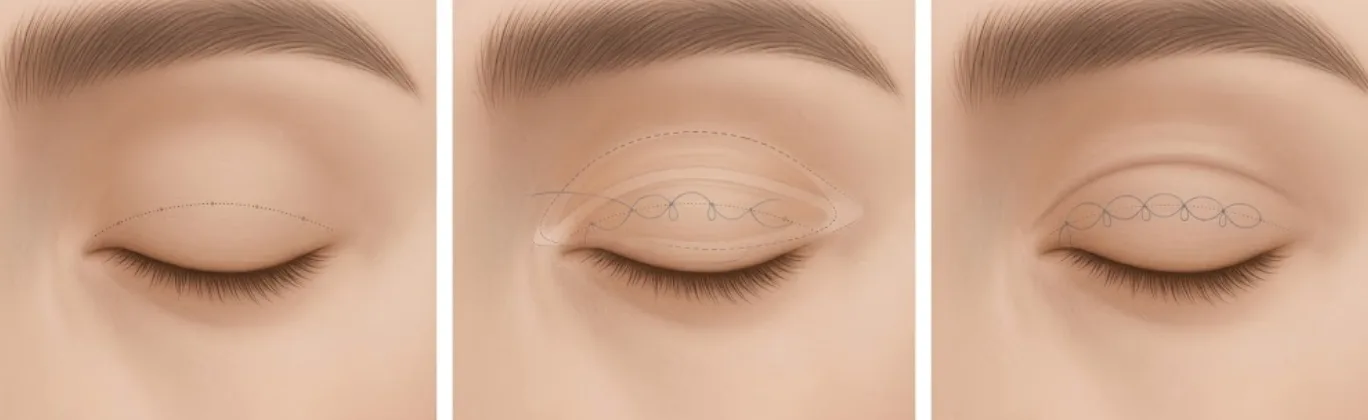
Illustration: a thin buried suture is looped along the planned crease through tiny points, with no skin incision, so the lid folds at the new line.
As the swelling resolves, the crease lowers and softens into a more natural fold. This is a gradual process with no single reveal: the change is steady week by week, which is exactly what you want from an eyelid result. The technique is designed so that the adhesion holds while the surrounding tissue settles around it.
So 'when will I see results' has two answers. You will see a clear double-eyelid shape almost immediately, but the final, natural result is what emerges over the following weeks as the last swelling fades. The timeline below walks through what that looks like, and it pairs with our detailed recovery timeline.
First week
The first week: peak swelling, then a steady drop
Days one to three bring the most visible swelling. The crease looks high and the lids feel tight; this is normal and not a sign that the fold will stay that way. Keeping your head elevated, using cool compresses gently, and avoiding alcohol and strenuous activity all help the swelling come down faster. We cover the same measures in detail on the swelling and bruising page.
By around day five, the buried sutures are typically removed and the early swelling has already begun to settle. The crease at this point still looks somewhat higher and fuller than its final form, so try not to judge the result yet. Suture removal is a good milestone because it confirms the early healing is on track, though the look keeps changing after it.
By the end of the first week, most patients see a clear, defined double eyelid that already looks far more settled than day two. Light makeup is often possible around this stage once cleared, though the lid is still maturing underneath.
Weeks 2–4
Weeks two to four: the crease relaxes
Through weeks two to four the fold continues to lower and soften. The slightly 'sausage' fullness that can make a fresh crease look thick fades, and the eyelid starts to move and close more naturally. Most of the swelling that other people would notice is gone by around the two-week mark, which is why many patients feel comfortable returning to normal social settings by then.
This is also when the crease begins to look like your eye and less like a freshly operated one. The height and curve you and the surgeon designed become more truly visible as the puffiness that was distorting it resolves. If you had a particular crease in mind, this is the stage where you can really start to see it.
It is normal for the two eyes to settle at slightly different rates during this window. Minor asymmetry in the first few weeks usually evens out as both sides finish de-swelling, so it is best assessed later, once both sides have settled.
Final result
The settled, natural fold
The final, natural result typically settles over roughly four to twelve weeks. By this point the last traces of swelling have resolved, the crease has lowered to its true height, and the fold moves naturally when you blink and look up and down. This is the result you keep and the one to assess; the high crease of the first week is not.
Because a non-incision crease forms a soft, natural-looking fold, the settled result tends to look like an eyelid you were born with. For most patients the eye also looks subtly brighter and more open simply because the crease lifts the lid line. If you are an international patient timing photos or events, plan around this 4-to-12-week window and not the first weeks.
If you want to understand how the longevity of a non-incision crease compares with an incisional one, and what affects how a buried-suture crease holds over time, our pages on non-incision vs incision double eyelid and who the procedure suits cover that ground.
What's normal
What's normal, and what's worth a call
Through the settling weeks, the following are normal: a crease that starts high and lowers, mild puffiness that fades, slight differences between the two eyes early on, and a fold that softens gradually over weeks. None of these mean something has gone wrong. They are the expected path to a natural result.
What is worth contacting your clinic about is anything unusual, as opposed to gradual: swelling that keeps increasing after the first few days, marked and persistent asymmetry well beyond the early weeks, significant pain, signs of infection such as spreading redness, warmth or discharge, or a crease that loses definition. These are uncommon, but they are the right reasons to reach out promptly.
The simplest reassurance is structured follow-up by the surgeon who placed the crease. If you can be reviewed at set intervals, you do not have to self-diagnose week by week, because you have a clear point of comparison and an expert eye on whether your settling is normal.
At Garnet
How Garnet follows your result over time
Garnet is a single-surgeon clinic in Apgujeong, Seoul. Dr. In-Soo Baek is a board-certified plastic surgeon (Korean medical licence no. 77407) and the only operating doctor. He designs and places your crease himself, then reviews how it settles, so the person assessing your result is the person who created it.
Follow-up is structured at 1, 3 and 6 months, which maps neatly onto how a non-incision crease matures: the one-month check falls in the window where the fold is relaxing into shape, and the later checks confirm the settled result. For international patients, most of this happens by messenger: you send photos and the same surgeon reviews how the crease is maturing from home.
If you are still deciding, you can start with a no-obligation online assessment: send clear photos of your eyes and the surgeon will give a candid view of what crease shape suits you and what a realistic result timeline looks like for your eyes.
Dr. In-Soo Baek
Director & sole operating surgeon
Korean medical licence no. 77407
Operate on what you came for. Trained at Korea University Medical Center. Every case planned, performed and reviewed by the same hands.
1Operating surgeon
~2Surgeries per day
7Registered techniques
Board-certified plastic surgeon
Plastic surgery training at Korea University College of Medicine & graduate school
Korean Society of Plastic and Reconstructive Surgeons member, in its facial-contour, eye & rhinoplasty groups
Consults, operates and follows up each case himself
Peer-reviewed papers behind the facts on this page. Each describes findings in its own study group — not results at Garnet — and none predicts your own outcome.
Baek JS et al. Comparison Between Continuous Buried Suture and Interrupted Buried Suture Methods for Double Eyelid Blepharoplasty. Journal of Craniofacial Surgery. 2015. doi:10.1097/scs.0000000000001984
Li L et al. Creating Natural Double Eyelids With Continuous Buried Suture and Mini-incision Technique Using Subcutaneous Absorbable Suture for Patients With Puffy Eyelids. JAMA Facial Plastic Surgery. 2014. doi:10.1001/jamafacial.2013.2512
Hwang K et al. Tension and Distortion of the Upper Double Eyelid by a Nonincision Method. Journal of Craniofacial Surgery. 2012. doi:10.1097/scs.0b013e31824e27dd
FAQ
Common questions
When will I see the final results of a non-incision double eyelid?
You will see a clear double-eyelid shape almost immediately, but the final, natural fold settles over roughly 4 to 12 weeks as the last swelling resolves and the crease lowers to its true height. The result to assess is the settled one; the high, puffy crease of the first week will change.
Why does my crease look so high right after surgery?
Early swelling pushes the fold up, so the crease looks higher, deeper and puffier than it will end up. This is the most common early worry and almost always just swelling. The crease lowers and softens steadily as the swelling resolves over the following weeks.
When is the swelling gone after a non-incision double eyelid?
The most visible swelling settles over the first one to two weeks, and most of what others would notice is gone by around two weeks. The last subtle swelling that affects the final crease height resolves over roughly four to twelve weeks.
How does the result change over time?
The crease starts high and full from swelling, then lowers and softens week by week. By two to four weeks it looks far more natural, and by four to twelve weeks it has settled into its final, natural fold that moves naturally when you blink and look up or down.
When can I wear makeup again?
Light eye makeup is often possible around the end of the first week once your surgeon clears it and the sutures are out, but follow your specific guidance. Gentle handling is best while the lid is still settling, and avoid heavy rubbing of the crease area.
Is it normal for one eye to look different from the other early on?
Yes. The two eyes often settle at slightly different rates in the first few weeks, so minor asymmetry early on is normal and usually evens out as both sides finish de-swelling. Asymmetry is best assessed at the settled stage.
When should I take 'before and after' photos?
For a fair comparison, plan your 'after' photos around the settled window of roughly 4 to 12 weeks. The early crease is distorted by swelling, so photos taken too soon will not represent your real result.
How long do non-incision double eyelid results last?
A buried-suture crease can hold well, though longevity depends on the eye, the technique and individual tissue. How it compares with an incisional crease is covered in our non-incision vs incision guide; an online consultation can give you a realistic view of what to expect for your eyes.
What if my crease loses definition?
A crease that visibly loses definition is uncommon and worth contacting your clinic about promptly. At a single-surgeon clinic the surgeon who placed the crease reviews it and advises on next steps, including whether any adjustment is appropriate.
How does Garnet check that my result is settling normally?
Garnet runs structured follow-up at 1, 3 and 6 months with the same board-certified surgeon who created the crease. For international patients this mostly happens by messenger: you send photos so he can confirm the crease is settling normally or flag anything that needs attention.
My mom recently had a brow lift and lower blepharoplasty with Dr. Baek, and our experience has been wonderful so far. The Garnet team was incredibly kind and welcoming, with Kelly assisting us as our English consultant—she made everything…
I’m so happy I chose this clinic for my lower blepharoplasty. I was traveling from abroad by myself, so I was a little nervous, but from the beginning I felt comfortable and truly cared for. Everyone was kind, patient, and professional…
Came in for an in-person consult and ended up choosing Garnet and Dr.Baek for my non-incisional DES and tiplasty/alarplasty. I communicated with Kelly (English consultant) from the start till now (3 weeks post-op). She really help me feel…
My under-eyes have been sagging and folding for years... I tried to cover it up with makeup, but it actually got stuck in the wrinkles and made it stand out even more. While going for consultations, I noticed that the bigger the hospital…
For a realistic view of what crease shape and result timeline suit your eyes, send clear photos for a no-obligation pre-assessment before you plan anything.
Send photos and your question before you travel. An English-speaking coordinator reviews every double eyelid enquiry and replies with guidance on whether surgery is appropriate, the likely plan and timing.
✓ Reviewed by the clinic coordinator, not a bot
✓ Photo-based pre-assessment before you fly
✓ Foreign-patient scheduling & after-care
✓ One surgeon for consultation, surgery and follow-up
Prefer to chat now? Reach the coordinator directly:









 T S7 months ago



