A non-incision double eyelid is one of the more travel-friendly procedures to have in Korea: it uses no skin incision, the buried sutures usually come out around day five, and downtime is modest. The planning question for an international patient is less about the surgery and more about timing the trip, the consultation and the follow-up, and this guide walks through each.
The short answer
Non-incision double eyelid uses a buried-suture adhesion line with no skin incision, so the recovery footprint that shapes your trip is small.
Sutures are typically removed around day five, which is the single date most international itineraries are built around.
You can settle most of the decision before you fly through an online consultation, sending clear eye photos for a pre-assessment.
Because Garnet is a single-surgeon clinic, the same board-certified surgeon consults, operates and reviews your follow-up, including by messenger after you return home.
For an international patient, the most useful first step comes before any flight booking: an online consultation from abroad. You send clear photos of your eyes (looking straight ahead, eyes gently closed, and looking up), describe the crease shape you have in mind, and the surgeon gives a pre-assessment of whether a non-incision technique suits you before you commit to travel.
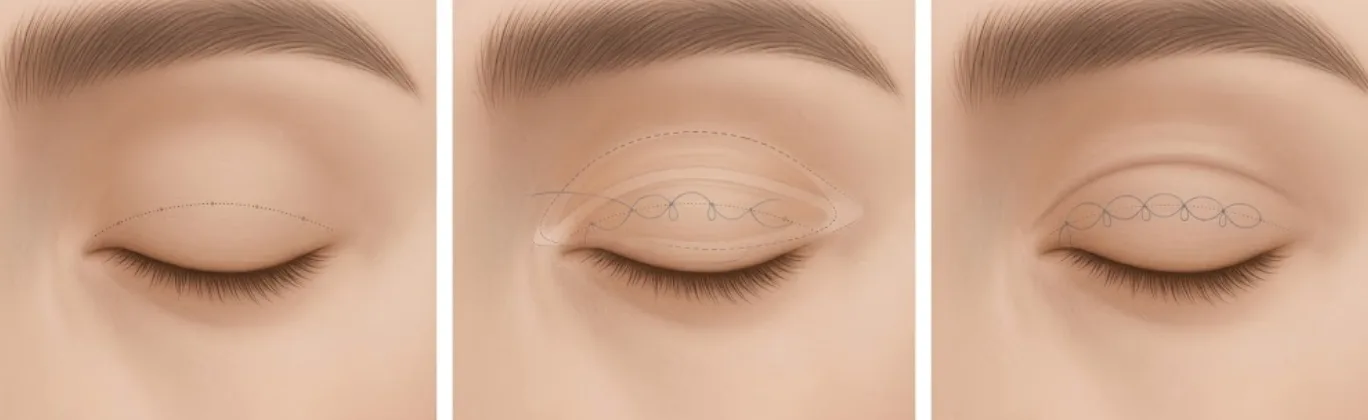
Illustration: a thin buried suture is looped along the planned crease through tiny points, with no skin incision, so the lid folds at the new line.
This matters because the non-incision method is not right for every eye. It works best for lids with thinner skin and limited excess tissue; heavier or hooded lids, or eyes that also need other correction, may be better served by an incisional approach. Finding that out online, before a long flight, is the whole point of a remote first step. If the buried-suture method is not the right fit, you want to know while you can still change the plan.
An online consultation also lets you ask the questions that decide a trip: how the crease is designed for your eye, what the realistic recovery looks like for you, when the sutures come out, and how follow-up will work once you are home. None of that requires you to be in the room yet, and a clear answer here is what makes the in-person visit short and predictable.
How long
How long should you stay in Korea?
The non-incision double eyelid has a short recovery footprint because there is no skin incision to heal; the crease is held by a buried-suture adhesion line. The date that shapes your itinerary is suture removal, which for this procedure is typically around day five. Many international patients plan a stay that comfortably covers surgery day through that suture-removal visit.
A practical window is roughly five to seven days in Seoul: an arrival and consultation day, the surgery itself, a few quiet recovery days while the early swelling settles, the suture-removal appointment around day five, and a margin day before flying. That margin matters, because you do not want the suture-removal visit and your flight stacked on the same morning. For a fuller view across procedures, see our guide on how long to stay in Korea for surgery.
If your schedule is tight, it can be possible to have sutures removed by a trusted clinic closer to home, but staying through the day-five visit is the cleaner option: the same surgeon who placed the sutures checks the crease as it settles and confirms healing is on track. A flexible return ticket gives you room if you would simply like an extra day; a fixed same-week ticket does not.
The visit
What your days in Seoul look like
Garnet is in Apgujeong, a part of Gangnam that is straightforward to reach from Incheon Airport and easy to stay near. On your consultation day, the surgeon goes over in person what was discussed online. The crease height and shape are designed for your eyes, your questions are answered, and there is no pressure to decide the same day.
The procedure itself is short. Because it is a non-incision technique, you leave with fine buried sutures and no incision line, and you can usually walk out the same day. The first two to three days bring the most visible swelling; this is normal and settles steadily, and we cover the detail in our pages on swelling and bruising and the day-by-day recovery timeline.
Plan your in-between days gently (rest, keep your head elevated, avoid alcohol and strenuous activity), though you are not confined to a hotel room. Many patients are comfortable with quiet sightseeing once the first couple of days pass. Our guide to recovering in Seoul after surgery covers where to stay and how to pace the trip.
After you fly
Follow-up once you return home
The crease from a non-incision procedure keeps maturing after you leave Korea: residual puffiness fades over the following weeks, and the fold looks progressively more natural as the tissue settles. So follow-up does not stop at the airport. Once the sutures are out and healing is confirmed, you can continue to be reviewed remotely, sending photos by messenger so the same surgeon can check how the crease is settling and answer questions as they come up.
Garnet runs structured follow-up at one, three and six months. For an international patient that mostly happens by message, but the principle is the same: the surgeon who designed and placed your crease is the one reviewing how it matures. If you want a sense of how the result evolves over those weeks, see when you will see results.
Flying itself is low-risk after a non-incision eyelid procedure once the early swelling has settled and sutures are out, but it is worth confirming your specific timing. Our guide on when you can fly after surgery covers the general rules, and your surgeon will give you a clear answer for your case.
Who operates
Confirm who actually performs your surgery
For an international patient who cannot easily return, the question of who operates carries extra weight. In some clinics the surgeon you consult is not the one who performs the procedure, a practice often called ghost surgery. With a small procedure like a non-incision double eyelid it is easy to assume this does not apply, but the crease design is a matter of millimetres and judgement, and the surgeon's hand matters.
Ask directly, and get the answer in writing: will the same board-certified surgeon who assessed my eyes design and place the sutures, and review my follow-up? A single-surgeon clinic answers that question structurally. There is only one operating doctor, which removes the uncertainty before you ever board a flight.
This is also why the online consultation and the in-person surgeon should be the same person. If the doctor who reviewed your photos is the doctor who operates and the doctor who follows up, the continuity is unbroken from your first message to your six-month check.
At Garnet
How Garnet coordinates an international visit
Garnet is a single-surgeon clinic in Apgujeong, Seoul, registered with Korea's foreign-patient programme. Dr. In-Soo Baek is a board-certified plastic surgeon (Korean medical licence no. 77407) and the only operating doctor. He handles the online assessment, the in-person consultation, the procedure and the follow-up himself, and the clinic keeps the day light so each case has unhurried time.
A dedicated coordinator stays with you from your first message through recovery, helping with scheduling, the visit itself and remote follow-up after you fly home. For a non-incision double eyelid that means a clear plan around the day-five suture removal and continued review at 1, 3 and 6 months, most of it by messenger once you are back.
If you are weighing the trip, start with a no-obligation online assessment: send clear photos of your eyes, and the surgeon will tell you plainly whether a non-incision approach suits you and what a realistic stay would look like before you book anything.
Dr. In-Soo Baek
Director & sole operating surgeon
Korean medical licence no. 77407
Operate on what you came for. Trained at Korea University Medical Center. Every case planned, performed and reviewed by the same hands.
1Operating surgeon
~2Surgeries per day
7Registered techniques
Board-certified plastic surgeon
Plastic surgery training at Korea University College of Medicine & graduate school
Korean Society of Plastic and Reconstructive Surgeons member, in its facial-contour, eye & rhinoplasty groups
Consults, operates and follows up each case himself
Peer-reviewed papers behind the facts on this page. Each describes findings in its own study group — not results at Garnet — and none predicts your own outcome.
Munakata H et al. Comparison of One-Year Outcomes Between Younger and Older Patients Undergoing Continuous Buried Suture Double-Eyelid Surgery: A Retrospective Cohort Study of 788 Cases. Aesthetic Plastic Surgery. 2026. doi:10.1007/s00266-026-05765-8
Alkaelani MT et al. Complications of Medical Tourism in Aesthetic Surgery. Annals of Plastic Surgery. 2023. doi:10.1097/sap.0000000000003683
Okumura K et al. Comparison of Long-Term Stability Between Continuous and Two-Point Buried Suture Methods in Double Eyelid Surgery: A 4-Year Retrospective Cohort Study of 1000 Cases. Aesthetic Plastic Surgery. 2025. doi:10.1007/s00266-025-05024-2
Vaccari S et al. Literature Review: Venous Thromboembolism Prophylaxis in Plastic Surgery. Aesthetic Plastic Surgery. 2023. doi:10.1007/s00266-023-03508-7
FAQ
Common questions
How do international patients get a non-incision double eyelid in Korea?
Most start with an online consultation, sending clear eye photos for a pre-assessment of whether the buried-suture method suits them. If it does, they plan a short trip to Seoul that covers the surgery and the suture-removal visit, then continue follow-up remotely after flying home.
How long should I stay in Korea for a non-incision double eyelid?
A practical window is about five to seven days: arrival and consultation, the procedure, a few quiet recovery days, the suture-removal visit around day five, and a margin day before flying. The day-five appointment is the date most itineraries are built around.
Can I start with an online consultation for a non-incision double eyelid?
Yes. You can send photos of your eyes looking straight ahead, gently closed and looking up, describe the crease you want, and receive a pre-assessment before you travel. This is a reliable way to confirm the non-incision method suits your eyes while you can still adjust the plan.
Is a non-incision double eyelid suitable for everyone travelling from abroad?
No. It works best for lids with thinner skin and limited excess tissue. Heavier or hooded lids, or eyes that also need other correction, may be better served by an incisional approach. An online consultation is the way to find this out before committing to a flight.
How does follow-up work after I fly home?
Once the sutures are out and healing is confirmed, the same surgeon can continue to review you remotely: you send photos by messenger so he can check how the crease is settling. Garnet runs structured follow-up at one, three and six months, which for international patients mostly happens by message.
When can I fly home after a non-incision double eyelid?
Flying is low-risk once the early swelling has settled and the sutures are out, which is typically around day five. It is worth confirming your specific timing with your surgeon, who will give you a clear answer based on how you are healing.
Will the same surgeon who consults me also perform the surgery?
At a single-surgeon clinic, yes. There is only one operating doctor, so the surgeon who assesses your eyes online and in person is the one who designs and places the crease and reviews your follow-up. Confirm this in writing wherever you go, as it is the safety question international patients most often overlook.
Can I do sightseeing during my recovery in Seoul?
The first two to three days bring the most swelling and are best kept quiet, with rest and head elevation. After that, many patients are comfortable with gentle sightseeing while avoiding alcohol and strenuous activity until cleared. Stay near the clinic so the suture-removal visit is easy.
Does Garnet treat international patients for eyelid surgery?
Yes. Garnet is registered with Korea's foreign-patient programme and coordinates the online consultation, scheduling, the visit and remote after-care for international patients, with the same board-certified surgeon throughout.
Do I need someone to travel with me?
It is not required for a non-incision double eyelid, as downtime is modest and you can usually walk out the same day. Many patients travel alone. That said, having someone with you for the first day or two can make rest and getting around more comfortable while the early swelling settles.
My mom recently had a brow lift and lower blepharoplasty with Dr. Baek, and our experience has been wonderful so far. The Garnet team was incredibly kind and welcoming, with Kelly assisting us as our English consultant—she made everything…
I’m so happy I chose this clinic for my lower blepharoplasty. I was traveling from abroad by myself, so I was a little nervous, but from the beginning I felt comfortable and truly cared for. Everyone was kind, patient, and professional…
Came in for an in-person consult and ended up choosing Garnet and Dr.Baek for my non-incisional DES and tiplasty/alarplasty. I communicated with Kelly (English consultant) from the start till now (3 weeks post-op). She really help me feel…
My under-eyes have been sagging and folding for years... I tried to cover it up with makeup, but it actually got stuck in the wrinkles and made it stand out even more. While going for consultations, I noticed that the bigger the hospital…
Thinking about flying to Korea for a non-incision double eyelid? Send clear photos of your eyes for a no-obligation pre-assessment before you plan the trip.
Send photos and your question before you travel. An English-speaking coordinator reviews every enquiry and replies with guidance on whether surgery is appropriate, the likely plan and timing.
✓ Reviewed by the clinic coordinator, not a bot
✓ Photo-based pre-assessment before you fly
✓ Foreign-patient scheduling & after-care
✓ One surgeon for consultation, surgery and follow-up
Prefer to chat now? Reach the coordinator directly:









 T S7 months ago



