Most people considering a nose job worry about a visible scar across the bridge, but rhinoplasty incisions are placed elsewhere. The marks from a well-planned rhinoplasty are mostly hidden inside the nostrils, and the one small external scar in an open approach sits in a place that fades remarkably well. This page explains, in depth, exactly where the scars are, why the technique you choose changes them, and what realistic healing looks like over the first year.
The short answer
Most rhinoplasty incisions sit inside the nostrils, so they leave no scar you can see from the outside.
A closed approach keeps every incision internal; an open approach adds one small bridging incision across the columella, the strip of skin between the nostrils.
When cartilage is taken from the septum or behind the ear to refine the tip, the donor site is also hidden: inside the nose or in the natural crease behind the ear.
Scars mature slowly: they look their reddest at a few weeks, then soften and pale over six to twelve months with diligent aftercare.
The single most reassuring fact about rhinoplasty is that there is no incision across the bridge of the nose. Reshaping the dorsum and tip is done from underneath the skin, through incisions placed inside the nostrils where no one can see them. When the lining of the nostril heals, those internal incisions become thin lines hidden in tissue that is already pink and moist, so they do not read as scars at all.
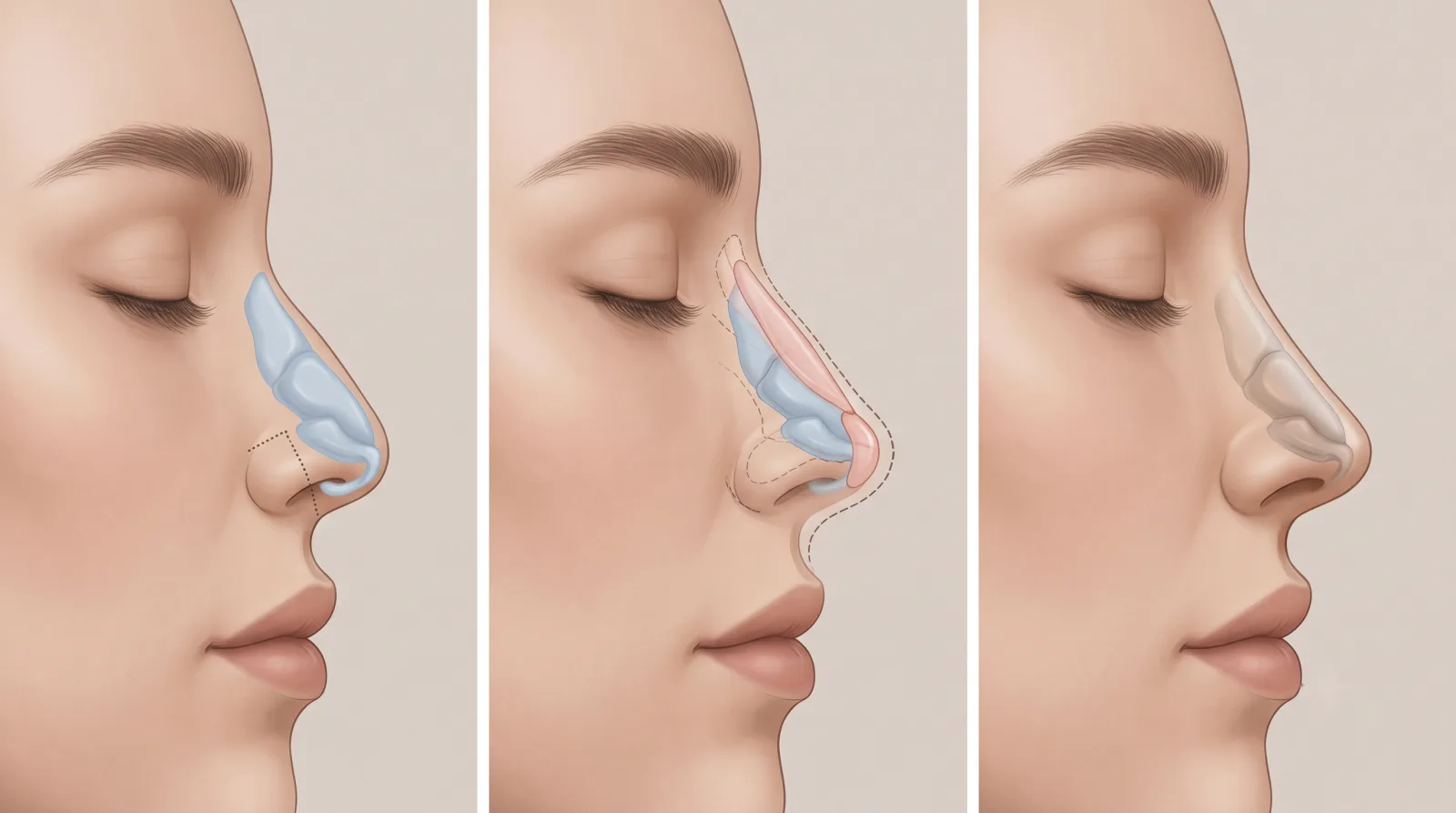
Illustration: the nasal framework (blue) is reshaped to raise the bridge and refine the tip. The dashed outline shows the original contour.
In a primary rhinoplasty, the surgeon's plan determines whether any incision is external at all. The work itself, refining the tip with the patient's own cartilage and adjusting the dorsal profile, happens through the same internal access points whether the approach is closed or open. The only variable that adds a visible mark is the open approach, and even then it is one small, well-placed incision on the columella.
It helps to separate two different things people lump together as “the scar”: the access incisions that let the surgeon work, which are almost all internal, and any donor site where cartilage is harvested to build a natural tip. Both are planned to stay out of sight, and we cover the donor sites in their own section below.
Closed vs open
Closed versus open: the columellar incision explained
In a closed (endonasal) rhinoplasty, every incision is made inside the nostrils. There is no external scar at all. The surgeon lifts the soft tissue from within and reshapes the framework through those hidden access points. The trade-off is that the surgeon works through a more limited view, which is well suited to certain dorsal and tip adjustments.
In an open rhinoplasty, the same internal incisions are used, plus one small bridging incision across the columella, the narrow strip of skin between the two nostrils. This lets the surgeon lift the tip skin and see the cartilage framework directly, which is valuable for precise tip refinement and for placing grafts accurately. That columellar incision is the only scar a rhinoplasty normally leaves on the outside of the nose, and it is deliberately shaped (often in a stepped or zig-zag line) so the healed scar is broken up and hard to spot.
Garnet's rhinoplasty is described as closed or open per case: the approach is chosen for what your nose needs. If your plan calls for detailed tip work with cartilage grafts, an open approach and its tiny columellar scar may be a reasonable trade for a more controlled, predictable result. The surgeon will tell you at consultation which approach he expects to use and why, so there are no surprises about whether you will have an external mark.
Donor sites
Where cartilage is taken — and what those sites look like
Garnet builds a natural tip with the patient's own (autologous) cartilage instead of relying on the implant alone. The dorsum may be augmented with a silicone implant while the tip is refined with septal or ear cartilage. Using your own tissue for the tip tends to produce a softer, more natural shape, and it means there is a second, small donor site to consider.
When cartilage is taken from the nasal septum (the wall of cartilage inside the nose), the harvest is entirely internal, so there is no external donor scar at all. When a little extra cartilage is needed and it is taken from behind the ear, the incision is tucked into the natural crease where the ear meets the head. That site heals to a faint line hidden in a fold that is hard to see even when someone looks for it, and it does not change the shape of the ear.
Donor sites are part of the conversation before surgery: the surgeon explains where cartilage will come from for your specific plan, so you know in advance whether there will be any mark behind the ear and how it is expected to heal. For most tip work the septum supplies what is needed, keeping everything internal.
Healing over time
How rhinoplasty scars heal over the first year
Scar healing follows a predictable arc, and knowing it prevents needless worry. In the first one to two weeks, while the nose is dressed and the splint is on, any external columellar incision is closed with fine sutures; at Garnet the nose sutures come out at around 7 days, with dressing changes on day 1 and day 3. At that stage a fresh incision can look pink or slightly raised. This is normal early healing and does not predict a bad scar.
Over the following weeks the scar typically goes through its most noticeable phase: it can stay pink or red and feel firm for several weeks to a couple of months as the body remodels collagen. This is the point where patients sometimes panic, but a reddish, slightly firm line at six weeks is exactly what a maturing scar looks like. From roughly the third month onward it begins to soften, flatten and fade toward the surrounding skin tone.
By six to twelve months a well-placed columellar scar has usually settled into a faint line that is difficult to notice in normal light, and internal incisions are long since invisible. Healing speed varies with skin type, age and how diligently you protect the area. That is why aftercare matters as much as surgical placement, and why the surgeon reviews the scar at structured follow-ups.
Aftercare
Aftercare that helps a rhinoplasty scar fade well
The placement of an incision sets the ceiling for how invisible a scar can become; aftercare decides how close you get to it. Keep the incision clean and follow the dressing schedule exactly, avoid picking at crusts, and do not smoke, because nicotine narrows the small blood vessels the healing tissue depends on. Sleeping with your head slightly elevated in the first week helps reduce swelling around the incision.
Once the incision has fully closed, sun protection becomes the most important habit: a fresh scar that is exposed to UV can darken and stay discoloured, so keeping the area shaded and using sun protection for the first several months pays off. Many surgeons also recommend silicone gel or sheeting and gentle massage once the wound is sealed, which can help a scar flatten and pale. Your surgeon will advise what is appropriate for your skin and when to start.
Because the same surgeon who operates also reviews your recovery, you have a clear point of contact if a scar looks like it is healing slowly or becoming raised. International patients can continue this review remotely after flying home, sending photographs of the columella and any ear donor site at intervals so the surgeon can check that each scar is maturing normally or step in early. You can read how the timeline fits together on the rhinoplasty recovery timeline page.
At Garnet
How Garnet plans incisions and scarring
Garnet is a single-surgeon clinic in Apgujeong, Seoul, where Dr. In-Soo Baek, a board-certified plastic surgeon (Korean medical licence no. 77407), personally consults, operates and follows up. Because the same surgeon plans your incision, performs it and reviews the scar at 1, 3 and 6 months, the decisions about closed versus open, septal versus ear cartilage, and exactly where each incision sits are all made by the person accountable for the outcome.
At your consultation the surgeon explains, for your nose specifically, whether he expects to use a closed or open approach, where any cartilage will be taken from, and what your healing is likely to look like, including whether an external columellar scar is part of the plan. There is no pressure to add procedures you did not come for, and no consultation fee.
If you are weighing a nose procedure from abroad, you can start with a no-obligation pre-assessment: send photographs through an online consultation and the surgeon will give a candid view of the approach, the likely scarring and the recovery before you commit to travelling. For the wider decision of where to have surgery, the guide on how to choose a clinic in Korea is a useful next read.
Real Results
Before & After
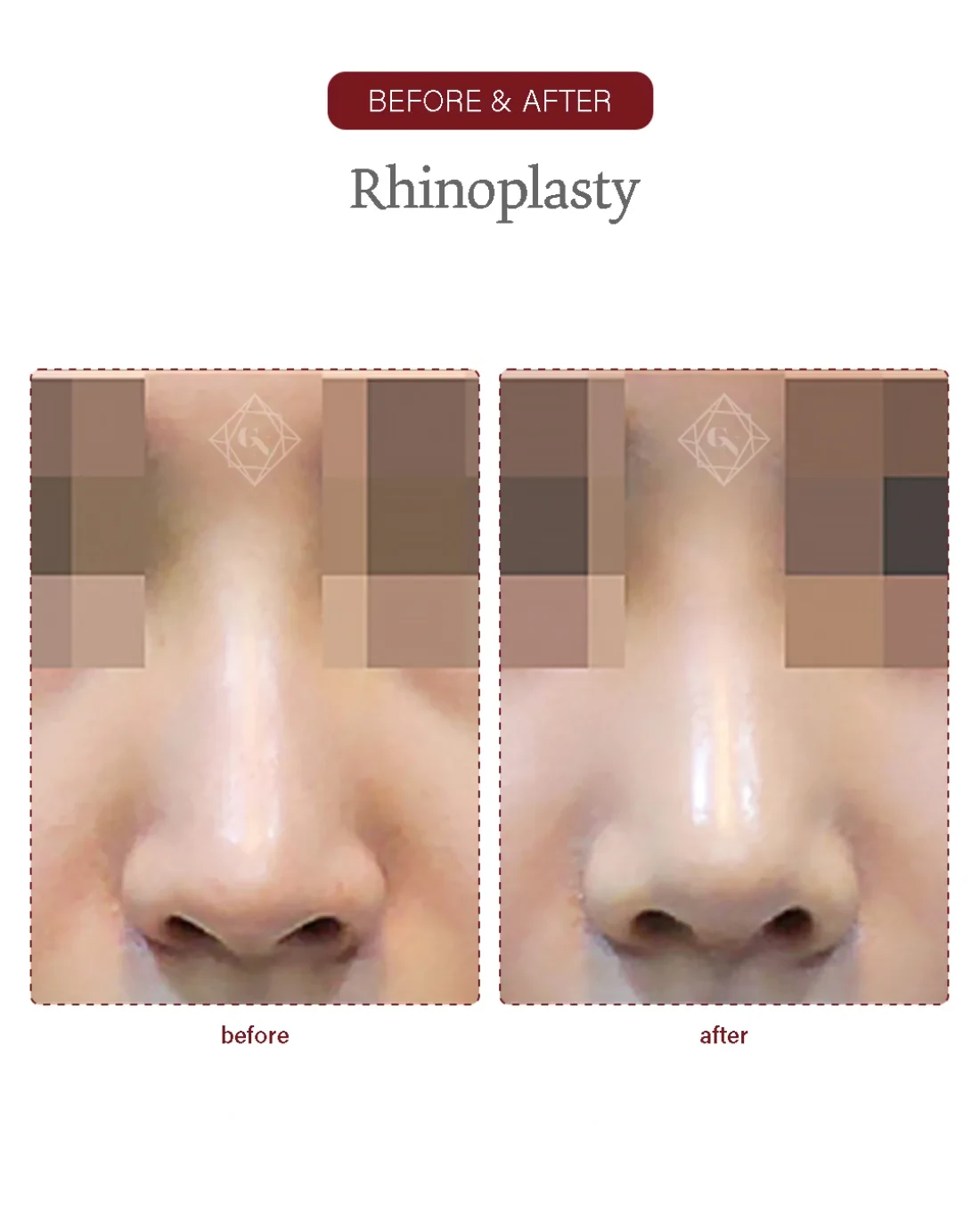
Rhinoplasty result of an actual Garnet patient (published with consent). Date, procedure and clinic (Garnet Plastic Surgery, Apgujeong) are labelled on the image, with the usual same-condition disclaimer. Results, recovery and suitability vary by individual and are not guaranteed.
Dr. In-Soo Baek
Director & sole operating surgeon
Korean medical licence no. 77407
Operate on what you came for. Trained at Korea University Medical Center. Every case planned, performed and reviewed by the same hands.
1Operating surgeon
~2Surgeries per day
7Registered techniques
Board-certified plastic surgeon
Plastic surgery training at Korea University College of Medicine & graduate school
Korean Society of Plastic and Reconstructive Surgeons member, in its facial-contour, eye & rhinoplasty groups
Consults, operates and follows up each case himself
Peer-reviewed papers behind the facts on this page. Each describes findings in its own study group — not results at Garnet — and none predicts your own outcome.
Toriumi DM et al. Asian Rhinoplasty. Facial Plastic Surgery Clinics of North America. 2007. doi:10.1016/j.fsc.2007.04.003
Frederick JW et al. Asian Augmentation Rhinoplasty. Facial Plastic Surgery. 2025. doi:10.1055/a-2595-5275
Frederick JW et al. Asian Male Blepharoplasty and Rhinoplasty. Facial Plastic Surgery Clinics of North America. 2024. doi:10.1016/j.fsc.2024.03.005
FAQ
Common questions
Where are the scars after rhinoplasty?
Most rhinoplasty incisions are inside the nostrils, so they leave nothing you can see from the outside. In a closed approach every incision is internal. In an open approach there is one small additional incision across the columella (the strip of skin between the nostrils), which fades to a faint line. If cartilage is taken from behind the ear, that incision sits hidden in the crease behind the ear. See also our rhinoplasty page. See also our rhinoplasty page. See also our rhinoplasty page.
Will my rhinoplasty scars be visible?
There is no scar across the bridge of the nose. Internal incisions are invisible once healed. The only potential external mark is a small columellar scar in an open approach, which is deliberately placed and shaped so that, after six to twelve months of healing, it is difficult to notice in normal light. See also our rhinoplasty page. See also our rhinoplasty page. See also our rhinoplasty recovery timeline page.
What is the difference between closed and open rhinoplasty scarring?
Closed (endonasal) rhinoplasty keeps all incisions inside the nostrils, leaving no external scar. Open rhinoplasty uses the same internal incisions plus one small bridging incision across the columella, which gives the surgeon a direct view for precise tip work. Garnet chooses closed or open per case based on what your nose needs. See also our rhinoplasty recovery timeline page. See also our rhinoplasty recovery timeline page. See also our rhinoplasty revision and correction page.
Does taking cartilage from the septum or ear leave a scar?
Cartilage taken from the nasal septum is harvested entirely inside the nose, so there is no external donor scar. If a small amount is taken from behind the ear, the incision is tucked into the natural crease behind the ear and heals to a faint, hidden line that does not change the ear's shape.
How long do rhinoplasty scars take to heal?
Healing follows a predictable arc. Any external incision is closed with fine sutures that come out at around seven days. A scar is usually at its pinkest and firmest from a few weeks to a couple of months, then softens and pales from around the third month, settling into a faint line by six to twelve months.
Why does my rhinoplasty scar look red and raised at a few weeks?
A pink, firm line on the columella at several weeks is normal early scar maturation and does not predict a poor result. The body remodels collagen during this phase before the scar softens and fades. If a scar stays thick or raised, the surgeon can review it at follow-up and advise treatment, which is why structured follow-ups matter.
How can I help my rhinoplasty scar fade?
Follow the dressing schedule, keep the incision clean, do not pick at crusts and do not smoke. Once the wound is sealed, protect it from the sun for several months and, if your surgeon advises, use silicone gel or sheeting and gentle massage. Diligent aftercare brings the scar closer to the ideal it can be.
Can I have a follow-up on my scar after I fly home?
Yes. At a single-surgeon clinic the operating surgeon reviews your recovery, and international patients can continue this remotely by sending photographs of the nose at intervals. The surgeon can then check that the scar is maturing normally or step in early if needed, alongside structured follow-ups at 1, 3 and 6 months.
Does Garnet treat international patients for rhinoplasty?
Yes. Garnet is registered with Korea's foreign-patient programme and coordinates consultation, scheduling and after-care for visitors, with the same board-certified surgeon throughout. You can begin with a no-obligation online pre-assessment from abroad before planning a trip.
My mom recently had a brow lift and lower blepharoplasty with Dr. Baek, and our experience has been wonderful so far. The Garnet team was incredibly kind and welcoming, with Kelly assisting us as our English consultant—she made everything…
I’m so happy I chose this clinic for my lower blepharoplasty. I was traveling from abroad by myself, so I was a little nervous, but from the beginning I felt comfortable and truly cared for. Everyone was kind, patient, and professional…
Came in for an in-person consult and ended up choosing Garnet and Dr.Baek for my non-incisional DES and tiplasty/alarplasty. I communicated with Kelly (English consultant) from the start till now (3 weeks post-op). She really help me feel…
My under-eyes have been sagging and folding for years... I tried to cover it up with makeup, but it actually got stuck in the wrinkles and made it stand out even more. While going for consultations, I noticed that the bigger the hospital…
Worried about scarring from a nose procedure? Send photos for a no-obligation pre-assessment. The surgeon will explain the approach, where any incisions would sit and how they heal, before you plan a trip.
Send photos and your question before you travel. An English-speaking coordinator reviews every enquiry and replies with guidance on whether surgery is appropriate, the likely plan and timing.
✓ Reviewed by the clinic coordinator, not a bot
✓ Photo-based pre-assessment before you fly
✓ Foreign-patient scheduling & after-care
✓ One surgeon for consultation, surgery and follow-up
Prefer to chat now? Reach the coordinator directly:









 T S7 months ago



