Rib cartilage rhinoplasty is one of the more involved nose operations, so it understandably sits above a standard rhinoplasty on price. A single number tells you little. The useful thing to understand is what actually drives the cost, what a complete quote should cover, and why comparing only the headline figure can be misleading.
The short answer
Rib cartilage rhinoplasty costs more than standard rhinoplasty because it adds a second surgical site, a longer operation and more demanding graft carving.
Surgeon experience, whether the cartilage is your own rib or donor (processed costal) cartilage, and the complexity of your nose all move the price.
A proper quote should bundle the consultation, anaesthesia, the operation, dressings, suture removal and structured follow-up. Confirm what is and is not included.
The cheapest quote is rarely the right comparison; for a structural rebuild, the surgeon and what the price covers matter more than the number alone.
Why rib cartilage rhinoplasty costs more than standard rhinoplasty
A standard rhinoplasty usually reshapes the nose using a silicone implant for the bridge and a small amount of your own septal or ear cartilage for the tip. Rib cartilage rhinoplasty is a different scale of operation: it builds the framework of the nose from costal (rib) cartilage, which means a second surgical site, more cartilage to harvest and carve, and a markedly longer time under anaesthesia. Each of those adds to what the operation costs.
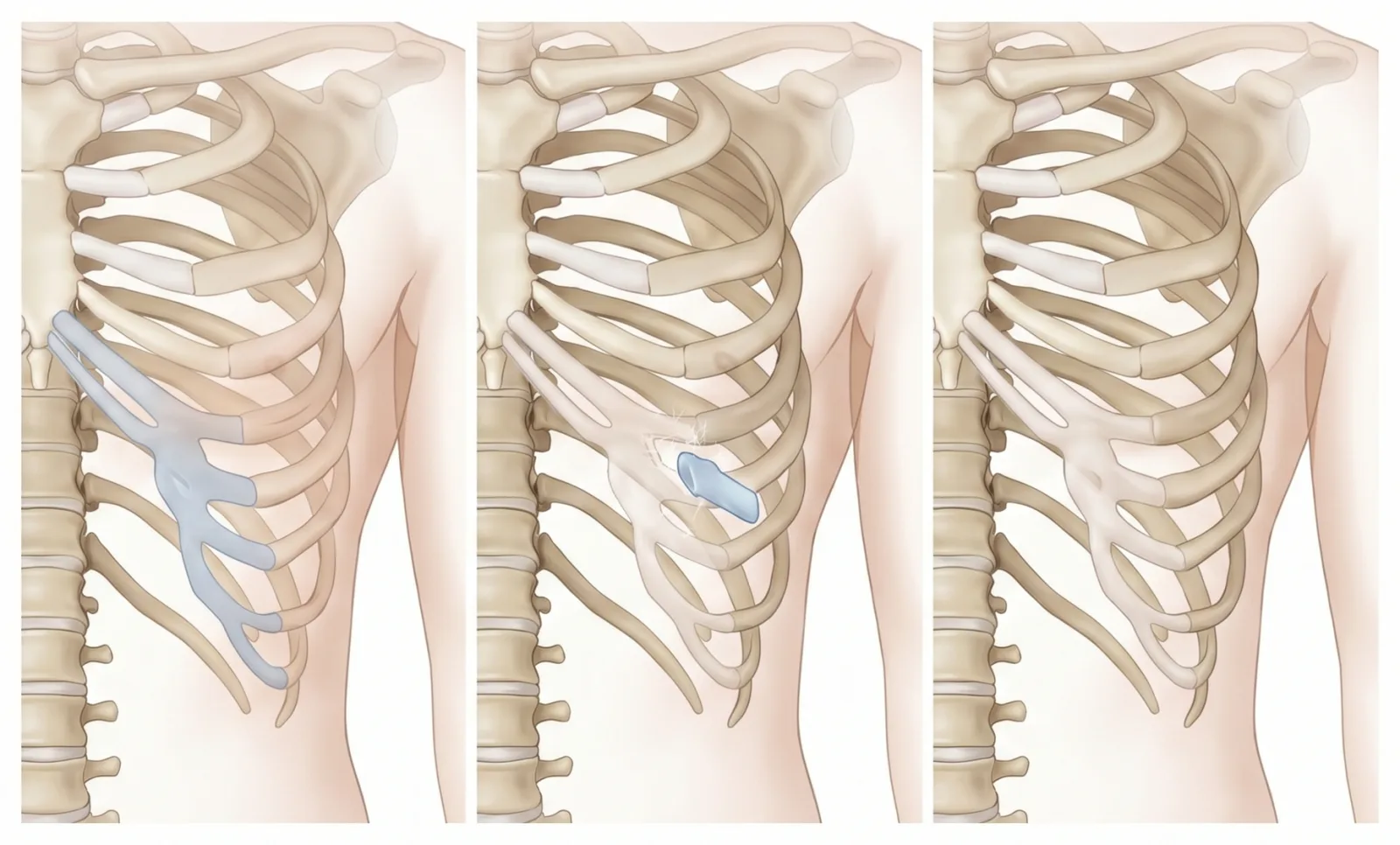
Illustration: where rib cartilage (blue) sits on the chest wall, and the small segment taken to build a stronger nasal framework.
There are three cost drivers stacked on top of a primary nose job. First, the rib harvest itself: opening, taking and closing a donor site on the chest is a separate procedure within the operation. Second, the carving. Costal cartilage has to be shaped into a stable dorsal and tip framework, which is slow, exacting work that depends heavily on the surgeon's hand. Third, the operating time, since more time in theatre means more anaesthesia and more of the surgeon's day.
Because of that, it is normal for rib cartilage rhinoplasty to sit clearly above a basic rhinoplasty and in the range of a complex revision rhinoplasty, which it often overlaps with. Treat any quote that is unusually low for this kind of structural work as a reason to ask more questions.
What affects price
The factors that move the price
No two rib cases cost the same, because no two noses need the same amount of rebuilding. The biggest variable is complexity. A nose that needs the bridge, the tip and the septum reconstructed takes more cartilage and more time than one where only the tip needs structural support. If you have had previous surgery, scarring and depleted cartilage stores make the operation harder and longer. That is why many rib cases are also revision or structural cases to begin with.
Surgeon experience is the next factor, and the one most worth paying for. Carving costal cartilage into a framework that stays straight and stable over time is a skill built over many cases; an experienced surgeon's fee reflects that, and it is not where you want to economise on a structural rebuild. The choice of cartilage source (your own rib or processed donor cartilage) also affects cost, as does whether the case needs additional grafts such as fascia.
Finally, your individual anatomy and goals shape the price. The amount of dorsal height you want, whether the tip needs significant lengthening or rotation, and any functional issues with breathing all change how much framework has to be built. This is exactly why a meaningful price can only come after an in-person or photo-based assessment. A flat number quoted before anyone has looked at your nose is, at best, a starting estimate. You can begin that assessment in an online consultation.
Rib source
Your own rib versus donor cartilage, and what it means for cost
Rib cartilage rhinoplasty uses costal cartilage as the building material, and there are two main sources. Autologous rib cartilage is taken from your own chest during the operation; donor (processed costal) cartilage is human rib tissue that has been prepared and sterilised by a tissue bank. Both are used to create a strong, lasting framework, and the right choice depends on your case, your cartilage availability and the surgeon's plan.
The two routes have different cost profiles. Using your own rib adds the harvest (a second incision, more operating time and a chest donor site to recover), which is part of why this operation costs more than a standard nose job. Donor cartilage avoids the chest harvest but carries its own material cost. Neither is automatically cheaper or better across the board; what matters is which is right for your nose, and a careful surgeon will explain why they are recommending one over the other and will not default to the cheapest path.
Because the cartilage decision affects both the operation and the price, it should be talked through openly before surgery and never decided for you on the day. If you want to understand the trade-offs first, the candidacy guide on who rib cartilage rhinoplasty is for walks through when each source tends to be considered.
What's included
What a complete rib rhinoplasty quote should include
The single most useful thing you can do with a price is ask exactly what it covers. A complete quote for rib cartilage rhinoplasty should bundle the consultation and any imaging, the anaesthesia and operating-theatre costs, the surgery itself including the rib harvest, your dressings, suture removal, and the structured follow-up afterwards. When a number looks low, the gap is often in what has been left out and added later as separate line items once you have committed.
Ask specifically about the things that are easy to overlook: general anaesthesia and the anaesthetist's fee, the cost of any donor cartilage or additional grafts, post-operative medication, the dressing changes in the first days, and removal of the nose and rib donor-site sutures (at Garnet, nose sutures come out around day 7 and rib donor-site sutures around day 10). For an international patient, also confirm whether after-care follow-up, and remote review once you fly home, is included.
Cost is not separate from the procedure itself; it reflects how thoroughly the operation and recovery are looked after. The broader picture of how nose surgery is priced is covered in the rhinoplasty cost guide and the general plastic surgery cost guide, both of which explain what tends to sit inside a quote and what to watch for.
Value vs cheapest
Rib cartilage value versus the cheapest quote
Rib cartilage rhinoplasty is structural surgery. It builds a framework that has to stay straight, stable and natural for years. That makes it one of the operations where the lowest quote is the least useful comparison. A poorly carved or unstable framework can warp or shift over time, and correcting it is harder, longer and more expensive than getting it right once. The cost of a revision almost always exceeds whatever was saved on the first operation.
When you compare quotes, compare what they actually contain: who performs the surgery from start to finish, how experienced they are with costal-cartilage frameworks, what the price includes, and how after-care works. A quote that is meaningfully cheaper than others usually differs on one of these: a less experienced surgeon, a shorter operation, fewer follow-ups, or items unbundled to be charged later. Knowing where the difference sits lets you compare like with like.
Korea is a common destination for this surgery partly because experienced rhinoplasty surgeons handle high volumes, and prices can compare well with some other countries. But the reason to choose a surgeon should be their suitability for your nose more than the headline figure. For a structural rebuild, paying for the right hands is the part that protects the result. If your case is a re-do of earlier surgery, the revision rhinoplasty cost guide covers how those quotes are built.
At Garnet
How Garnet approaches the cost conversation
Garnet is a single-surgeon clinic in Apgujeong, Seoul. Dr. In-Soo Baek is a board-certified plastic surgeon (Korean medical licence no. 77407) and the only operating doctor; he consults, performs the rib harvest and the rhinoplasty himself, and reviews every follow-up. Because the same surgeon plans and carries out the whole operation, the quote reflects one person's time and judgement. The work is not split across a team.
The clinic gives a price only after assessing your nose, so the figure matches your actual case and not a generic menu rate, and there is no consultation or imaging fee and no pressure to book the same day. A dedicated coordinator stays with you from consultation through recovery, and follow-up is structured at 1, 3 and 6 months, with remote review available after you return home, which matters when the surgery involves a chest donor site as well as the nose.
If you are weighing up cost, the most useful starting point is an assessment of what your nose actually needs. You can send photos for a no-obligation online consultation and get a realistic sense of the operation, the recovery and what a complete quote would include before you plan any travel.
Prices
Price at Garnet
Revision rhinoplasty
From₩4,000,000 + VATExcluding VAT (10% VAT is added at payment)Book now
Same price as Korean patients. Prices shown exclude 10% VAT; your written quote, issued after the in-person consultation, shows the full amount payable.
Dr. In-Soo Baek
Director & sole operating surgeon
Korean medical licence no. 77407
Operate on what you came for. Trained at Korea University Medical Center. Every case planned, performed and reviewed by the same hands.
1Operating surgeon
~2Surgeries per day
7Registered techniques
Board-certified plastic surgeon
Plastic surgery training at Korea University College of Medicine & graduate school
Korean Society of Plastic and Reconstructive Surgeons member, in its facial-contour, eye & rhinoplasty groups
Consults, operates and follows up each case himself
Peer-reviewed papers behind the facts on this page. Each describes findings in its own study group — not results at Garnet — and none predicts your own outcome.
Luan CW et al. Complications associated with irradiated homologous costal cartilage use in rhinoplasty: A systematic review and meta-analysis. Journal of Plastic, Reconstructive & Aesthetic Surgery. 2022. doi:10.1016/j.bjps.2022.02.026
Henry N et al. The Ever-Present Costs of Cosmetic Surgery Tourism: A 5-Year Observational Study. Aesthetic Plastic Surgery. 2021. doi:10.1007/s00266-021-02183-w
Drake VE et al. An update on rib grafting in rhinoplasty: which rib is right?. Current Opinion in Otolaryngology & Head & Neck Surgery. 2022. doi:10.1097/moo.0000000000000807
Venditto C et al. Complications of Cosmetic Surgery Tourism: Case Series and Cost Analysis. Aesthetic Surgery Journal. 2020. doi:10.1093/asj/sjaa092
FAQ
Common questions
How much does rib cartilage rhinoplasty cost in Korea?
There is no single fixed price, because the cost depends on the complexity of your nose, whether your own rib or donor cartilage is used, and the surgeon's experience. It sits clearly above a standard rhinoplasty because it adds a chest harvest, more demanding graft carving and a longer operation. A meaningful figure can only be given after your nose has been assessed in person or by photo.
Why is rib cartilage rhinoplasty more expensive than standard rhinoplasty?
It is a larger operation. A standard rhinoplasty often uses an implant and a small amount of septal or ear cartilage, while rib cartilage rhinoplasty builds the nasal framework from costal cartilage. That means a second surgical site on the chest, more cartilage to harvest and carve, and a markedly longer time under anaesthesia. Each of these adds to the cost.
What affects the cost of rib cartilage rhinoplasty?
The main factors are how much rebuilding your nose needs, whether it is a revision of earlier surgery, the cartilage source (your own rib versus processed donor cartilage), any additional grafts such as fascia, and above all the surgeon's experience with costal-cartilage frameworks. Your individual anatomy and goals also change how much framework has to be built.
Is using my own rib cheaper than donor cartilage?
Not necessarily. Using your own rib adds the harvest (a second incision, more operating time and a chest donor site to recover), while donor cartilage avoids the harvest but carries its own material cost. Neither is automatically cheaper or better; the right choice depends on your case, and price alone should not decide it.
What should be included in a rib cartilage rhinoplasty quote?
A complete quote should cover the consultation and imaging, anaesthesia and theatre costs, the surgery including the rib harvest, dressings, post-operative medication, and removal of both the nose and rib donor-site sutures, plus structured follow-up. For international patients it should also confirm whether remote review after you fly home is included. Ask what is left out if a price looks unusually low.
Is rib cartilage rhinoplasty in Korea cheaper than other countries?
It can compare well, partly because experienced rhinoplasty surgeons in Korea handle high case volumes. But price varies by surgeon and case, and the figure alone should not decide where you go. For a structural rebuild, the surgeon's experience and what the quote covers matter more than the headline number.
Why is the cheapest quote not the ideal comparison?
Rib cartilage rhinoplasty is structural surgery, and an unstable or poorly carved framework can warp or shift over time. Correcting it is harder and more expensive than getting it right the first time. A much cheaper quote usually differs on something (surgeon experience, operating time, follow-ups, or items unbundled to be charged later), so it is worth understanding where the difference sits.
Can I get a price before travelling to Korea?
You can get a realistic estimate. By sending photos and a history in an online consultation, the surgeon can assess roughly what your nose needs and explain the likely operation, recovery and what a complete quote would include. A precise figure is usually confirmed after an in-person examination, but you can understand the cost picture before you commit to travel.
Does the cost include the chest donor-site recovery?
It should be part of the conversation. The rib harvest leaves a small chest incision with sutures that come out around day 10, and the dressing and suture removal for that site should be covered in a complete quote. Confirm this is included and not charged separately, and ask how the donor site is reviewed during your follow-ups.
Is rib cartilage rhinoplasty worth the higher cost?
For the cases that genuinely need it (significant structural rebuilding, depleted septal or ear cartilage, or a complex revision), a costal-cartilage framework provides strength that other materials may not. Whether it is worth it depends on your nose, which is why an assessment comes first; a careful surgeon will tell you if a less involved operation would serve you just as well.
My mom recently had a brow lift and lower blepharoplasty with Dr. Baek, and our experience has been wonderful so far. The Garnet team was incredibly kind and welcoming, with Kelly assisting us as our English consultant—she made everything…
I’m so happy I chose this clinic for my lower blepharoplasty. I was traveling from abroad by myself, so I was a little nervous, but from the beginning I felt comfortable and truly cared for. Everyone was kind, patient, and professional…
Came in for an in-person consult and ended up choosing Garnet and Dr.Baek for my non-incisional DES and tiplasty/alarplasty. I communicated with Kelly (English consultant) from the start till now (3 weeks post-op). She really help me feel…
My under-eyes have been sagging and folding for years... I tried to cover it up with makeup, but it actually got stuck in the wrinkles and made it stand out even more. While going for consultations, I noticed that the bigger the hospital…
Send photos and your question before you travel. An English-speaking coordinator reviews every enquiry and replies with plain guidance on whether rib cartilage rhinoplasty is appropriate for your nose, the likely plan and timing.
✓ Reviewed by the clinic coordinator, not a bot
✓ Photo-based pre-assessment before you fly
✓ Foreign-patient scheduling & after-care
✓ One surgeon for consultation, surgery and follow-up
Prefer to chat now? Reach the coordinator directly:









 T S7 months ago



