Rib cartilage rhinoplasty rebuilds the nose with strong, straight costal cartilage from the chest, and most noses do not need it. It exists for the cases that need a large amount of that cartilage to rebuild structure. Choosing it when a smaller operation would do means more surgery than you need. Understanding who it is really for is the first step in deciding whether it fits you.
The short answer
Rib cartilage rhinoplasty is for cases that need a large amount of strong structural cartilage: significant rebuilding, lengthening, or support that ear and septal cartilage cannot provide.
Many candidates are revision patients whose own septal and ear cartilage has already been used or depleted by previous surgery.
If a smaller amount of support is enough, ear or septal cartilage is often the better, less involved choice. More surgery does not automatically give a better result.
Candidacy is decided by a careful assessment of your nose and goals, and the right answer may be a less involved operation.
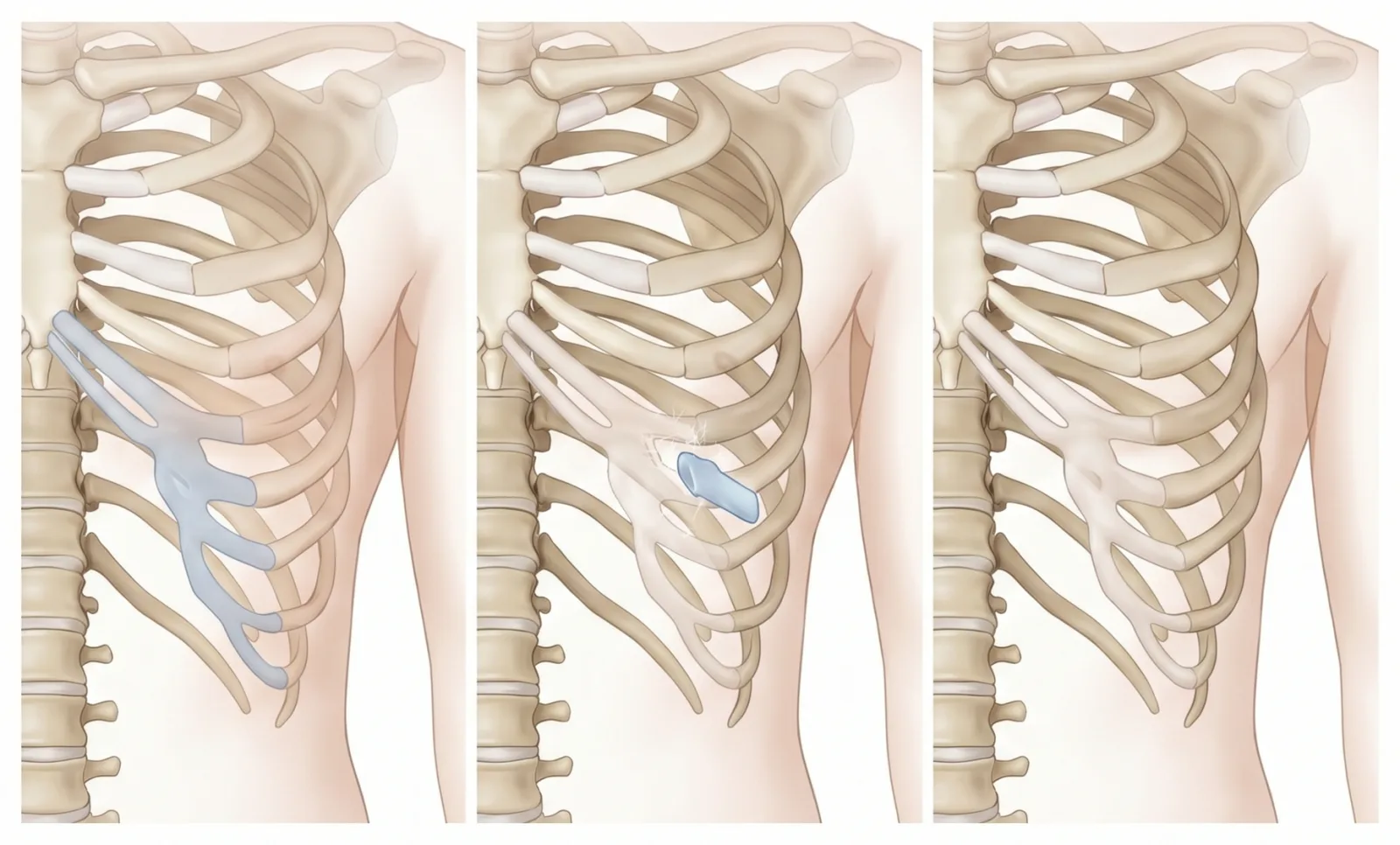
Rib cartilage rhinoplasty uses costal (rib) cartilage to build the framework of the nose. The reason it exists is supply and strength: the rib provides a large quantity of robust cartilage that can be carved into a stable dorsal line and a strong tip support. When a nose needs a lot of structure, well beyond a refinement, the rib is often the only source that can provide enough strong material in one operation.
Illustration: where rib cartilage (blue) sits on the chest wall, and the small segment taken to build a stronger nasal framework.
That makes it fundamentally different from a standard rhinoplasty, which usually augments the bridge with an implant and shapes the tip with a small piece of septal or ear cartilage. Those operations handle the majority of cosmetic noses well. Rib cartilage rhinoplasty steps in where the problem is structural: significant lengthening, rebuilding a collapsed or over-resected bridge, or supporting a tip that needs more than a small graft can give.
Put simply, the operation is matched to the size of the job. A nose that needs a modest change does not need a rib harvest; a nose that needs to be rebuilt from a strong, straight framework often does. Deciding which group you fall into is the whole point of a careful assessment, and you can begin one in an online consultation before committing to anything.
Good candidate
Who tends to be a good candidate
The clearest candidates are people whose noses need a large amount of structural support. That includes significant tip projection or lengthening, for example a short, upturned or contracted nose that needs to be extended, which puts heavy demand on the supporting framework. It also includes rebuilding a bridge that has collapsed, been over-resected by previous surgery, or never had enough support, where a strong, straight dorsal graft is needed.
Functional cases overlap here too. Where breathing structure has been compromised (a deviated or weakened septum, or collapse after earlier surgery), costal cartilage can provide the strong grafts needed to rebuild support while reshaping the nose. Many of these noses simply need more material and more strength than the small cartilage stores in the septum or ears can supply, which is the core reason rib is considered.
Being a good candidate is also about fitness and expectations. You should be in good general health to undergo a longer operation under general anaesthesia, willing to accept a small chest donor site, and realistic that this is structural surgery with a recovery to match. If your goal is a subtle refinement, you are usually not a rib candidate, and a careful surgeon will tell you so even if you came in asking for it.
Revision cases
Revision noses and depleted cartilage
A large share of rib cartilage rhinoplasty patients are revision cases. When a nose has already been operated on, sometimes more than once, the septal and ear cartilage that a surgeon would normally reach for has often already been used, scarred, or removed. With those local sources depleted, the rib becomes the practical way to find enough strong cartilage to rebuild what previous surgery weakened or removed.
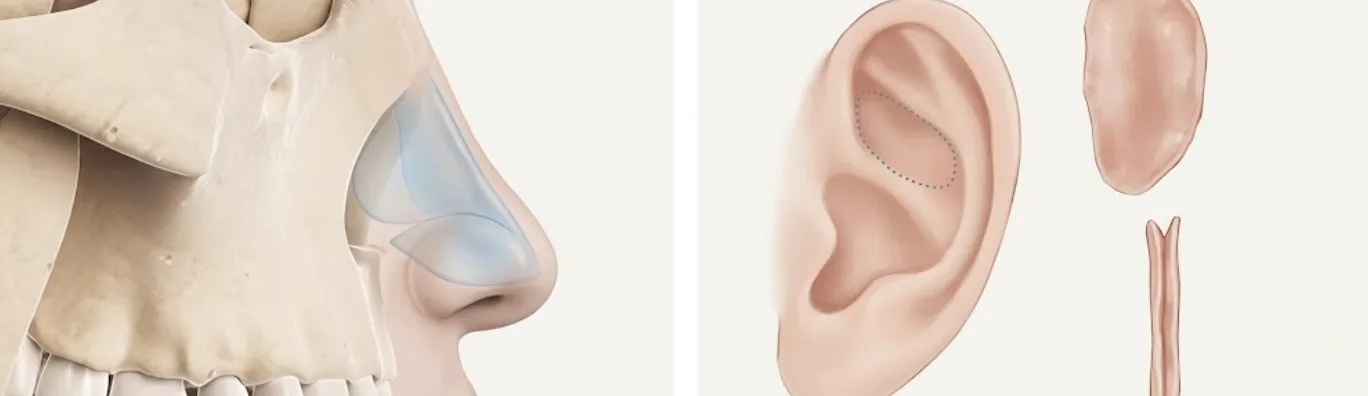
Illustration: the previous implant (outlined) is removed and the framework is rebuilt with the patient's own cartilage for support.
Revision noses are also harder for reasons beyond cartilage supply: scar tissue distorts the anatomy, the skin may be thinned or contracted, and earlier grafts or implants may have shifted or caused problems. These cases need a strong, reliable framework precisely because the foundation has been disturbed, and costal cartilage is well suited to providing it. This is why rib and revision work overlap so often, and why this operation is closely related to revision rhinoplasty.
If your nose is a re-do, the candidacy question is less whether rib could help and more whether your case specifically needs that much rebuilding. Some revisions are minor and need only a small graft; others need a full structural reset. The revision-specific guide on who revision rhinoplasty is for covers how those cases are sorted, and an assessment of your nose is what tells the two apart.
Rib vs ear vs septal
Rib versus ear and septal cartilage — which fits you
Surgeons choose a cartilage source to match how much support a nose needs, and rib is at the high end of that scale. Septal cartilage, taken from inside the nose, is the first choice when there is enough of it, because it is local and well suited to tip work. Ear (conchal) cartilage adds a curved, springy graft that suits the tip and certain refinements. Both are excellent when the amount of structure required is modest.
Illustration: two common sources of the patient's own cartilage: the septum inside the nose (blue) and the curved cartilage of the ear.
Rib cartilage is reserved for when those sources are not enough, either because the job is too big for them or because they have been depleted by previous surgery. The trade-off is real: rib provides far more strong material, but it adds a chest donor site, a longer operation and a longer recovery. So the useful question is which cartilage is enough for your nose. If ear or septal cartilage can do the job, choosing rib means more surgery than you need.
This is why a careful surgeon will sometimes steer you away from rib toward a smaller operation such as septal or ear-cartilage rhinoplasty or an implant-free rhinoplasty. More cartilage and a bigger operation add nothing if they are not needed. The right answer is the smallest operation that reliably achieves your goal.
Not recommended
When rib cartilage rhinoplasty is not recommended
Rib cartilage rhinoplasty is usually not the right choice when only a modest change is needed. If your nose needs a small amount of tip refinement or a moderate bridge adjustment, ear or septal cartilage will typically achieve it with less surgery, no chest donor site and a shorter recovery. Choosing rib in that situation adds risk and downtime for no real gain, a clear sign to step down to a smaller operation.
It is also generally deferred or declined where the timing or health is wrong: very recent previous nose surgery where tissues are still settling, ongoing infection, or general health that makes a longer operation under general anaesthesia unwise. Expectations matter too — if you are hoping for a dramatic change that your skin, anatomy or healing realistically cannot deliver, the responsible answer is to explain the limits and decline to operate beyond them.
None of this can be judged from a wish list; it comes from looking at your actual nose, your history and your skin. The point of candidacy is to protect you from both under- and over-treatment, and the most useful outcome of an assessment is sometimes the advice that a different, smaller operation, or none for now, is the better path. You can put your case to a surgeon in an online consultation before deciding.
At Garnet
How Garnet decides whether rib is right for you
Garnet is a single-surgeon clinic in Apgujeong, Seoul. Dr. In-Soo Baek is a board-certified plastic surgeon (Korean medical licence no. 77407) and the only operating doctor. He examines your nose, chooses between rib, ear and septal cartilage, performs the operation himself and reviews every follow-up. One surgeon's judgement therefore runs from the candidacy decision through the operation.
The clinic's approach is to address only what you came for and to avoid over-recommending surgery. If your nose can be handled well with septal or ear cartilage, you will be told that and will not be steered into a larger operation. Where rib genuinely is the right tool (a major rebuild, a depleted revision, significant lengthening), the plan is explained clearly, including the chest donor site and the longer recovery it involves.
If you are not sure which category you fall into, an assessment will place you. Send photos and your surgical history for a no-obligation online consultation, and you will get a frank view of whether rib cartilage rhinoplasty fits your nose, or whether a smaller operation would suit you better.
Prices
Price at Garnet
Revision rhinoplasty
From₩4,000,000 + VATExcluding VAT (10% VAT is added at payment)Book now
Same price as Korean patients. Prices shown exclude 10% VAT; your written quote, issued after the in-person consultation, shows the full amount payable.
Dr. In-Soo Baek
Director & sole operating surgeon
Korean medical licence no. 77407
Operate on what you came for. Trained at Korea University Medical Center. Every case planned, performed and reviewed by the same hands.
1Operating surgeon
~2Surgeries per day
7Registered techniques
Board-certified plastic surgeon
Plastic surgery training at Korea University College of Medicine & graduate school
Korean Society of Plastic and Reconstructive Surgeons member, in its facial-contour, eye & rhinoplasty groups
Consults, operates and follows up each case himself
Peer-reviewed papers behind the facts on this page. Each describes findings in its own study group — not results at Garnet — and none predicts your own outcome.
Drake VE et al. An update on rib grafting in rhinoplasty: which rib is right?. Current Opinion in Otolaryngology & Head & Neck Surgery. 2022. doi:10.1097/moo.0000000000000807
Pfaff MJ et al. Cadaveric Costal Cartilage Grafts in Rhinoplasty and Septorhinoplasty: A Systematic Review and Meta-Analysis of Patient-Reported Functional Outcomes and Complications. Journal of Craniofacial Surgery. 2021. doi:10.1097/scs.0000000000007400
McGuire C et al. Prevention of Autologous Costal Cartilage Graft Warping in Secondary Rhinoplasty. Journal of Craniofacial Surgery. 2020. doi:10.1097/scs.0000000000006429
FAQ
Common questions
Who is a good candidate for rib cartilage rhinoplasty?
The clearest candidates are people whose noses need a large amount of strong structural cartilage: significant tip projection or lengthening, rebuilding a collapsed or over-resected bridge, or functional support that ear and septal cartilage cannot provide. Many are also revision patients. Being in good general health for a longer operation and accepting a small chest donor site are part of being suitable.
Am I suitable for rib cartilage rhinoplasty?
It depends on how much rebuilding your nose actually needs, which can only be judged by assessing it. If you need a major structural change or your own septal and ear cartilage has been depleted by previous surgery, you may be a candidate. If you want a modest refinement, a smaller operation is usually more appropriate. Assessing your nose is the only reliable way to know.
Why do revision patients often need rib cartilage?
Previous surgery frequently uses up or removes the septal and ear cartilage a surgeon would normally reach for, leaving those local sources depleted. Revision noses also tend to have scar tissue and disturbed structure that need a strong, reliable framework to rebuild. The rib provides a large quantity of robust cartilage in one operation, which is why it and revision work overlap so often.
When is ear or septal cartilage better than rib?
When the amount of support needed is modest. Septal cartilage is the first choice when there is enough of it, and ear cartilage suits the tip and certain refinements, both with no chest donor site and a shorter recovery. Rib is reserved for when those sources are not enough, either because the job is too big or because they have been depleted. If ear or septal can do the job, rib is more surgery than you need.
When is rib cartilage rhinoplasty not recommended?
It is usually not recommended when only a modest change is needed, since a smaller operation achieves it with less risk and downtime. It is also deferred or declined where timing or health is wrong (very recent previous surgery, ongoing infection, or general health that makes a longer operation under general anaesthesia unwise), or where the desired change is beyond what your anatomy can realistically deliver.
Do I have to use my own rib, or is donor cartilage an option?
Both are options. Autologous cartilage comes from your own chest during the operation; processed donor (costal) cartilage avoids the chest harvest. The right choice depends on your case, your cartilage availability and the surgeon's plan, and it should be discussed at consultation. Candidacy is about whether you need a costal-cartilage framework at all; the source is a second decision within that.
Can a first-time (primary) nose use rib cartilage?
Sometimes. While many rib cases are revisions, a primary nose can need rib cartilage if it requires major structural rebuilding or significant lengthening that septal and ear cartilage cannot support. The scale of the job determines candidacy, whether or not it is a first operation, and most first-time noses do not need a rib harvest.
Will a surgeon tell me if I don't need rib cartilage?
A careful surgeon will. The goal of a candidacy assessment is to protect you from both under- and over-treatment, so if your nose can be handled well with ear or septal cartilage, that is what should be recommended, even if you came in asking specifically for rib. A bigger operation with more cartilage adds nothing when it is not needed.
Does my general health affect whether I'm a candidate?
Yes. Rib cartilage rhinoplasty is a longer operation under general anaesthesia and adds a chest donor site, so you should be in good general health to undergo it. Significant medical conditions, current infection, or anything that makes prolonged general anaesthesia unwise can mean the operation is deferred or a less involved approach is recommended. Your health and history are reviewed at consultation.
Can I find out if I'm a candidate before flying to Korea?
Yes. By sending clear photos and your full surgical history in an online consultation, the surgeon can give a frank initial view of whether your nose needs a costal-cartilage framework or whether a smaller operation would serve you better. A final decision usually follows an in-person examination, but you can understand your candidacy before committing to travel.
My mom recently had a brow lift and lower blepharoplasty with Dr. Baek, and our experience has been wonderful so far. The Garnet team was incredibly kind and welcoming, with Kelly assisting us as our English consultant—she made everything…
I’m so happy I chose this clinic for my lower blepharoplasty. I was traveling from abroad by myself, so I was a little nervous, but from the beginning I felt comfortable and truly cared for. Everyone was kind, patient, and professional…
Came in for an in-person consult and ended up choosing Garnet and Dr.Baek for my non-incisional DES and tiplasty/alarplasty. I communicated with Kelly (English consultant) from the start till now (3 weeks post-op). She really help me feel…
My under-eyes have been sagging and folding for years... I tried to cover it up with makeup, but it actually got stuck in the wrinkles and made it stand out even more. While going for consultations, I noticed that the bigger the hospital…
Send photos and your question before you travel. An English-speaking coordinator reviews every enquiry and replies with guidance on whether surgery is appropriate, the likely plan and timing.
✓ Reviewed by the clinic coordinator, not a bot
✓ Photo-based pre-assessment before you fly
✓ Foreign-patient scheduling & after-care
✓ One surgeon for consultation, surgery and follow-up
Prefer to chat now? Reach the coordinator directly:








 T S7 months ago



