Rib cartilage rhinoplasty has two recovery sites, the nose and the chest where the rib cartilage is taken, so the answer to “is it painful?” is more nuanced than for a standard nose job. You are asleep under general anaesthesia for the operation itself, and the discomfort afterward is manageable, but it is worth understanding the chest donor site specifically so nothing comes as a surprise.
The short answer
The operation is performed under general anaesthesia, so you feel nothing during the surgery itself.
There are two recovery sites, the nose and the chest rib donor area, and for many patients the chest is the more noticeable of the two early on.
Discomfort is typically a dull ache and tightness. It is managed with prescribed pain relief that eases over the first week.
Nose sutures come out around day 7 and the chest donor-site sutures around day 10, with comfort improving steadily across that period.
Rib cartilage rhinoplasty is performed under general anaesthesia. Unlike a small, closed nose refinement that can sometimes be done under sedation, this operation involves harvesting cartilage from the chest and building a framework for the nose. That work takes longer and reaches a second surgical site, so being fully asleep is the appropriate and standard approach. You feel nothing during the surgery itself.
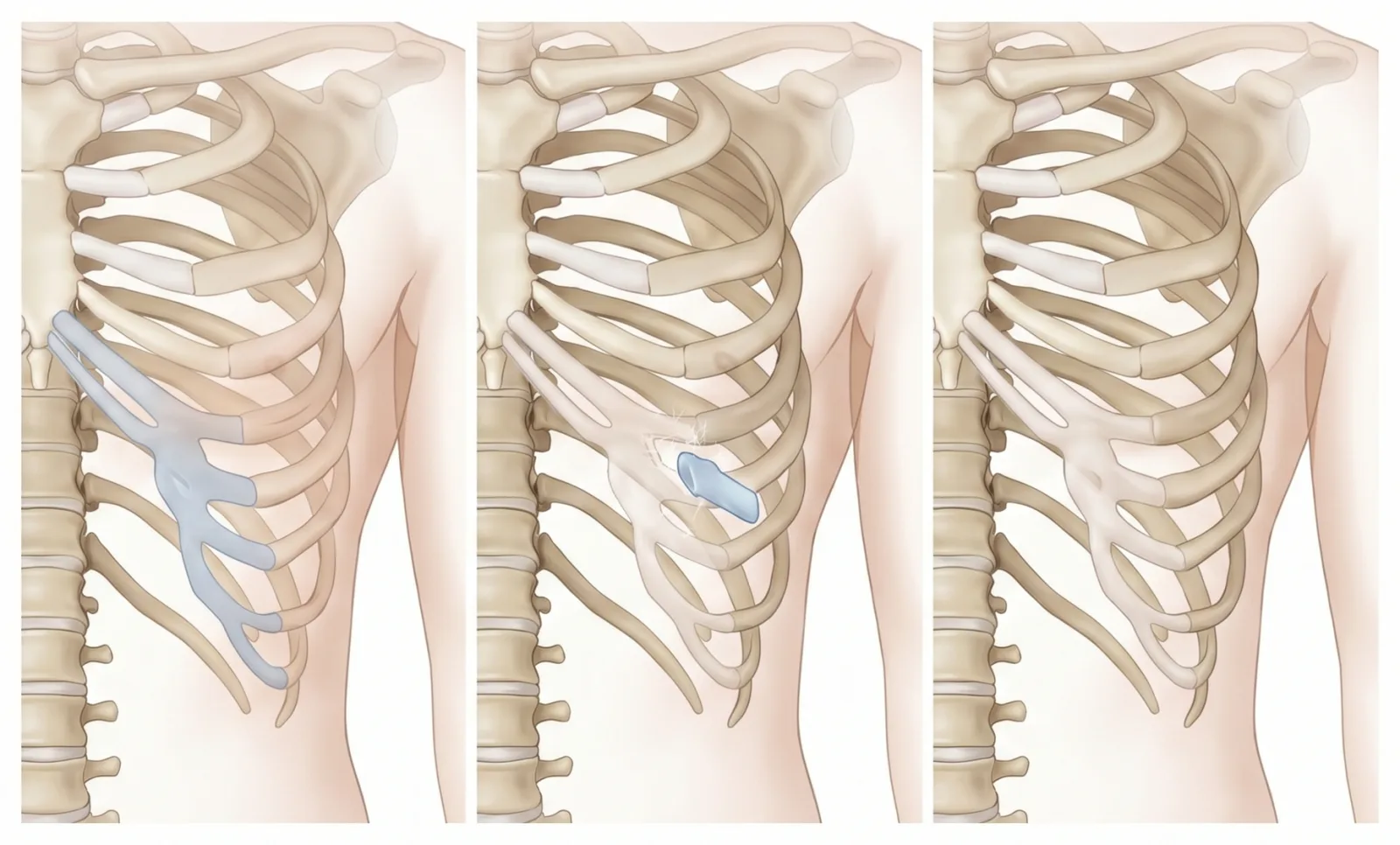
Illustration: where rib cartilage (blue) sits on the chest wall, and the small segment taken to build a stronger nasal framework.
General anaesthesia is given and monitored by an anaesthetist throughout, and you are assessed beforehand to make sure it is safe for you. That is one reason your general health and history matter to candidacy for this operation. You wake up in recovery with the nose splinted and the chest dressed, and any immediate discomfort is treated straight away before you are discharged or settled.
Because you are asleep for the whole procedure, the pain conversation is really about recovery. The same is true across structural nose surgery; the broader picture of nose-surgery anaesthesia and discomfort is covered in the rhinoplasty pain and anaesthesia guide, while this page focuses on what is specific to the rib version.
Two sites
Two recovery sites: the nose and the chest
The thing that sets rib cartilage rhinoplasty apart from a standard rhinoplasty is that you recover from two areas at once. The nose behaves much like any rhinoplasty: congestion, swelling, a splint and a blocked-up feeling, with little sharp pain. The chest is the second site: a small incision where the costal cartilage was harvested, and this is the part many patients are least prepared for.
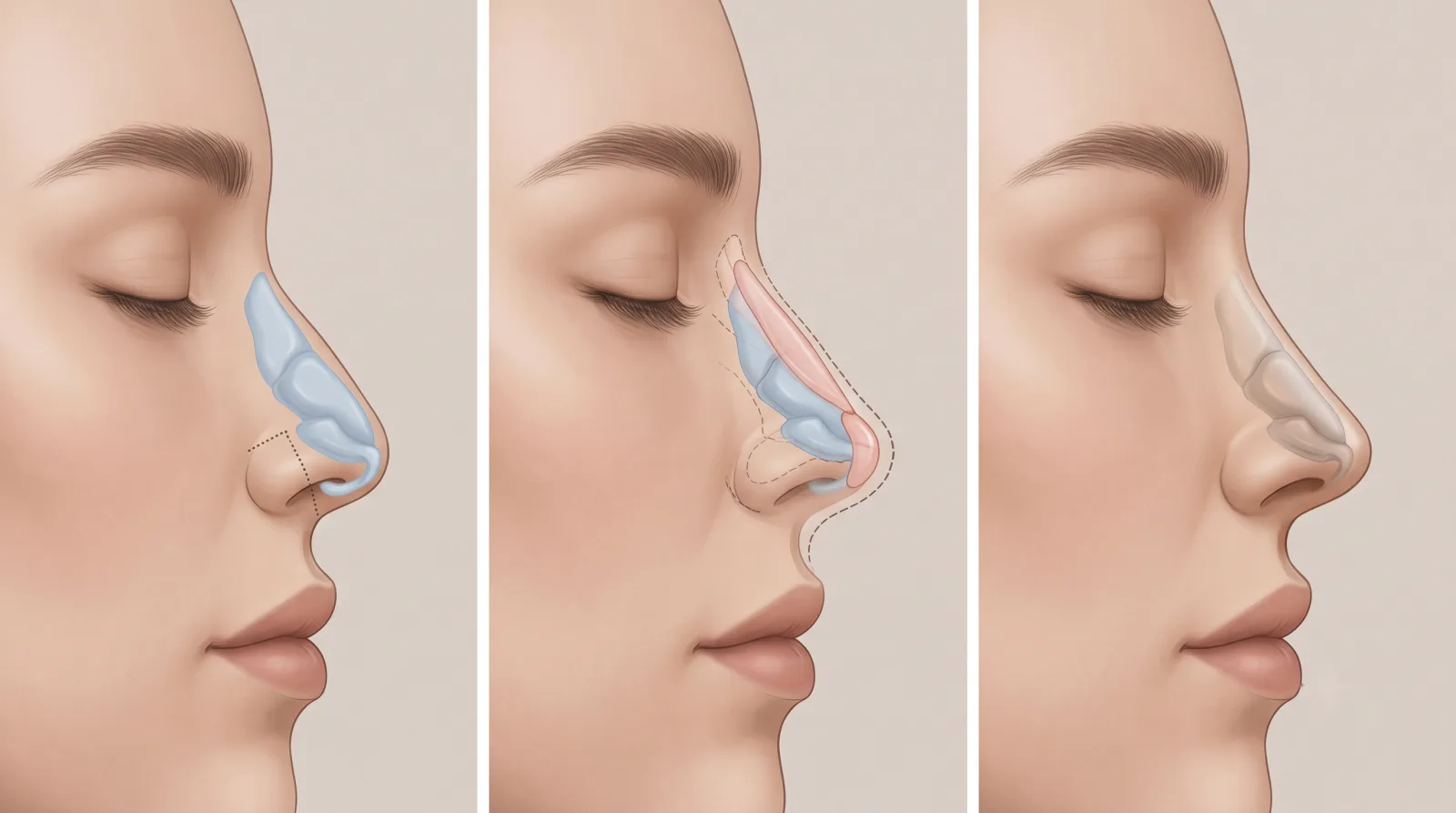
Illustration: the nasal framework (blue) is reshaped to raise the bridge and refine the tip. The dashed outline shows the original contour.
For most people the nose itself is not especially painful. It feels stuffy and tight, you breathe through your mouth for a while, and there is pressure without a stabbing sensation. The discomfort that surprises patients tends to come from the chest, because that area moves every time you breathe, cough, laugh or change position, so even a modest ache there makes itself known more than a quiet nose does.
Knowing this in advance is genuinely helpful, because the chest discomfort is normal and expected. It does not mean anything is wrong. It is part of the trade-off for the strong cartilage the rib provides, and it settles steadily over the first week to ten days. The practical framing is simple: plan for two recovering areas, with the chest needing a little patience early on.
Chest donor site
The chest donor site: what to expect at the rib
The rib donor site is a small incision on the chest from which a segment of costal cartilage is taken. In the first few days it feels tight and tender, with a dull ache that is most noticeable when you take a deep breath, cough, laugh or twist your upper body, or do anything that moves the rib cage. This is the most distinctive part of rib cartilage rhinoplasty recovery, and it is entirely expected.
Practically, that means some everyday movements need care for a short while: getting in and out of bed, reaching overhead, and bracing the area gently when you cough are all easier if you anticipate them. The sutures at the chest donor site are removed around day 10, a little later than the nose, which comes out around day 7. The soreness eases well before then, fading from a clear ache in the first days to a mild tightness by the end of the first week.
Most patients describe the chest as uncomfortable but not severe, and very manageable with the prescribed pain relief. It is worth being realistic: this is the part of the operation people underestimate, so building a few quiet days into your plan for it pays off. The candidacy guide on who rib cartilage rhinoplasty is for covers why accepting this donor site is part of being a suitable candidate.
Day by day
What the discomfort feels like, day by day
On the day of surgery and the first night, both sites feel their most tender, and this is when pain relief matters most. You are given medication and the nose is splinted, the chest dressed. Most of the early discomfort is a combination of nasal congestion and pressure plus the chest tightness. Sharp pain is not typical. Rest, keeping your head elevated, and taking medication on schedule make the first 48 hours much easier.
Across days two to four the worst of it lifts. Facial swelling and bruising are often at their peak around this time, but the raw soreness softens into an ache, and the chest becomes easier to move around. Dressings are typically checked in the early days, the same window used in standard rhinoplasty for dressing changes. By the end of the first week, the nose sutures come out around day 7 and most patients feel substantially more comfortable, with the chest the lingering reminder.
Between day 7 and day 10 the chest donor-site sutures are removed and discomfort settles to a mild tightness that fades over the following weeks. Swelling in the nose takes much longer to fully resolve, which is normal for any structural rhinoplasty, but pain, in the sense of something that needs managing, is generally a first-week-to-ten-day story. International patients usually plan their stay around suture removal; the general timing of when it is safe to fly is covered in the flying after surgery guide.
Managing it
How the discomfort is managed
Comfort is managed in layers. The operation itself is pain-free because you are under general anaesthesia; afterward you are given prescribed pain relief to take on a schedule, which is most effective when you take it before discomfort builds. Do not wait for it to peak. The nose is supported by a splint and the chest by a dressing, both of which protect the areas and reduce the sense of movement that drives the ache.
Simple measures help a lot: keeping your head elevated, especially when sleeping, reduces nasal congestion and throbbing; moving gently and avoiding heavy lifting or vigorous activity protects the chest while it knits; and bracing the donor site when you need to cough or laugh blunts the sharper twinges. Cold compresses around the eyes and cheeks ease facial swelling in the early days. None of this is complicated, but doing it consistently is what keeps recovery smooth.
If something feels outside the normal range, such as pain that worsens instead of easing, fever, or unusual swelling or discharge at either site, report it promptly. Do not wait it out. At a single-surgeon clinic the same surgeon who operated reviews your recovery, so there is a clear point of contact. You can ask about pain, anaesthesia and after-care in advance during an online consultation so you know exactly what to expect.
At Garnet
How Garnet keeps the experience comfortable
Garnet is a single-surgeon clinic in Apgujeong, Seoul. Dr. In-Soo Baek is a board-certified plastic surgeon (Korean medical licence no. 77407) and the only operating doctor. He performs both the rib harvest and the rhinoplasty himself, so the chest donor site and the nose are handled by the same hands that planned them. The clinic caps the day at two surgeries, which means unhurried operating time for each nose.
After surgery you are given clear after-care instructions and prescribed pain relief, and a dedicated coordinator stays with you from consultation through recovery to help with anything practical. Follow-up is structured at 1, 3 and 6 months, with the nose sutures removed around day 7 and the chest donor-site sutures around day 10, and remote review available after you fly home, which is reassuring when two sites are healing at once.
If pain is your main worry, the most useful thing is to talk it through before you commit. You can send photos and ask about the anaesthesia, the chest donor site and the realistic recovery in a no-obligation online consultation, and get a realistic picture of what the experience involves before planning any travel.
Dr. In-Soo Baek
Director & sole operating surgeon
Korean medical licence no. 77407
Operate on what you came for. Trained at Korea University Medical Center. Every case planned, performed and reviewed by the same hands.
1Operating surgeon
~2Surgeries per day
7Registered techniques
Board-certified plastic surgeon
Plastic surgery training at Korea University College of Medicine & graduate school
Korean Society of Plastic and Reconstructive Surgeons member, in its facial-contour, eye & rhinoplasty groups
Consults, operates and follows up each case himself
Peer-reviewed papers behind the facts on this page. Each describes findings in its own study group — not results at Garnet — and none predicts your own outcome.
Luan CW et al. Complications associated with irradiated homologous costal cartilage use in rhinoplasty: A systematic review and meta-analysis. Journal of Plastic, Reconstructive & Aesthetic Surgery. 2022. doi:10.1016/j.bjps.2022.02.026
Drake VE et al. An update on rib grafting in rhinoplasty: which rib is right?. Current Opinion in Otolaryngology & Head & Neck Surgery. 2022. doi:10.1097/moo.0000000000000807
Pfaff MJ et al. Cadaveric Costal Cartilage Grafts in Rhinoplasty and Septorhinoplasty: A Systematic Review and Meta-Analysis of Patient-Reported Functional Outcomes and Complications. Journal of Craniofacial Surgery. 2021. doi:10.1097/scs.0000000000007400
FAQ
Common questions
Is rib cartilage rhinoplasty painful?
You feel nothing during the operation because it is done under general anaesthesia. Afterward there are two recovering areas: the nose and the chest where the rib cartilage was taken. Most patients describe it as a manageable ache and tightness, with the chest often more noticeable than the nose early on. It is well controlled with prescribed pain relief and eases over the first week to ten days.
What anaesthesia is used for rib cartilage rhinoplasty?
General anaesthesia. Because the operation harvests cartilage from the chest and builds a framework for the nose, which is longer, more involved work reaching a second surgical site, being fully asleep is the standard and appropriate approach. It is given and monitored by an anaesthetist throughout, and you are assessed beforehand to confirm it is safe for you.
Why is the chest more uncomfortable than the nose?
The chest donor site moves every time you breathe, cough, laugh or change position, so even a modest ache there makes itself felt more than a quiet, congested nose does. The nose tends to feel stuffy and tight with pressure, while the chest needs a little patience in the first days. Both are normal and settle over the first week to ten days.
How long does the chest donor-site pain last?
It is most noticeable in the first few days as a dull ache that is worse on deep breaths or coughing, then eases steadily. The chest donor-site sutures are removed around day 10, and the soreness usually softens to a mild tightness well before then, fading further over the following weeks. Most patients find it uncomfortable but not severe, and very manageable with medication.
When are the sutures removed?
At Garnet the nose sutures come out around day 7 and the chest rib donor-site sutures around day 10. Comfort improves steadily across that period, and international patients often plan their stay around suture removal. Swelling in the nose takes longer to fully resolve, but pain that needs managing is generally a first-week-to-ten-day matter.
How is the pain managed after surgery?
Through prescribed pain relief taken on a schedule, plus the nose splint and chest dressing that support both sites. Keeping your head elevated reduces nasal throbbing, moving gently protects the chest, and bracing the donor site when you cough or laugh blunts the sharper twinges. Cold compresses help facial swelling. Taking medication before discomfort peaks keeps recovery smoother.
Will I be able to breathe through my nose after surgery?
Not well at first. Expect congestion and a blocked feeling, with a splint in place, so you will breathe mostly through your mouth for a while. This is pressure and stuffiness, and it improves as swelling settles over the following weeks. It is a normal part of any structural rhinoplasty recovery and is not specific to the rib version.
Is the pain worse than a standard rhinoplasty?
There is an additional recovering area, the chest donor site, that a standard rhinoplasty does not have, so the overall recovery asks a little more of you. The nose itself feels similar to other rhinoplasty recoveries. Most patients manage the chest discomfort well with prescribed pain relief and find it the trade-off for the strong cartilage the rib provides.
What should I watch for during recovery?
Some ache, tightness, swelling and bruising are all normal and improve day by day. Pain that worsens instead of easing, fever, or unusual swelling or discharge at either the nose or chest should be reported promptly. At a single-surgeon clinic the surgeon who operated reviews your recovery and can advise remotely after you fly home.
Can I ask about pain and anaesthesia before travelling?
Yes. You can raise pain, the anaesthesia, the chest donor site and the realistic recovery in an online consultation before you commit to anything. A clear picture in advance, including how the two sites heal and how comfort is managed, helps you plan your trip and your time off around a realistic recovery.
My mom recently had a brow lift and lower blepharoplasty with Dr. Baek, and our experience has been wonderful so far. The Garnet team was incredibly kind and welcoming, with Kelly assisting us as our English consultant—she made everything…
I’m so happy I chose this clinic for my lower blepharoplasty. I was traveling from abroad by myself, so I was a little nervous, but from the beginning I felt comfortable and truly cared for. Everyone was kind, patient, and professional…
Came in for an in-person consult and ended up choosing Garnet and Dr.Baek for my non-incisional DES and tiplasty/alarplasty. I communicated with Kelly (English consultant) from the start till now (3 weeks post-op). She really help me feel…
My under-eyes have been sagging and folding for years... I tried to cover it up with makeup, but it actually got stuck in the wrinkles and made it stand out even more. While going for consultations, I noticed that the bigger the hospital…
Worried about the recovery, especially the chest donor site? Send photos and ask about pain and after-care in a no-obligation pre-assessment before you plan a trip.
Send photos and your question before you travel. An English-speaking coordinator reviews every enquiry and replies with guidance on whether surgery is appropriate, the likely plan and timing.
✓ Reviewed by the clinic coordinator, not a bot
✓ Photo-based pre-assessment before you fly
✓ Foreign-patient scheduling & after-care
✓ One surgeon for consultation, surgery and follow-up
Prefer to chat now? Reach the coordinator directly:








 T S7 months ago



