The cost of septal/ear-cartilage rhinoplasty depends mostly on how much cartilage work your nasal tip needs, and it is one of the first questions international patients ask. A single headline number rarely tells the real story. What matters is what shapes that figure, what it includes, and whether the price reflects the surgery you actually need. The operation that is easiest to sell may not be it.
The short answer
We do not publish a price here. Under Korean medical advertising rules cost is confirmed individually at consultation, because it depends on your anatomy and the work you actually need.
The main cost drivers are how much tip work is required, the use of two donor and grafting sites (nose and ear), the surgeon's training, and the anaesthesia and facility.
A meaningful quote should be itemised and include anaesthesia, the operation, follow-up visits and after-care on top of the base figure.
The cheapest option rarely represents the strongest value; with a single-surgeon clinic you are paying for the same board-certified surgeon to plan, operate and follow up.
Why this procedure does not have a single flat price
Septal/ear-cartilage rhinoplasty is tailored to each nose, so a single advertised number would be misleading. The work needed to refine and project a tip varies enormously between patients. Some need a small amount of cartilage for subtle definition, others need a more substantial rebuild. Two donor and grafting areas are involved, the nose and the ear, and the amount of cartilage used and the complexity of shaping it differ in every case.
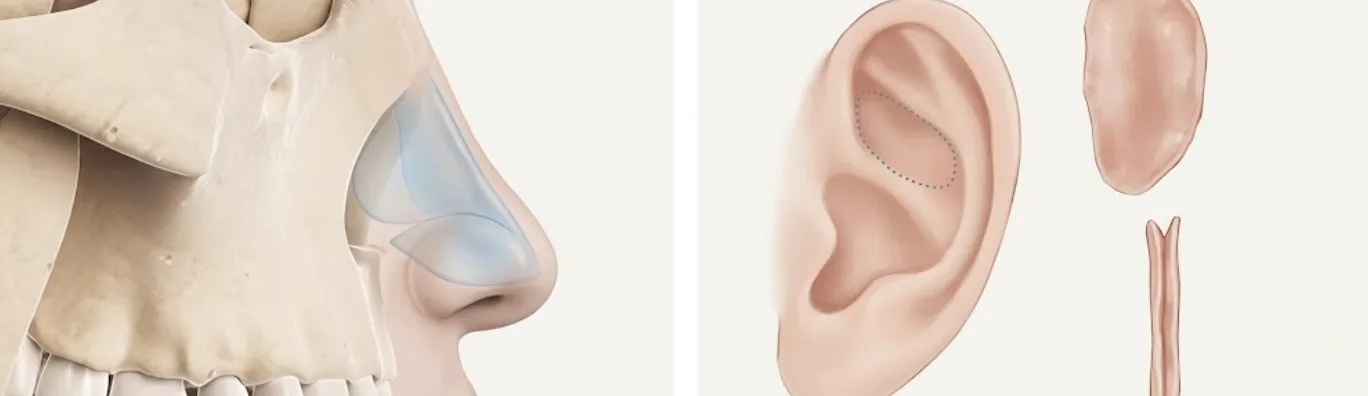
Illustration: two common sources of the patient's own cartilage: the septum inside the nose (blue) and the curved cartilage of the ear.
Korean medical advertising rules also shape how cost is communicated: prices are confirmed individually after an assessment and are not published as a fixed figure, because the right number depends on your anatomy and goals. That is why this page explains what shapes the cost instead of listing one. For the operation itself, see the septal/ear-cartilage rhinoplasty overview; for the broader picture of pricing in Korea, see plastic surgery cost in Korea.
The practical takeaway: be wary of any clinic that gives you a firm price before they have properly assessed your nose. A responsible quote comes after a proper evaluation of your nose.
Cost drivers
What actually shapes the cost
The amount of tip work. The core of this procedure is using septal and ear (conchal) cartilage to project and define the tip. How much structural grafting your tip needs (a refinement versus a more significant rebuild) is the biggest single driver. A simple case and a complex one are genuinely different operations.
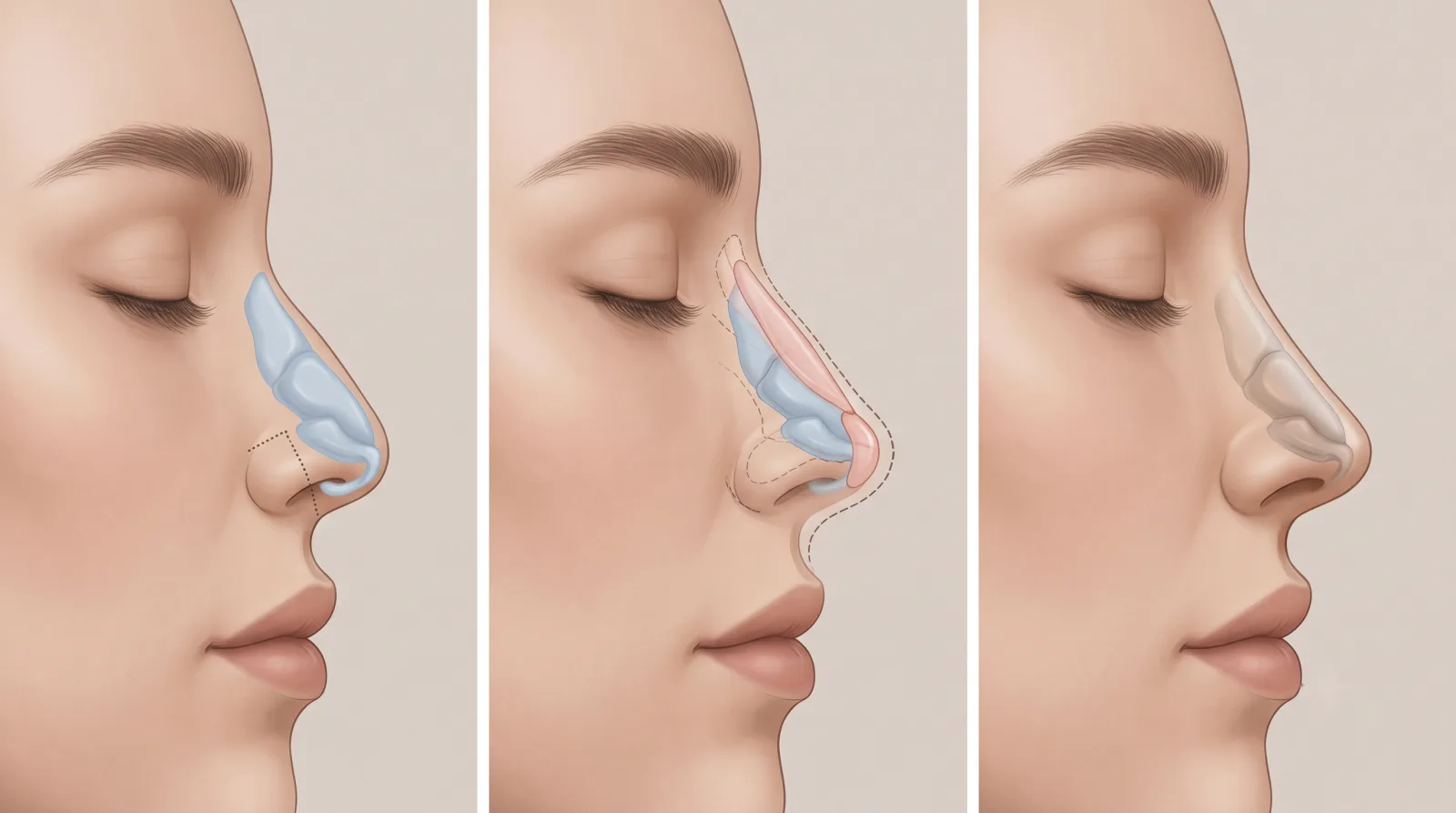
Illustration: the nasal framework (blue) is reshaped to raise the bridge and refine the tip. The dashed outline shows the original contour.
Two surgical areas. Because cartilage is harvested from both the septum and the ear, the operation involves managing two sites. This is part of why a cartilage-based tip rhinoplasty differs in scope from a basic rhinoplasty that may rely on an implant for the bridge. The donor work adds surgical time and care.
The surgeon, anaesthesia and facility. A board-certified plastic surgeon with deep nose-specific experience, the type of anaesthesia used, the operating-room standard, and the after-care programme all factor in. If you are revising a previous nose, complexity rises, and with it the cost; a sturdier framework from rib cartilage changes the picture again.
What's included
What a fair quote should include
A number on its own tells you little; what counts is what sits inside it. A transparent quote for this procedure should make clear whether it covers the surgeon's fee, the operation itself, anaesthesia, the operating facility, post-operative dressings and suture removal at both the nose and ear, medications, and your follow-up visits. When these are itemised, you can compare like with like and see what a low headline figure leaves out.
For international patients, ask specifically whether the quote includes the structured follow-up that matters for a tip that refines over months (at Garnet, reviews at 1, 3 and 6 months), and whether remote follow-up after you fly home is part of the package. A cheaper price that ends the moment you leave the operating room is not really cheaper if it omits the care you will need for the next six months.
Also confirm there is no charge for the things that should be free: at Garnet there is no consultation or CT fee and no pressure to book the same day. Knowing what is and is not billable up front prevents surprises. For how foreign-patient billing works in practice, see paying as a foreign patient.
Value vs cheapest
Value versus the cheapest option
The cheapest rhinoplasty rarely represents the strongest value, and with a structural tip procedure the gap matters more than usual. Tip work using your own cartilage is technically demanding: it is shaped by hand, it has to hold its projection as it heals, and small differences in execution show up months later. A very low price often reflects a high-volume model, less surgeon time per case, or a quote that quietly excludes after-care.
What you are really paying for at a single-surgeon clinic is continuity: the same board-certified surgeon assesses you, performs the operation himself, and reviews your healing. There are no shadow doctors and no uncertainty about who is in the room. For why that distinction affects value as well as comfort, see what is a single-surgeon clinic and ghost surgery and single-surgeon care.
Value also means candour before surgery. A clinic that tells you that you do not need as much work as you feared, or that a different approach suits you better, is protecting your result and your budget. A hard sell that inflates the operation to inflate the bill is the opposite of value. For the factors that move cost across any procedure, see what affects plastic surgery cost.
Korea vs abroad
Korea compared with other countries
Many international patients consider Korea partly because the combination of surgical experience and cost can compare favourably with their home country, where a structural cartilage rhinoplasty can be expensive. But a fair comparison has to be like-for-like: the same scope of tip work, the same standard of facility, the same after-care, and the same surgeon doing the whole operation. Comparing a full cartilage rebuild abroad with a stripped-back package elsewhere is not a real comparison.
Factor in the true cost of travelling too when you weigh Korea against home: flights, around 10 days of accommodation in Seoul to cover both nose and ear suture removal, and recovery time. For most patients these are manageable, but they belong in the maths. See how long to stay in Korea for surgery to budget the time, and planning a plastic surgery trip to Korea for the wider logistics.
Korea is sometimes cheaper for comparable work. Even so, price should not be the deciding factor for surgery on the centre of your face. The surgeon, the assessment and the after-care matter more than the headline figure.
Confirming cost
Confirming your cost accurately
Because the right price depends on your nose, the most useful step is an assessment of it. You can begin one before you travel: send photos for a pre-assessment and the surgeon can give you a realistic sense of what your case involves and what shapes the cost, without committing to anything. See online consultation from abroad for how this works for international patients.
When you receive a figure, ask for it itemised, ask what is excluded, and ask whether follow-up and any realistic touch-ups are covered. A clinic confident in its work will answer these plainly. At Garnet the assessment is unhurried and there is no consultation or CT fee, so you can understand your options before any money is discussed.
Above all, treat a quote as the end of a careful evaluation of your nose. The same board-certified surgeon, Dr. In-Soo Baek (Korean medical licence no. 77407), who would assess you also performs and follows up the surgery, so the plan you are quoted for is the plan that is actually carried out.
Real Results
Before & After
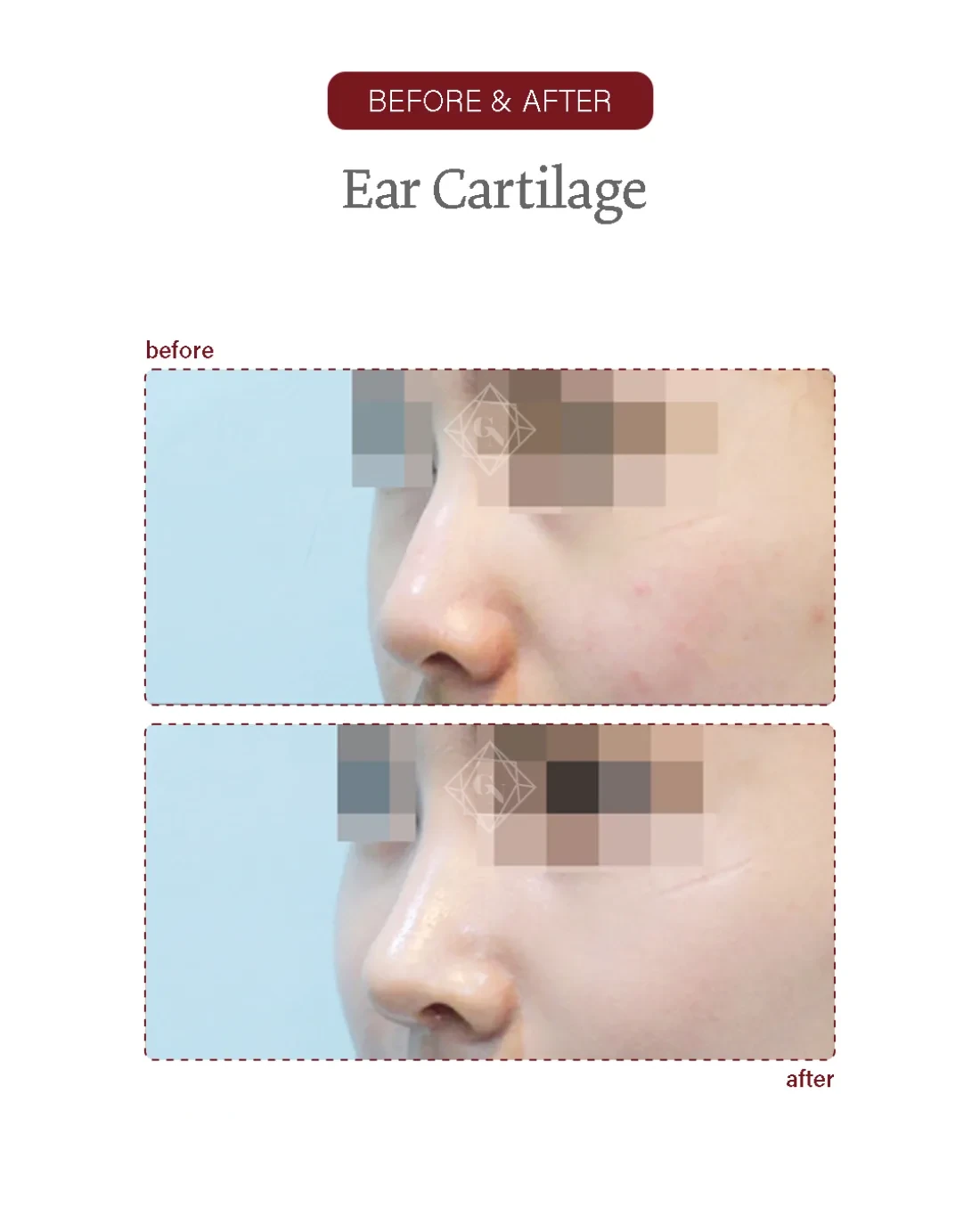
Ear-cartilage rhinoplasty result of an actual Garnet patient, Apgujeong (published with consent; same lighting and angle before and after). Results, recovery and suitability vary by individual and are not guaranteed; further sets are reviewed privately at consultation.
Dr. In-Soo Baek
Director & sole operating surgeon
Korean medical licence no. 77407
Operate on what you came for. Trained at Korea University Medical Center. Every case planned, performed and reviewed by the same hands.
1Operating surgeon
~2Surgeries per day
7Registered techniques
Board-certified plastic surgeon
Plastic surgery training at Korea University College of Medicine & graduate school
Korean Society of Plastic and Reconstructive Surgeons member, in its facial-contour, eye & rhinoplasty groups
Consults, operates and follows up each case himself
Peer-reviewed papers behind the facts on this page. Each describes findings in its own study group — not results at Garnet — and none predicts your own outcome.
Skochdopole AJ et al. Current Surgical Outcomes of Nasal Tip Grafts in Rhinoplasty: A Systematic Review. Plastic & Reconstructive Surgery. 2023. doi:10.1097/prs.0000000000010257
Duggan RP et al. Unanticipated Economic Burden of Cosmetic Surgery Tourism: A Single Academic Center’s Experience. Aesthetic Plastic Surgery. 2024. doi:10.1007/s00266-024-04516-x
Eid I et al. Using Ultrasound to Evaluate Nasal Septal Cartilage. Facial Plastic Surgery & Aesthetic Medicine. 2021. doi:10.1089/fpsam.2020.0053
Hery D et al. Plastic Surgery Tourism: Complications, Costs, and Unnecessary Spending?. Aesthetic Surgery Journal Open Forum. 2023. doi:10.1093/asjof/ojad113
FAQ
Common questions
How much does septal/ear-cartilage rhinoplasty cost in Korea?
There is no single flat price, and under Korean medical advertising rules cost is confirmed individually at consultation. The figure depends on how much tip work your nose needs, the two donor sites involved, the surgeon, the anaesthesia and the after-care. The most reliable way to learn your cost is an assessment of your nose.
What affects the cost the most?
The biggest driver is the amount of structural tip work: a subtle refinement versus a more substantial rebuild. Other factors include managing two surgical areas (nose and ear), the surgeon's training and experience, the anaesthesia and facility, and whether the case is a revision.
What should be included in the quote?
A fair quote should itemise the surgeon's fee, the operation, anaesthesia, the facility, dressings and suture removal at both the nose and ear, medications, and follow-up visits. For international patients it should also be clear whether structured and remote follow-up after you fly home is included.
Why won't you just publish a price?
Because the procedure is tailored to each nose, a single advertised number would be misleading, and Korean medical advertising rules mean cost is confirmed individually after an assessment. A responsible quote follows a proper evaluation of your nose.
Is ear-cartilage rhinoplasty in Korea cheaper than other countries?
Sometimes, for comparable work. Only a like-for-like comparison is meaningful: the same scope of tip work, facility standard, after-care, and the same surgeon doing the whole operation. Remember to factor in flights, around ten days of accommodation, and recovery time.
Is the cheapest option a good idea?
Rarely. A very low price often reflects a high-volume model, less surgeon time, or a quote that excludes after-care. For demanding tip work using your own cartilage, continuity and surgeon experience matter more than the headline figure.
Are there any hidden fees I should ask about?
Ask whether consultation, imaging, anaesthesia, medications, suture removal at both sites, and follow-up are billed separately. At Garnet there is no consultation or CT fee and no pressure to book the same day, so the cost picture is clear before anything is decided.
Does the quote cover follow-up after I fly home?
Ask specifically. Because the tip refines over months, after-care matters. At Garnet that means structured reviews at 1, 3 and 6 months, with the operating surgeon continuing to review your healing remotely after you return home. A quote that ends at the operating-room door only looks cheaper.
Will a revision cost more than a first-time nose?
Usually yes. Revision work is more complex, the tissue is altered from previous surgery, and a sturdier framework may be needed, all of which add to cost. Your surgeon can explain how your specific situation affects the figure at consultation.
How do I find out my actual cost?
Begin with a pre-assessment. You can send photos before you travel, and the surgeon will give a realistic sense of what your case involves and what shapes the cost. A precise figure follows a proper in-person evaluation of your nose.
My mom recently had a brow lift and lower blepharoplasty with Dr. Baek, and our experience has been wonderful so far. The Garnet team was incredibly kind and welcoming, with Kelly assisting us as our English consultant—she made everything…
I’m so happy I chose this clinic for my lower blepharoplasty. I was traveling from abroad by myself, so I was a little nervous, but from the beginning I felt comfortable and truly cared for. Everyone was kind, patient, and professional…
Came in for an in-person consult and ended up choosing Garnet and Dr.Baek for my non-incisional DES and tiplasty/alarplasty. I communicated with Kelly (English consultant) from the start till now (3 weeks post-op). She really help me feel…
My under-eyes have been sagging and folding for years... I tried to cover it up with makeup, but it actually got stuck in the wrinkles and made it stand out even more. While going for consultations, I noticed that the bigger the hospital…
Want a realistic sense of what your case involves and what shapes the cost? Send photos for a no-obligation pre-assessment. There is no consultation fee and no pressure to book.
Send photos and your question before you travel. An English-speaking coordinator reviews every enquiry and replies with guidance on whether surgery is appropriate, the likely plan and timing.
✓ Reviewed by the clinic coordinator, not a bot
✓ Photo-based pre-assessment before you fly
✓ Foreign-patient scheduling & after-care
✓ One surgeon for consultation, surgery and follow-up
Prefer to chat now? Reach the coordinator directly:








 T S7 months ago



