Septal/ear-cartilage rhinoplasty is a specific tool for a specific job: refining and projecting the nasal tip using your own cartilage. It suits some noses beautifully and is the wrong choice for others. Knowing which group you fall into before you book saves you from an operation that will not give you what you want.
The short answer
This approach is well suited to refining and projecting the nasal tip, improving definition, lift and shape with septal and ear (conchal) cartilage. No implant is used at the tip.
It suits patients who want a natural, structural result from their own tissue and who have enough usable septal cartilage to work with.
It is often not the right choice for a major rebuild, a complex revision, or very little remaining septal cartilage. In those cases rib cartilage gives a sturdier framework.
Candidacy is confirmed by assessment with the operating surgeon, without a sales conversation. Sometimes the right outcome is a different procedure or none at all.
What septal/ear-cartilage rhinoplasty actually does
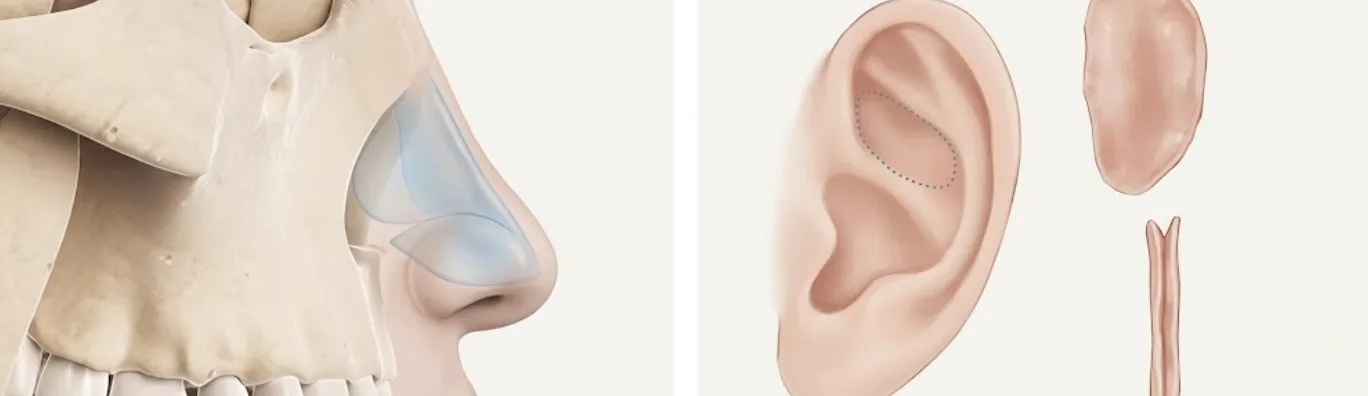
This procedure uses your own cartilage to refine and project the nasal tip. Septal cartilage, taken from inside the nose, gives strong, straight support that is ideal for building tip structure; ear (conchal) cartilage, harvested from behind the ear, has a natural curve that is well suited to softening and shaping the tip's contour. Together they let the surgeon add definition, lift and projection without relying on an implant for the tip.
Illustration: two common sources of the patient's own cartilage: the septum inside the nose (blue) and the curved cartilage of the ear.
Because it uses your own tissue, the result tends to feel and look natural, and it avoids the considerations that come with a synthetic graft at the tip. It is a structural tip operation and is distinct from a basic bridge augmentation. For the full mechanics, see the septal/ear-cartilage rhinoplasty overview, and to see where it sits among nose options, the main rhinoplasty page.
Understanding what it does well is the key to candidacy. If your concern is the tip (its definition, projection or shape), this is squarely the right family of options. If your concern is something else entirely, a different approach may serve you better.
Good candidate
Who is a good candidate
You are likely a good candidate if your main goal is tip refinement or projection for a tip that is under-projected, bulbous, poorly defined, or droops slightly, and you want a natural result built from your own tissue with no tip implant. Patients who specifically want to avoid synthetic material at the tip, and who like the idea that the graft is living cartilage that integrates with the nose, are a natural fit.
Practically, good candidates have enough usable septal cartilage to provide the structural backbone, healthy skin and tissue, realistic expectations, and are in good general health. The amount of correction is moderate: a refinement or a clear improvement in definition. Wholesale reconstruction is a different operation. Patients combining a modest bridge change with tip work using their own cartilage often suit this approach too; if no bridge implant is wanted at all, the closely related implant-free rhinoplasty may be discussed.
Realistic expectations are part of candidacy. A tip built from cartilage refines over months, and the goal is a natural, balanced nose without a dramatic transformation: 'younger, but still yourself' in spirit. If that matches what you want, you are in the right place.
Ear vs rib
When ear cartilage is enough — and when rib fits better
Ear (conchal) cartilage is excellent for tip refinement and modest projection, but it is softer and available in limited quantity. For a nose that needs a large amount of structural support, such as a major increase in projection, a significant rebuild, or a strong, straight framework, rib cartilage provides a sturdier and more abundant source. Choosing between them is one of the central candidacy questions for tip-focused rhinoplasty.
As a rough guide: if you want refinement and a natural improvement in tip shape and have usable septal cartilage, the septal/ear approach is often ideal. If you need substantial projection, are revising a previous nose with little cartilage left, or need a robust framework, rib cartilage may be the better tool, at the cost of a chest donor site. See rib vs ear-cartilage rhinoplasty for the direct comparison, and who suits rib-cartilage rhinoplasty.
The donor site differs too, and it is worth weighing: the ear donor area is minor, with a small, hidden incision and a quick recovery, whereas a rib donor site is more involved. The right answer is whichever source matches the structure your nose actually needs, and only an in-person assessment can confirm that.
Not recommended
When this procedure is not recommended
This approach is usually not the right choice when the goal is a major rebuild that ear cartilage cannot support, when there is too little usable septal cartilage to provide structure, or in a complex revision where the tissue has been altered by previous surgery and a stronger framework is needed. In those situations pushing on with ear cartilage would risk an under-supported result, and a different plan, often rib cartilage, suits you better. See revision rhinoplasty candidacy if you have had previous nose surgery.
It is also not recommended if your real concern is not the tip: for example, a purely cosmetic bridge change, or a functional breathing problem that needs a different surgical focus. And like any elective surgery, it is not advisable if your general health, unrealistic expectations, or active medical issues make the risks outweigh the benefit. A responsible surgeon will say so.
Being told 'this is not the procedure for you' means the assessment is working. Garnet's stated approach is no over-recommendation: only the area you came for is addressed, and you will not be steered into surgery you do not need. That frankness is the whole point of a careful consultation.
Deciding candidacy
How candidacy is actually decided
Candidacy is decided by examining your nose. A photo alone or a wish list is not enough. The surgeon assesses your skin thickness, the existing tip support, how much usable septal cartilage you have, your nasal structure and your goals, then matches the technique to what your nose can realistically deliver. This is why an unhurried assessment of your septum and tip matters more than any online promise.
You can begin remotely: send photos for a pre-assessment and the surgeon can give you an early, realistic view of whether this approach suits you, what it could achieve, and whether a different option would suit you better, before you commit to travel. See online consultation from abroad. A final plan is confirmed at the in-person consultation in Seoul.
Crucially, the surgeon who assesses you is the one who will operate and follow up, so the candidacy judgement and the surgical plan come from the same hand. There is no risk of being assessed by one person and operated on by another.
At Garnet
Your nose assessment at Garnet
Garnet is a single-surgeon clinic in Apgujeong, Seoul. Dr. In-Soo Baek is a board-certified plastic surgeon (Korean medical licence no. 77407) and the only operating doctor. The consultation, the operation and each follow-up review are all handled by him personally. With one patient per hour and no shadow doctors, the assessment is unhurried, and the plan you agree is the plan that is carried out.
That model is built for exactly the candidacy question this page is about: you get a clear opinion on whether septal/ear-cartilage rhinoplasty is right for you, whether rib cartilage would suit you better, or whether you would do well to wait or choose something else. Garnet is registered with Korea's foreign-patient programme and coordinates consultation, scheduling and after-care for international visitors.
If you are weighing this procedure, the most useful next step is simply an opinion on your own nose, with no obligation to proceed. You can start with a no-obligation online assessment and decide from there.
Prices
Price at Garnet
Revision rhinoplasty
From₩4,000,000 + VATExcluding VAT (10% VAT is added at payment)Book now
Same price as Korean patients. Prices shown exclude 10% VAT; your written quote, issued after the in-person consultation, shows the full amount payable.
Dr. In-Soo Baek
Director & sole operating surgeon
Korean medical licence no. 77407
Operate on what you came for. Trained at Korea University Medical Center. Every case planned, performed and reviewed by the same hands.
1Operating surgeon
~2Surgeries per day
7Registered techniques
Board-certified plastic surgeon
Plastic surgery training at Korea University College of Medicine & graduate school
Korean Society of Plastic and Reconstructive Surgeons member, in its facial-contour, eye & rhinoplasty groups
Consults, operates and follows up each case himself
Peer-reviewed papers behind the facts on this page. Each describes findings in its own study group — not results at Garnet — and none predicts your own outcome.
Gode S et al. The Joint Tip Graft: A Joint Support for Rim, Facet and Infratip Lobule in Rhinoplasty. Aesthetic Plastic Surgery. 2019. doi:10.1007/s00266-019-01329-1
Jang YJ et al. Tip Grafting for the Asian Nose. Facial Plastic Surgery Clinics of North America. 2018. doi:10.1016/j.fsc.2018.03.008
Suh YC et al. Septum-Based Nasal Tip Plasty: A Comparative Study between Septal Extension Graft and Double-Layered Conchal Cartilage Extension Graft. Plastic & Reconstructive Surgery. 2018. doi:10.1097/prs.0000000000003920
FAQ
Common questions
Who is a good candidate for septal/ear-cartilage rhinoplasty?
Patients whose main goal is tip refinement or projection for a tip that is under-projected, bulbous, poorly defined or slightly drooping, who want a natural result from their own cartilage with no tip implant, who have enough usable septal cartilage, healthy tissue and realistic expectations.
Am I suitable if I only want my tip improved?
Very possibly. Tip definition, projection and shape are exactly what this approach addresses, using septal cartilage for support and ear cartilage for natural contour. An in-person or photo assessment confirms whether your tip support and cartilage make you a good fit.
When is ear cartilage enough versus needing rib cartilage?
Ear cartilage suits refinement and modest projection. If you need a large increase in projection, a major rebuild, or a strong framework, or have little septal cartilage left after previous surgery, rib cartilage is often the better, sturdier choice, at the cost of a chest donor site.
When is this procedure not recommended?
When the goal is a major rebuild ear cartilage cannot support, when there is too little usable septal cartilage, in complex revisions needing a stronger framework, when your concern is not the tip, or when health or expectations make the risk outweigh the benefit. A responsible surgeon will tell you so.
Is it suitable for revision rhinoplasty?
Sometimes, for modest revisions where enough cartilage remains. More complex revisions with altered tissue often need the sturdier framework that rib cartilage provides. An assessment of your previous surgery determines which is appropriate for you.
Does it use an implant?
Not for the tip, which is the point of this approach. The tip is built and projected with your own septal and ear cartilage. Whether the bridge involves an implant depends on your goals; if you want to avoid implants entirely, the implant-free approach can be discussed.
Will the ear cartilage harvest affect my ear?
No. A thin section of conchal cartilage is taken through a small, well-hidden incision, and the ear's shape and framework are preserved. The donor recovery is minor compared with the nose.
What if I'm told I'm not a good candidate?
That is the assessment doing its job. Garnet's approach is no over-recommendation, and you will not be steered into surgery you do not need. Being told a different option suits you better, or that you should wait, protects your result.
How is candidacy decided?
By examining your nose: skin thickness, existing tip support, usable septal cartilage, structure and goals. A wish list does not decide it. You can begin remotely by sending photos for a pre-assessment, with a final plan confirmed at the in-person consultation in Seoul.
Who decides whether I'm a candidate?
The same board-certified surgeon who would operate on you and follow up your recovery makes the candidacy judgement, so the assessment and the surgical plan come from one hand. You are never assessed by one person and operated on by another.
My mom recently had a brow lift and lower blepharoplasty with Dr. Baek, and our experience has been wonderful so far. The Garnet team was incredibly kind and welcoming, with Kelly assisting us as our English consultant—she made everything…
I’m so happy I chose this clinic for my lower blepharoplasty. I was traveling from abroad by myself, so I was a little nervous, but from the beginning I felt comfortable and truly cared for. Everyone was kind, patient, and professional…
Came in for an in-person consult and ended up choosing Garnet and Dr.Baek for my non-incisional DES and tiplasty/alarplasty. I communicated with Kelly (English consultant) from the start till now (3 weeks post-op). She really help me feel…
My under-eyes have been sagging and folding for years... I tried to cover it up with makeup, but it actually got stuck in the wrinkles and made it stand out even more. While going for consultations, I noticed that the bigger the hospital…
Not sure if this is the right approach for your nose? Send photos for a no-obligation pre-assessment, including whether a different option would suit you better.
Send photos and your question before you travel. An English-speaking coordinator reviews every enquiry and replies with guidance on whether surgery is appropriate, the likely plan and timing.
✓ Reviewed by the clinic coordinator, not a bot
✓ Photo-based pre-assessment before you fly
✓ Foreign-patient scheduling & after-care
✓ One surgeon for consultation, surgery and follow-up
Prefer to chat now? Reach the coordinator directly:









 T S7 months ago



