Septal/ear-cartilage rhinoplasty heals on two tracks at once: the nose itself, and the small donor site behind your ear where the conchal cartilage is taken. Knowing what each does, week by week, removes most of the worry and helps you plan your trip around realistic dates.
The short answer
There are two healing sites: the nose (sutures out around day 7) and the ear donor area (sutures out around day 10). Plan your stay around the later of the two.
Most visible bruising and the worst swelling settle within the first two weeks; the tip refines slowly over months.
The ear donor site is usually less of a recovery factor than people expect: it is a small, well-hidden incision.
At a single-surgeon clinic, the same board-certified surgeon who operates also reviews your healing at structured follow-ups, including remotely after you fly home.
How septal/ear-cartilage rhinoplasty recovery works
This procedure refines and projects the nasal tip using your own cartilage: septal cartilage from inside the nose and conchal (ear) cartilage from behind the ear. Because two areas are involved, recovery runs on two tracks: the nose, where the structural work and any external sutures sit, and the ear, where a small piece of cartilage was harvested. The good news is that the ear donor site is minor compared with the nose, and most patients are surprised by how little it features in their day-to-day recovery.
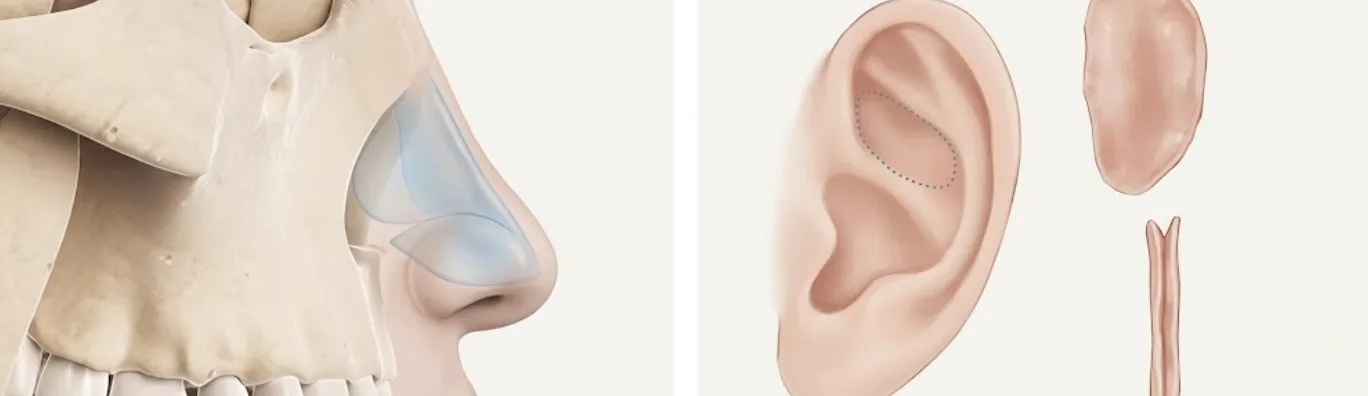
Illustration: two common sources of the patient's own cartilage: the septum inside the nose (blue) and the curved cartilage of the ear.
The single most important date to plan around is suture removal. At Garnet the nose sutures typically come out around day 7, and the ear donor sutures around day 10. That means your trip should be built around the later milestone — roughly a 10-day window in Seoul, and not on the nose alone. For the full picture of the operation itself, see the septal/ear-cartilage rhinoplasty overview, and for how this compares with the basic procedure, the main rhinoplasty page.
Everyone heals at their own pace, and your skin thickness, the amount of tip work done and your own biology all shape the timeline. The day-by-day below is a realistic guide. Your surgeon will give you dates specific to your case at consultation.
First week
Days 1 to 7: the first week, day by day
Day 0 (surgery day): You will have a small splint or cast over the nose bridge to hold the shape, light packing or internal supports inside the nostrils, and a small dressing behind the ear. Breathing through the nose feels blocked because of the swelling and supports, and it eases. Expect to rest, keep your head elevated, and apply cold compresses around (not on) the nose. Days 1 and 3 usually involve a dressing change or check, so the surgeon can see the nose settling early.
Days 2–4 are typically the peak of swelling and bruising, especially around the eyes and cheeks more than on the nose itself. Bruising, if you get it, looks worse before it fades. Sleep propped up, avoid bending or heavy lifting, and skip anything that raises blood pressure to the face. The ear donor area is mildly tender but not usually painful. It feels like a dull ache that paracetamol manages well.
Days 5–7: swelling visibly drops and the bruising starts to yellow and fade. Around day 7 the nose splint and any external nasal sutures come out. This is a quiet, undramatic appointment, and most patients feel a real lift seeing the nose without the cast. The tip will still look swollen and a little firm; that is expected and normal at this stage.
Ear donor site
The ear donor site: smaller than you think
Conchal cartilage is taken from the bowl of the ear through a small incision usually hidden in the natural fold behind the ear or within the ear's contour, so the scar is well concealed once healed. Harvesting it does not change the shape or projection of your ear. The surgeon takes a thin section and the ear's framework is preserved. Most patients find this part of the recovery far less significant than they feared.
Expect mild tenderness, a small dressing, and sometimes a feeling of fullness or numbness around the ear for a few weeks that settles on its own. The donor sutures generally come out around day 10, which is why your stay is planned around this date. Keep the area clean and dry as instructed, sleep so you are not pressing directly on that ear, and avoid earphones or glasses arms resting heavily on the site early on.
If you are weighing where the cartilage comes from, it is worth understanding the alternatives. Ear cartilage suits tip refinement and modest projection; larger or revision rebuilds may call for a sturdier framework. See rib vs ear-cartilage rhinoplasty and the rib-cartilage recovery timeline to see how the donor site changes the recovery picture.
Weeks to months
Weeks two to twelve, and the long tail of refinement
Weeks 2–3: by the end of the second week most bruising is gone and swelling has dropped enough that you look presentable in everyday settings. Makeup can usually cover any residual discolouration, and many patients return to desk work around this point. The nose still feels firm and the tip looks fuller and higher than the final result; this is normal and will keep changing.
Weeks 4–8: swelling continues to subside steadily, breathing normalises as internal healing completes, and the nose starts to soften and look more natural. You can ease back into light exercise from around week 3–4 with your surgeon's clearance, building to full activity by around week 6. Numbness at the tip and around the ear gradually returns to normal sensation.
Months 3–12: the tip, the area built up with septal and ear cartilage, is the slowest to refine. Residual swelling there resolves over months, and the definition you came for becomes clearer over the first three to six months, with subtle settling continuing toward a year. Garnet's structured follow-ups at 1, 3 and 6 months track exactly this. For how nasal results mature in general, see rhinoplasty recovery timeline.
Normal vs not
Normal ear-cartilage rhinoplasty healing, and the signs to act on
Normal in the early weeks: a blocked-feeling nose, firmness and fullness at the tip, asymmetric swelling that comes and goes, numbness at the tip and around the ear, occasional shooting or tingling sensations as nerves recover, and a tip that looks higher or wider than your goal. Mild oozing or crusting inside the nose in the first days is also expected. None of these mean something has gone wrong. They are the ordinary texture of healing.
Signs worth contacting the clinic about: spreading redness or increasing warmth at either the nose or ear site, fever, pus or a bad smell from a wound, sudden worsening pain after it had been improving, heavy or persistent bleeding, or one side of the ear donor area swelling firmly and tensely. These are uncommon, but they are the things your surgeon wants to hear about early.
Because the same surgeon who operated reviews your recovery, you are not explaining your case to a stranger if a question comes up. You can message the clinic with photos between appointments, and after you fly home the surgeon continues to review your healing remotely. See online consultation from abroad for how that works.
Flying & follow-up
When you can fly home, and how follow-up works
Plan to stay in Seoul long enough for both suture removals, around 10 days as a working minimum, since the ear donor sutures come out around day 10. Flying before then risks missing that appointment and travelling with sutures still in. Many international patients build in a day or two of buffer after the day-10 check so they leave with both sites reviewed and clear instructions in hand.
Most people are comfortable to fly once the nasal splint is off and the donor sutures are out, the swelling has settled enough for a long flight, and the surgeon has confirmed you are healing well. Cabin pressure does not damage your new nose, but a long-haul flight is more comfortable after the worst swelling has passed. For general guidance on timing air travel after surgery, see when can I fly after plastic surgery and recovering in Seoul after surgery.
After you return home, Garnet's follow-up continues at 1, 3 and 6 months by message and photo, with the operating surgeon, board-certified plastic surgeon Dr. In-Soo Baek (Korean medical licence no. 77407), reviewing your progress himself. That continuity matters most for this procedure, because the tip refines over months and it helps to have the person who built it watching how it settles.
Real Results
Before & After
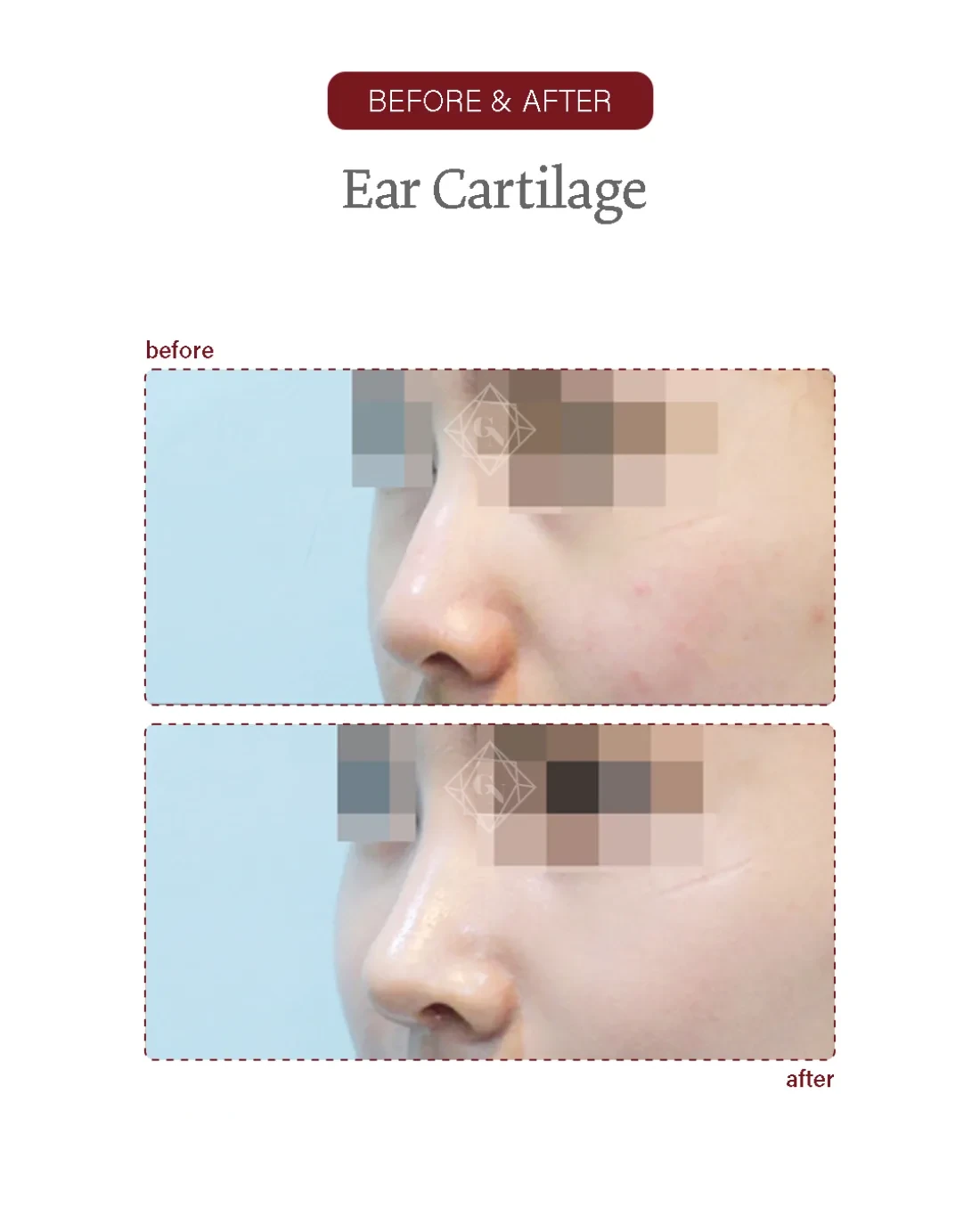
Ear-cartilage rhinoplasty result of an actual Garnet patient, Apgujeong (published with consent; same lighting and angle before and after). Results, recovery and suitability vary by individual and are not guaranteed; further sets are reviewed privately at consultation.
Dr. In-Soo Baek
Director & sole operating surgeon
Korean medical licence no. 77407
Operate on what you came for. Trained at Korea University Medical Center. Every case planned, performed and reviewed by the same hands.
1Operating surgeon
~2Surgeries per day
7Registered techniques
Board-certified plastic surgeon
Plastic surgery training at Korea University College of Medicine & graduate school
Korean Society of Plastic and Reconstructive Surgeons member, in its facial-contour, eye & rhinoplasty groups
Consults, operates and follows up each case himself
Peer-reviewed papers behind the facts on this page. Each describes findings in its own study group — not results at Garnet — and none predicts your own outcome.
Cobo R et al. Septal Extension Graft Versus Columellar Strut. Facial Plastic Surgery Clinics of North America. 2024. doi:10.1016/j.fsc.2024.06.005
Skochdopole AJ et al. Current Surgical Outcomes of Nasal Tip Grafts in Rhinoplasty: A Systematic Review. Plastic & Reconstructive Surgery. 2023. doi:10.1097/prs.0000000000010257
Eid I et al. Using Ultrasound to Evaluate Nasal Septal Cartilage. Facial Plastic Surgery & Aesthetic Medicine. 2021. doi:10.1089/fpsam.2020.0053
FAQ
Common questions
How long does septal/ear-cartilage rhinoplasty recovery take?
The active recovery is about two weeks for the visible swelling and bruising, but plan your stay in Korea around suture removal: nose sutures come out around day 7 and the ear donor sutures around day 10. You will look presentable in everyday settings by the end of week two; the tip refines slowly over three to six months and settles toward a year.
What is the day-by-day recovery like?
Days 1–3 bring the most swelling and any bruising, with dressing checks on days 1 and 3. By days 5–7 swelling drops and the nasal splint and sutures come out. The ear donor sutures follow around day 10. From week two most bruising is gone, and over the following months the tip slowly softens to its final shape.
How bad is the ear donor site?
Usually much milder than patients expect. The cartilage is taken through a small, well-hidden incision behind or within the ear, the ear's shape is preserved, and recovery there is mainly mild tenderness and a temporary feeling of fullness. The donor sutures come out around day 10.
When can I return to work after the surgery?
Many international patients return to desk-based work around two weeks, once the splint and sutures are out and bruising can be covered. Physically demanding jobs need longer, typically three to four weeks before strenuous activity, with your surgeon's clearance.
When will I see my final nose shape?
The overall shape is visible within a few weeks, but the tip, built up with septal and ear cartilage, is the slowest area to refine. Most of the definition emerges over the first three to six months, with subtle settling continuing toward a year.
When can I fly home after ear-cartilage rhinoplasty?
Plan to stay until the ear donor sutures come out around day 10 and the surgeon confirms you are healing well. Cabin pressure does not harm the nose, but a long flight is more comfortable once the worst swelling has passed. Building in a short buffer after the day-10 check is wise.
Will the ear cartilage harvest change the shape of my ear?
No. The surgeon takes a thin section of conchal cartilage and preserves the ear's framework, so the shape and projection of the ear are not altered. The small incision is concealed in a natural fold and fades as it heals.
What aftercare follows the surgery?
Keep your head elevated, use cold compresses around the nose early on, keep both wound sites clean and dry, avoid bending and heavy lifting, sleep so you are not pressing on the operated ear, and follow the surgeon's instructions on saline care inside the nose. Structured follow-ups at 1, 3 and 6 months track your healing.
What recovery signs are normal versus concerning?
Normal: a blocked nose, firmness and fullness at the tip, numbness, and swelling that comes and goes. Contact the clinic for spreading redness or warmth, fever, pus, a bad smell, sudden worsening pain, heavy bleeding, or tense firm swelling at the ear site. These are uncommon but worth flagging early.
Who reviews my recovery after I go home?
The same board-certified surgeon who performed your operation reviews your recovery, including remotely at structured 1, 3 and 6-month follow-ups. You can also send photos between appointments, so you are never explaining your case to someone who did not operate on you.
My mom recently had a brow lift and lower blepharoplasty with Dr. Baek, and our experience has been wonderful so far. The Garnet team was incredibly kind and welcoming, with Kelly assisting us as our English consultant—she made everything…
I’m so happy I chose this clinic for my lower blepharoplasty. I was traveling from abroad by myself, so I was a little nervous, but from the beginning I felt comfortable and truly cared for. Everyone was kind, patient, and professional…
Came in for an in-person consult and ended up choosing Garnet and Dr.Baek for my non-incisional DES and tiplasty/alarplasty. I communicated with Kelly (English consultant) from the start till now (3 weeks post-op). She really help me feel…
My under-eyes have been sagging and folding for years... I tried to cover it up with makeup, but it actually got stuck in the wrinkles and made it stand out even more. While going for consultations, I noticed that the bigger the hospital…
Send photos and your question before you travel. An English-speaking coordinator reviews every enquiry and replies with guidance on whether surgery is appropriate, the likely plan and timing.
✓ Reviewed by the clinic coordinator, not a bot
✓ Photo-based pre-assessment before you fly
✓ Foreign-patient scheduling & after-care
✓ One surgeon for consultation, surgery and follow-up
Prefer to chat now? Reach the coordinator directly:









 T S7 months ago



