After a cartilage rhinoplasty, the most common question is simply when the nose will actually look like the result you planned. You see a strong preview quickly, but the tip, the part ear cartilage is used to shape, is the slowest to settle, and the final result arrives gradually over months.
The short answer
You see a meaningful first preview once the cast comes off and early swelling drops in the first few weeks, but it is not your final nose.
The tip, which ear cartilage is used to define and project, settles the most slowly because its skin is thick and holds swelling longest.
By around three months most of the obvious swelling has resolved and the shape is close; subtle refinement continues quietly toward roughly twelve months.
Healing is not perfectly linear. Mild day-to-day and morning swelling for months is normal and does not mean the result is changing for the worse.
Why ear cartilage rhinoplasty results take time to appear
A rhinoplasty changes the structure under the skin, but what you see is that structure as it shows through swelling that resolves on its own schedule. Septal and ear-cartilage rhinoplasty uses your own septal and conchal (ear) cartilage to build and project the tip, so the underlying framework is set on the day of surgery, yet the visible shape only emerges as the overlying soft tissue calms down over months. That gap between structure and appearance is why patience is part of the procedure. The full overview of the operation lives on the parent guide, septal and ear-cartilage rhinoplasty.
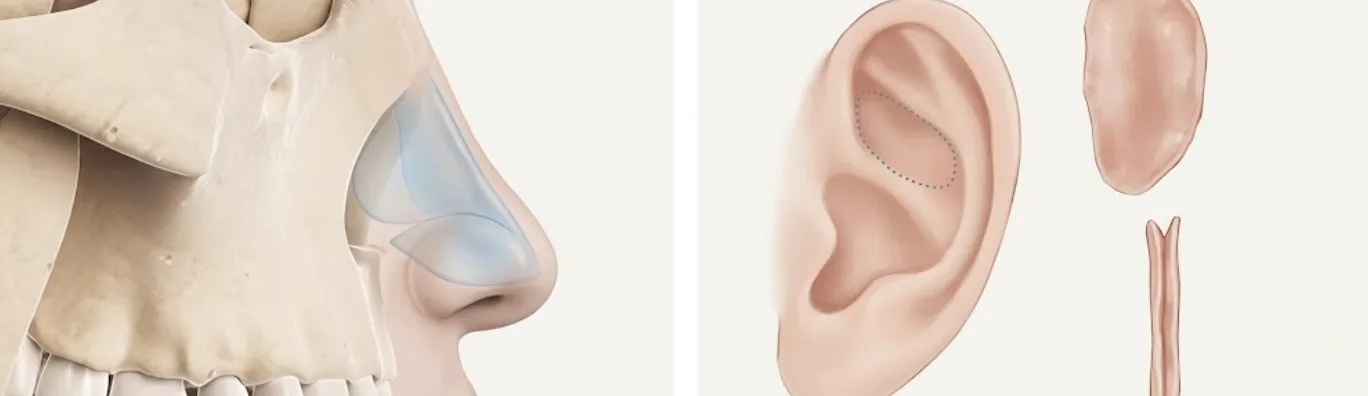
Illustration: two common sources of the patient's own cartilage: the septum inside the nose (blue) and the curved cartilage of the ear.
The tip is the area most affected by this. Tip skin is the thickest and least forgiving on the nose, so it holds swelling the longest and reveals fine detail last. Because ear cartilage is chosen precisely to refine and support the tip, the part of your result you are most curious about is also the part that takes the most time to declare itself. This is normal anatomy, and it is no complication.
It also helps to keep results separate from scarring. The redness and firmness along an incision follows its own course, covered in the page on scars and healing; here we are tracking the shape of the nose itself.
First weeks
The first weeks: a real preview of the cartilage-shaped nose
For the first week the nose is supported by a cast or splint and you should expect visible swelling and some bruising, particularly around the bridge and under the eyes. Nose sutures are usually removed around day 7, and the ear donor sutures around day 10, because the two sites heal on slightly different clocks. When the cast comes off, most patients are encouraged to see it as a starting point instead of a verdict: the nose will still be swollen and the tip will sit higher and look fuller than it eventually will.
Across the second to fourth weeks the most dramatic swelling subsides and you get your first genuine preview of the new bridge line and overall balance. This is often when patients feel reassured, because the broad shape they discussed is clearly there. It is also a normal time to feel impatient with the tip, which still looks thicker and less defined than the bridge because its swelling lags behind.
By the end of the first month many people feel comfortable in everyday social settings, even though refinement is far from finished. If you are coordinating travel, the broader recovery rhythm, including when it is reasonable to fly, is detailed in the recovery timeline guide.
1–3 months
One to three months: the shape comes into focus
Between roughly one and three months the result sharpens noticeably. The bridge looks settled, the residual puffiness over the tip continues to drop, and the projection and definition that the cartilage grafts were placed to create start to read clearly. For most patients this is the period where the nose begins to genuinely match the plan they discussed before surgery, even if a little softness remains.
Swelling in this phase is typically uneven through the day: the nose often looks slightly fuller in the morning and after lying down, then settles as you are upright. That fluctuation can be unsettling if you measure your result hour to hour, but it averages out and steadily improves. Tip numbness or a stiff, slightly firm feeling is also common here and eases as nerves and tissues recover.
By around the three-month mark the great majority of obvious swelling has resolved and friends who did not know you had surgery usually see only a natural nose. The remaining changes from this point are subtle and gradual.
Final shape
When the shape is genuinely final
The widely accepted answer is that the tip's fine detail continues to refine for up to about a year, with the final result generally settling near the 12-month mark. After three months you are seeing perhaps the great majority of your outcome; the last fraction is the deepest tip swelling resolving and the grafted cartilage and overlying skin reaching their long-term contour. This is why surgeons ask you to judge the final result at around a year.
Thicker-skinned noses tend to sit at the longer end of this range because thick skin holds residual swelling longest, while thinner skin can declare its final shape a little sooner. Either way, the structure your surgeon built is stable from the day of surgery. What changes over the months is how clearly that structure shows through the softening soft tissue; the framework itself stays put.
Because the slowest part of the result is also the part patients care about most, it is worth comparing notes with your surgeon at each follow-up before judging it yourself in the mirror. Structured reviews at 1, 3 and 6 months give a far more reliable read on whether your healing is on track than any single day's reflection.
What's normal
What is normal while you wait for the final result
A good deal of what you will notice for months is expected: mild swelling that is worse in the morning, a tip that feels firm or numb, slight asymmetry as the two sides settle at marginally different rates, and a shape that looks a touch fuller than your eventual result. None of these mean the outcome is going wrong. They are the soft tissue catching up to the structure underneath.
It is still worth contacting the clinic if you notice signs that fall outside ordinary healing: a sudden change in shape after a knock, swelling or pain that increases, warmth, spreading redness or discharge around an incision, or difficulty breathing that does not improve. These are uncommon, but early review is always better than waiting and worrying. How the recovery feels day to day, including discomfort, is covered in pain and anaesthesia.
The single most useful habit is to protect the result while it matures: follow your aftercare, avoid contact activities until cleared, keep your follow-ups, and resist comparing your week-three nose to someone else's one-year photo. The timeline is part of the procedure itself.
At Garnet
How Garnet follows your result over the year
At Garnet, a single-surgeon clinic in Apgujeong, Seoul, Dr. In-Soo Baek is a board-certified plastic surgeon (Korean medical licence no. 77407) who consults, performs the operation himself and personally reviews each follow-up. For a procedure whose result unfolds over a year, that continuity matters: the same surgeon who designed your tip judges how it is settling at structured reviews at 1, 3 and 6 months. No other doctor is left reading a chart.
Because the result is a months-long arrival, Garnet sets expectations from the first consultation: you are told what to expect at 1 week, 1 month and 3 months, and that the tip is the slowest part to finish. Garnet is registered with Korea's foreign-patient programme, so international patients can continue to share photos for assessment after they fly home, keeping the same surgeon involved across the full timeline.
If you are planning from abroad, you can send photos for a pre-assessment and discuss a realistic timeline for your specific skin and anatomy before you book. It also helps to read the scars and healing page alongside this one, since the incisions and the shape mature on separate but parallel clocks.
Real Results
Before & After
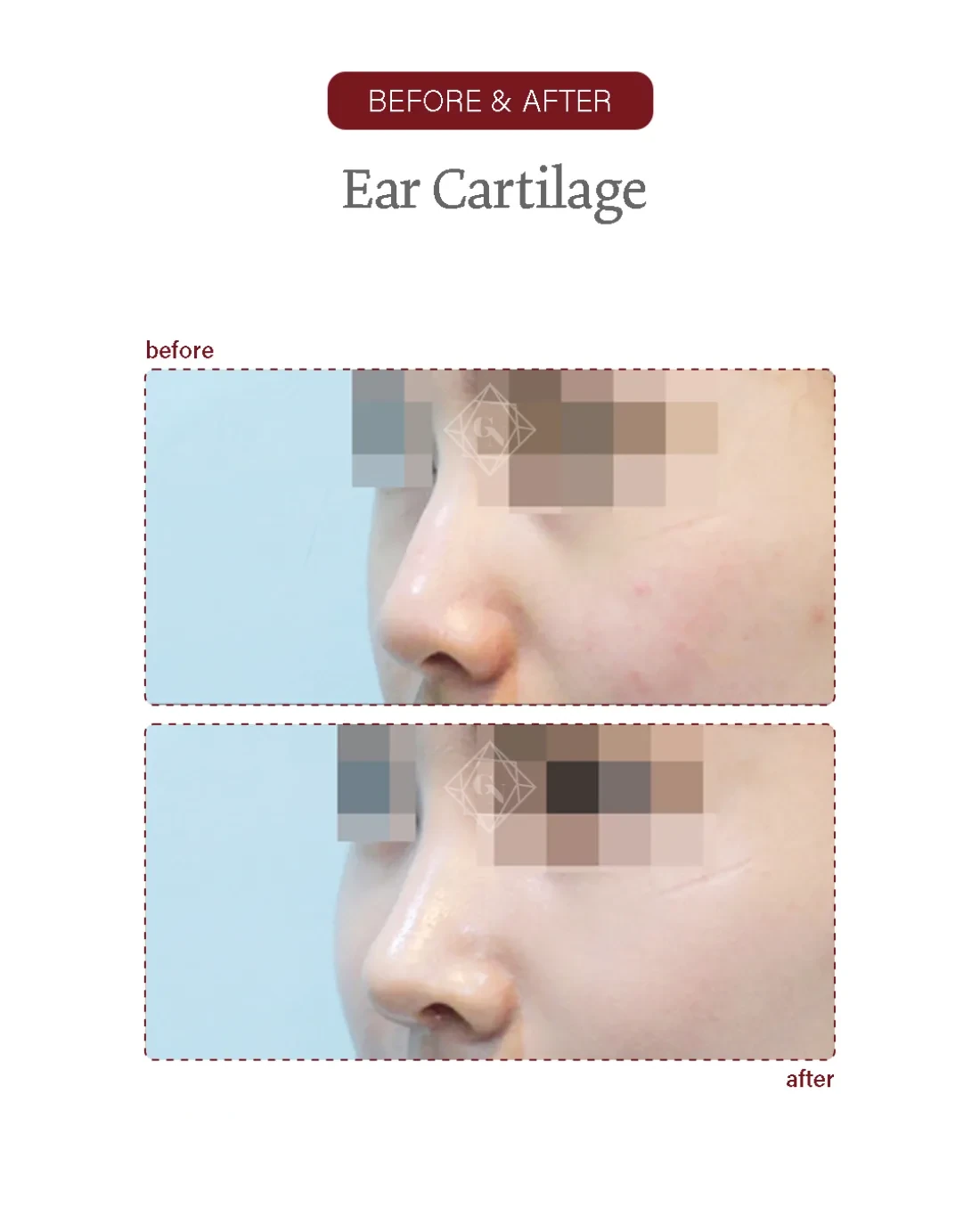
Ear-cartilage rhinoplasty result of an actual Garnet patient, Apgujeong (published with consent; same lighting and angle before and after). Results, recovery and suitability vary by individual and are not guaranteed; further sets are reviewed privately at consultation.
Dr. In-Soo Baek
Director & sole operating surgeon
Korean medical licence no. 77407
Operate on what you came for. Trained at Korea University Medical Center. Every case planned, performed and reviewed by the same hands.
1Operating surgeon
~2Surgeries per day
7Registered techniques
Board-certified plastic surgeon
Plastic surgery training at Korea University College of Medicine & graduate school
Korean Society of Plastic and Reconstructive Surgeons member, in its facial-contour, eye & rhinoplasty groups
Consults, operates and follows up each case himself
Peer-reviewed papers behind the facts on this page. Each describes findings in its own study group — not results at Garnet — and none predicts your own outcome.
Skochdopole AJ et al. Current Surgical Outcomes of Nasal Tip Grafts in Rhinoplasty: A Systematic Review. Plastic & Reconstructive Surgery. 2023. doi:10.1097/prs.0000000000010257
Eid I et al. Using Ultrasound to Evaluate Nasal Septal Cartilage. Facial Plastic Surgery & Aesthetic Medicine. 2021. doi:10.1089/fpsam.2020.0053
Brandstetter M et al. Comparative Analysis and Long-Term Results of Various Septal Extension Graft Types. Facial Plastic Surgery. 2020. doi:10.1055/s-0040-1712468
FAQ
Common questions
When will I see the final results of ear cartilage rhinoplasty?
You see a strong preview within the first few weeks once the cast is off and early swelling drops, and a close-to-final shape by around three months. The fine detail of the tip continues to refine for up to about a year, so the genuinely final result is usually judged near the twelve-month mark.
Why does the tip take the longest to settle?
The tip is the area ear cartilage is used to shape, and tip skin is the thickest on the nose, so it holds swelling longest and reveals fine detail last. The structure is set on the day of surgery, but the tip's appearance only declares itself as that thick skin calms down over months.
What will my nose look like at one month?
By the end of the first month the most dramatic swelling has gone and the new bridge line and overall balance are clearly visible, so most people feel comfortable in everyday social settings. The tip will still look slightly fuller and less defined than it eventually will, which is normal.
When is the swelling gone after ear cartilage rhinoplasty?
The obvious swelling is largely resolved by around three months, when friends typically see a natural nose. Subtle residual swelling, especially over the tip and in the mornings, can persist and gradually improves toward about twelve months.
Is it normal for my nose to look different in the morning?
Yes. For months it is common for the nose to look slightly fuller in the morning and after lying down, then settle once you are upright. This day-to-day fluctuation averages out and steadily improves; it is not a sign that the result is changing for the worse.
Does skin thickness affect how soon I see results?
Yes. Thicker-skinned noses tend to take longer because thick skin holds residual swelling longest, so the tip detail appears later. Thinner skin can show its final shape a little sooner. Your surgeon can give you a realistic estimate for your specific skin at consultation.
When can I judge whether I am happy with the result?
It is best to judge the final result at around a year, because the slowest part of the change is the tip refining over months. Comparing notes with your surgeon at the 1, 3 and 6-month follow-ups gives a far more reliable read than any single day in the mirror.
What should I report while I wait for my result?
Mild morning swelling, a firm or numb tip and slight asymmetry are all normal. Contact the clinic if you notice a sudden change in shape after a knock, increasing swelling or pain, warmth, spreading redness or discharge around an incision, or breathing that does not improve. These are uncommon but respond best to early review.
Will the same surgeon follow my result over the year?
Yes. Garnet is a single-surgeon clinic, so the board-certified surgeon who designed and performed your rhinoplasty personally reviews how it is settling at structured follow-ups at 1, 3 and 6 months. International patients can keep sharing photos for assessment after returning home.
Can I discuss my expected timeline before travelling to Korea?
Yes. You can send photos for a pre-assessment in an online consultation and discuss a realistic timeline for your specific skin and anatomy, including how soon the tip is likely to settle — before you commit to booking or travel.
My mom recently had a brow lift and lower blepharoplasty with Dr. Baek, and our experience has been wonderful so far. The Garnet team was incredibly kind and welcoming, with Kelly assisting us as our English consultant—she made everything…
I’m so happy I chose this clinic for my lower blepharoplasty. I was traveling from abroad by myself, so I was a little nervous, but from the beginning I felt comfortable and truly cared for. Everyone was kind, patient, and professional…
Came in for an in-person consult and ended up choosing Garnet and Dr.Baek for my non-incisional DES and tiplasty/alarplasty. I communicated with Kelly (English consultant) from the start till now (3 weeks post-op). She really help me feel…
My under-eyes have been sagging and folding for years... I tried to cover it up with makeup, but it actually got stuck in the wrinkles and made it stand out even more. While going for consultations, I noticed that the bigger the hospital…
Send photos and your question before you travel. An English-speaking coordinator reviews every enquiry and replies with guidance on whether surgery is appropriate, the likely plan and timing.
✓ Reviewed by the clinic coordinator, not a bot
✓ Photo-based pre-assessment before you fly
✓ Foreign-patient scheduling & after-care
✓ One surgeon for consultation, surgery and follow-up
Prefer to chat now? Reach the coordinator directly:









 T S7 months ago



