Fat grafting takes fat from the abdomen or thigh and places it in the face through tiny cannula entry points, with no long incision at either site. Many patients worry about scarring on the face and at the donor site, and these small punctures are the whole of it. This page explains exactly where those points sit, why they leave so little, and how the small wounds settle over the weeks.
The short answer
Both the donor area (abdomen or thigh) and the treated part of the face are reached through tiny cannula entry points. No long incision is made, so no scar line runs across the skin.
Fat is collected with a gentle liposuction through small punctures and injected through openings of a similar size, sometimes hidden in a crease.
The punctures tend to close fast and fade to faint marks. What you notice while healing is mostly swelling and bruising, with no long scar to mature.
Dr. Baek, who performs the graft, also sees you at 1, 3 and 6 months and looks at the entry points and donor area himself at each visit.
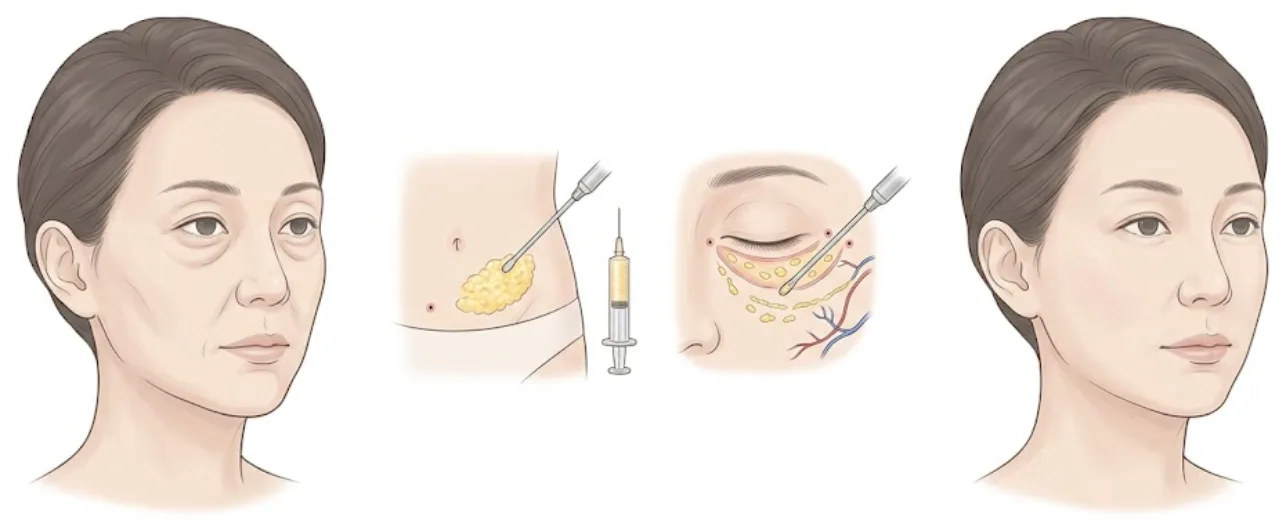
Fat grafting does not use a long incision. The surgeon works through tiny cannula entry points, punctures only wide enough for a thin cannula. You get two groups of them. One or two sit at the donor area, normally the abdomen or thigh, where a gentle liposuction collects the fat. The others sit at the recipient site on the face, where the purified fat goes in, and these are often hidden in a natural crease.
Illustration: the patient's own fat is gently taken from a donor area such as the abdomen, refined, and placed in small amounts where volume has been lost.
With every step done through these small openings and no open cut, there is no scar line to run across the skin. At Garnet the harvested fat is prepared as micro-fat and, where appropriate, supplemented with the patient's own PRP before being layered into areas such as the under-eye, the eyelid or the mid-face. The entry points needed to do this are small by design, which is why fat grafting appeals to patients whose main concern is visible scarring.
The fat grafting overview covers how the procedure is planned and performed. This page stays on the entry points and how they heal, which is what most patients ask about.
Why the marks stay minimal
Why the fat grafting marks stay minimal
Several things work in your favour. The first is size. Each cannula opening is a puncture, so the wound is tiny and has little to mark. The second is placement. On the face the openings go into creases or out-of-the-way spots; on the abdomen or thigh they go where underwear or clothing hides them. The third is the gentle technique. Fine cannulas for both harvest and injection keep each opening small, and the resulting marks are usually faint.
Lifting or repositioning tissue needs an open incision. Fat grafting only adds volume, and it does so through small ports, so there is no scar line at all. If you are comparing fat grafting with other ways of adding volume, such as filler, the trade-offs in longevity and approach are covered on the fat grafting versus filler page. When the aim is to add your own fat with very few marks, the cannula approach is the discreet one.
'Minimal' still means something. For the first weeks the abdomen or thigh can feel firm and look bruised, and the openings can stay pink for a while. On the face, the swelling from the new fat stands out far more than any puncture. Once healed, the openings usually become faint marks that few people ever spot.
How they heal over time
How the entry points heal, week by week
During the first one to two weeks the openings have closed, while the abdomen or thigh is bruised, firm and slightly swollen. The punctures look new, pink and a little raised, and the harvest site can be tender. That is ordinary healing: the bruise is your body clearing the small amount of blood any liposuction leaves. The openings are small enough that stitches rarely need removing, and dressings are light.
Across the following weeks to about three months the openings flatten and lose their pink colour. Firmness at the harvest site eases and any lumps there even out. In the same period the face reabsorbs the share of grafted fat that does not survive, so the volume keeps changing. The punctures heal and the graft settles at the same time.
At a few months to a year, most marks on the face and the abdomen or thigh are faint spots you have to look for. Dr. Baek sees you at 1, 3 and 6 months, checks the openings and harvest site himself, and adjusts his advice to how your skin is healing. The fat grafting swelling and bruising page covers that side of recovery in detail.
Caring for the area
How to help the area heal well
Good outcomes are part technique and part aftercare. Clean and dry the openings as you are shown, leave any tiny scabs alone, and keep them out of the sun once they close. Ultraviolet light can darken even a small mark, so shade and sunscreen matter in the first months. If a compression garment is recommended for the abdomen or thigh, wearing it helps the swelling there go down evenly and the punctures close neatly.
Treat the grafted part of the face gently at first. Skip firm pressure, strong massage and sleeping face-down until you are told it is safe, since new fat needs an undisturbed blood supply to take. Hold off on heavy lifting and hard exercise for the first weeks, as both can deepen bruising at the harvest site. You may get separate instructions for the face and for the abdomen or thigh, because the two heal at slightly different speeds.
Smoking and poorly controlled health conditions slow healing, so give a full medical history at consultation and the plan can allow for them. Patients who fly home can still have aftercare guided from Seoul by sending photos of the face and the harvest site at each milestone. How long the settled volume lasts has its own page: how-long-it-lasts page.
What is normal, what is not
Normal healing versus a reason to check in
Expect a bruised, firm harvest site, small pink openings that fade, mild swelling where fat was added to the face, and some unevenness that evens out as the graft settles. A tender abdomen or thigh during recovery usually means it is healing. All of this eases week by week over the first months.
Contact the clinic promptly for redness that spreads out from an opening, warmth, throbbing pain that gets worse over time, discharge or fever, a sudden pocket of blood or clear swelling on one side, or an opening that turns thick, raised and itchy after the early months. These are rare. Reporting them early makes them simpler to treat.
If you have had keloids or thick scars anywhere on your body, mention it before surgery. Skin that scars readily can react even to small punctures, and that may change where the openings go and how they are followed. You can bring it up in an online consultation from home, before any travel is booked.
Fat grafting care at Garnet
How fat grafting healing is handled at Garnet
Garnet is a single-surgeon clinic in Apgujeong, Seoul. Dr. In-Soo Baek, a board-certified plastic surgeon (Korean medical licence no. 77407), is the one surgeon who operates there. He decides where the openings go, harvests and injects the fat himself, and examines the face and the harvest site at every follow-up. At 1, 3 and 6 months, the marks and the graft are judged by the surgeon who placed each opening.
Because the clinic caps the day at two surgeries and sees one patient per hour, the work is unhurried and meticulous. In fat grafting, gentle handling of the fat and small, well-placed openings account for much of the result. Garnet is registered with Korea's foreign-patient programme, so international patients are supported through scheduling, recovery and the remote follow-ups that let both areas be reviewed after you return home.
If scarring is what holds you back, start with a pre-assessment. In an online consultation you can send photos and ask where the openings would go on your face and abdomen or thigh, and how they usually heal, before you plan a trip.
Dr. In-Soo Baek
Director & sole operating surgeon
Korean medical licence no. 77407
Operate on what you came for. Trained at Korea University Medical Center. Every case planned, performed and reviewed by the same hands.
1Operating surgeon
~2Surgeries per day
7Registered techniques
Board-certified plastic surgeon
Plastic surgery training at Korea University College of Medicine & graduate school
Korean Society of Plastic and Reconstructive Surgeons member, in its facial-contour, eye & rhinoplasty groups
Consults, operates and follows up each case himself
Peer-reviewed papers behind the facts on this page. Each describes findings in its own study group — not results at Garnet — and none predicts your own outcome.
Strong AL et al. Technical Precision with Autologous Fat Grafting for Facial Rejuvenation: A Review of the Evolving Science. Plastic & Reconstructive Surgery. 2023. doi:10.1097/prs.0000000000010643
Marten T et al. Periorbital Fat Grafting. Facial Plastic Surgery Clinics of North America. 2021. doi:10.1016/j.fsc.2021.02.003
Chen HH et al. Lipotransfer in the upper third of the face. Current Opinion in Otolaryngology & Head and Neck Surgery. 2011. doi:10.1097/moo.0b013e32834896a0
FAQ
Common questions
Where are the scars after fat grafting?
There is no long incision. Fat grafting uses tiny cannula entry points: small punctures at the donor area, usually the abdomen or thigh, and at the recipient site on the face, often tucked into a crease. No scar line runs across the skin.
Will fat grafting leave visible marks?
Only faint ones, if any. Each opening is a small puncture placed in a crease or a covered area. Early on the harvest site may be bruised and the points pink; both usually fade to marks few people notice.
Does fat grafting scar the donor area too?
Only small marks. One or two small punctures on the abdomen or thigh, in a spot clothing covers, are enough for the gentle liposuction harvest. They heal to faint spots with no scar line, and early firmness there eases over the weeks.
Why does fat grafting leave so little scarring?
It adds volume through small cannula entry points and needs no open incision. The openings are small by design, placed in creases or covered areas, and made with fine cannulas, so the marks are usually faint and fade over the months.
Do the entry points need stitches removed?
Usually little or none. The openings need only a light dressing and often no stitch removal, so the punctures add almost no downtime. Recovery is mostly about swelling and bruising going down.
How long do the marks take to fade?
Over about three months the openings flatten and their pink colour fades. By a few months to a year they are faint spots that take effort to find, and firmness at the abdomen or thigh softens over the same period.
How can I help the area heal well?
Keep the openings clean and dry, leave scabs alone, shield them from sun once closed, and wear a compression garment on the harvest site if one is recommended. Handle the grafted face gently at first, and skip heavy lifting and hard exercise for the first weeks.
What is not normal during healing?
Call the clinic promptly about redness spreading from an opening, warmth, throbbing pain that keeps worsening, discharge or fever, a sudden pocket of blood or marked swelling on one side, or an opening that becomes thick, raised and itchy after the early months. They are rare, and early reporting makes them easier to deal with.
I scar easily — can I still have fat grafting?
Mention any history of keloid or thick scars when you consult. It does not automatically rule you out. Skin that scars readily can react even to small punctures, which may change where the openings go and how they are followed. You can bring this up from home before travelling.
Can my recovery be reviewed after I fly home?
Yes. After you fly home, send photos of the face and the abdomen or thigh at each milestone. Dr. Baek, who did the graft, reviews them and guides your aftercare remotely, with support through Korea's foreign-patient programme.
My mom recently had a brow lift and lower blepharoplasty with Dr. Baek, and our experience has been wonderful so far. The Garnet team was incredibly kind and welcoming, with Kelly assisting us as our English consultant—she made everything…
I’m so happy I chose this clinic for my lower blepharoplasty. I was traveling from abroad by myself, so I was a little nervous, but from the beginning I felt comfortable and truly cared for. Everyone was kind, patient, and professional…
Came in for an in-person consult and ended up choosing Garnet and Dr.Baek for my non-incisional DES and tiplasty/alarplasty. I communicated with Kelly (English consultant) from the start till now (3 weeks post-op). She really help me feel…
My under-eyes have been sagging and folding for years... I tried to cover it up with makeup, but it actually got stuck in the wrinkles and made it stand out even more. While going for consultations, I noticed that the bigger the hospital…
If marks or scarring worry you, send photos for a no-obligation pre-assessment. We'll explain where the entry points would sit and how they heal before you plan a trip.
Send photos and your question before you travel. An English-speaking coordinator reviews every enquiry and replies with guidance on whether fat grafting is appropriate for you, the likely plan and timing.
✓ Reviewed by the clinic coordinator, not a bot
✓ Photo-based pre-assessment before you fly
✓ Foreign-patient scheduling & after-care
✓ One surgeon for consultation, surgery and follow-up
Prefer to chat now? Reach the coordinator directly:









 T S7 months ago



