Facial fat grafting involves two areas, so the swelling and bruising happen in two places: the donor site, where fat is gently harvested through a cannula from the abdomen or thigh, and the recipient areas on the face, where the purified fat is placed in fine layers. Dr. Baek overfills the under-eye or cheek slightly on purpose, so early extra fullness is planned. Both sites swell most in the first days and calm down over the next weeks, and a few simple habits help them along. Below you will find the weekly course for the face and the abdomen or thigh, plus the warning signs that need a prompt call.
The short answer
Expect puffiness where the PRP-supplemented fat went in on the face, and bruising plus firmness on the abdomen or thigh where the cannula collected it.
Because part of the transferred fat does not stay, Dr. Baek places slightly more than the target, so a fuller-than-intended look in the early weeks is planned.
Puffiness in the under-eye, eyelid or cheek is greatest in the first few days and drops a lot by weeks 2 to 3; the harvest site takes about as long, sometimes a little longer.
Sleeping propped up, a light touch on the face, rest, less salt, and no alcohol, blood thinners or hard exercise all help, and progress is checked at 1, 3 and 6 months.
Why both the face and the donor area swell after fat grafting
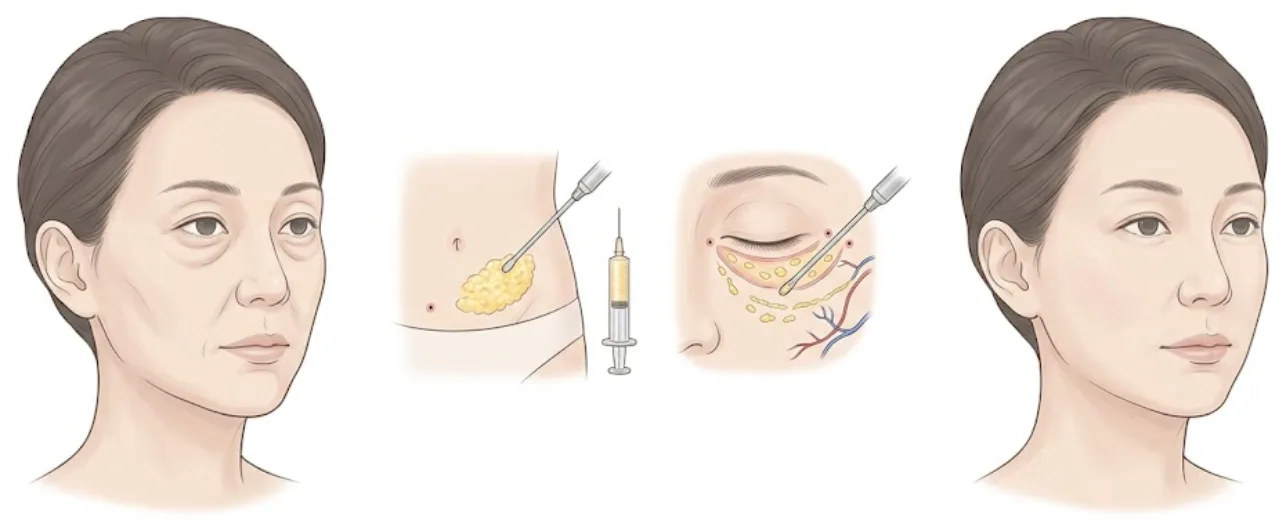
Fat grafting at Garnet is two gentle procedures in one. Fat is first collected with a fine cannula, usually from the abdomen or thigh, through tiny openings that leave no true scar line. After purification it is mixed with PRP and injected in thin layers wherever the face needs volume: the under-eye, the eyelid area or the mid-cheek. The harvest site and the face are each injured a little, so each swells, and they heal on separate schedules.
Illustration: the patient's own fat is gently taken from a donor area such as the abdomen, refined, and placed in small amounts where volume has been lost.
The face is deliberately given a little more fat than the end goal, since some of it will not survive long-term. Early over-fullness therefore reflects the plan and does not mean too much was injected. Ordinary post-procedure swelling then adds to that extra volume, which is why the under-eye or cheek can look clearly puffy for the first days. On the abdomen or thigh there is no wound to stitch; the cannula leaves firmness, tenderness and bruising.
Knowing this takes much of the worry out of the early weeks. In the first days your face shows planned fullness plus swelling, and fat grafting is judged over months as the volume settles. The recovery timeline covers the whole course, and when you will see results covers the long view.
Timeline
Fat grafting swelling, week by week
Days 1–5: puffiness in the under-eye, eyelid or cheek rises to its highest point within the first few days, stacked on the planned overfill. The injected areas feel full and firm, and any bruises show up and darken. The abdomen or thigh is sore, firm and bruised. Be strict now about sleeping propped up, resting and keeping your hands off the face. Looking full and puffy at this point is expected, and the settled result is still weeks away.
Week 1–2: the facial puffiness starts to drop steadily, and bruises on both the face and the harvest site turn from dark to green-yellow. The tiny entry points on the face have usually closed; the abdomen or thigh may still feel firm and sore. At the end of week 2 the face is far less puffy than at its peak, yet the grafted spots still carry more volume than they will once the fat finishes settling.
Weeks 3–6 and beyond: the puffiness that other people would notice keeps fading from the face, and somewhere between weeks 3 and 6 most patients feel at ease socially, with a little planned extra fullness still present. Firmness or small lumps at the harvest site soften slowly over the following weeks. Final volume is judged over months. It is also normal for the left and right sides to go down at slightly different speeds before they match.
Bruising
Fat grafting bruises on the face and the harvest site
You can expect bruises in two places. On the face, they form around the under-eye, eyelid or cheek where fat was injected, and gravity can draw them slightly lower over the first days. On the donor area (abdomen or thigh), bruising and firmness often cover a wider patch than people expect, because fat is collected across a broad zone. Neither pattern signals a problem.
The colour moves from deep red-purple to blue, then green and yellow, before it disappears. Bruises on the face usually clear in 2 to 3 weeks, and those on the abdomen or thigh, along with the firmness there, take about as long or a little longer. Sleeping propped up and a light touch on the face in the first days both help, and once the facial marks are faint, makeup can usually hide the rest when Dr. Baek says it is fine.
Some ordinary things deepen bruising: blood thinners and supplements such as fish oil, high-dose vitamin E, ginkgo and some anti-inflammatories, drinking around the operation, and raised blood pressure or straining. Listing every medicine and supplement beforehand and following the pre-procedure instructions is the easiest way to limit it. Comfort during recovery is covered in pain and anaesthesia, and healing of the tiny entry points in scars and healing.
Reduce it
Helping fat grafting swelling and bruising settle sooner
What helps is simple, and it works best when you do it every day. Keep your head elevated, sleeping propped up for the first 1 to 2 weeks, so fluid drains away from the under-eye and cheeks. Facial puffiness is nearly always worst on waking, and elevation reduces that. Handle the grafted areas gently: no firm pressure, massage or heat on the face unless Dr. Baek asks for it, since newly injected fat has to be left alone to take. If cooling is suggested, keep it gentle and never put ice straight on the skin.
Rest and pace yourself. For 2 to 3 weeks, skip hard exercise, heavy lifting, bending over and anything else that pushes up blood pressure; each of these adds to swelling and can deepen bruising or, rarely, cause bleeding at the face or the harvest site. Keep your blood pressure steady by planning quiet first days. Skip alcohol and smoking. Smoking in particular slows healing and makes it harder for the grafted fat to take. Drink plenty of water and go easy on salt to limit fluid build-up.
On top of this, follow Dr. Baek's own instructions on caring for the abdomen or thigh, whether a garment or support is useful, when gentle movement is fine, and when light activity and then exercise can return. Each step is small, but together they shorten recovery, which is useful for international patients working within a fixed trip. See also recovering in Seoul after surgery.
What's normal
Normal fat grafting recovery versus an urgent call
These are expected: puffiness in the face that is greatest in the first few days and fades over the next weeks; under-eye or cheek volume that looks fuller than your goal on purpose and settles over weeks to months; facial bruises, plus firmness, soreness and bruising on the abdomen or thigh, clearing in 2 to 3 weeks or slightly longer; and small early differences between left and right. None of it needs treatment. It is how fat grafting normally heals.
Call urgently if recovery departs sharply from that pattern: swelling that grows fast and turns tense on one side of the face or at the harvest site, above all when it is firm and painful; strong or rising pain that your prescribed medicine does not ease; a sudden colour change in the skin over a grafted spot; fever, or spreading redness, warmth or discharge at an entry point, which can mean infection; or any new change in vision after under-eye grafting. Marked swelling or pain on one side in the first 1 to 2 days is the typical reason to phone the clinic at once.
The most useful safety net is direct access to Dr. Baek, who did your graft. You can send a photo of your face or harvest site and hear from him whether it is on track or whether you should come in, so you are not left guessing, even after you have flown home.
At Garnet
Fat grafting after-care at Garnet
Garnet is a single-surgeon clinic in Apgujeong, Seoul. Dr. In-Soo Baek, a board-certified plastic surgeon (Korean medical licence no. 77407), is its only operating doctor. He collects the fat, injects the PRP-supplemented graft and checks your recovery himself, so the swelling is judged by the person who did the work. With a light daily schedule, he has time to explain after-care for both the face and the harvest site.
The after-care plan is the list above (elevation, a light touch on the face, care of the abdomen or thigh, rest, blood-pressure care and things to avoid), and the planned early overfill is explained beforehand so it does not cause alarm. Reviews at 1, 3 and 6 months match the months grafted fat takes to settle. For international patients most of these happen by messenger: you send a photo, and Dr. Baek tells you whether things look on course or need attention.
Still deciding? Begin with a no-obligation online assessment. From clear photos, the surgeon can tell you how much swelling and bruising to expect on your face and harvest site, and how long to stay in Seoul.
Dr. In-Soo Baek
Director & sole operating surgeon
Korean medical licence no. 77407
Operate on what you came for. Trained at Korea University Medical Center. Every case planned, performed and reviewed by the same hands.
1Operating surgeon
~2Surgeries per day
7Registered techniques
Board-certified plastic surgeon
Plastic surgery training at Korea University College of Medicine & graduate school
Korean Society of Plastic and Reconstructive Surgeons member, in its facial-contour, eye & rhinoplasty groups
Consults, operates and follows up each case himself
Peer-reviewed papers behind the facts on this page. Each describes findings in its own study group — not results at Garnet — and none predicts your own outcome.
Fiedler LS et al. Autologous fat grafting in the face and neck: Multinational trends and knowledge of the safety, applications, and indications considering oncologic risk potential. Laryngoscope Investigative Otolaryngology. 2021. doi:10.1002/lio2.649
Yang Z et al. Fat Grafting for Facial Rejuvenation in Asians. Clinics in Plastic Surgery. 2020. doi:10.1016/j.cps.2019.08.003
Lin TM et al. Fat Grafting for Facial Contouring (Nose and Chin). Clinics in Plastic Surgery. 2020. doi:10.1016/j.cps.2019.08.009
FAQ
Common questions
How long does swelling last after fat grafting?
Puffiness in the grafted under-eye, eyelid or cheek is greatest in the first few days and then falls steadily; most of what others would notice is gone in 2 to 3 weeks. Some planned extra volume stays while the graft settles and softens over the next weeks to months. Firmness and bruising on the abdomen or thigh take about as long, or a bit longer.
Why are my abdomen or thigh sore as well as my face?
The fat is collected with a cannula from the abdomen or thigh, then injected into the face, so two sites are treated. Each one swells and bruises and heals at its own speed. Soreness and firmness at the harvest site while the face is puffy is the usual pattern.
Why does my face look too full after fat grafting?
Dr. Baek injects slightly more fat than the end goal, because part of it will not survive long-term. An over-full under-eye or cheek in the early weeks is therefore intended. The extra volume and the normal swelling both go down over the next weeks to months.
How long does bruising last after fat grafting?
Expect bruises around the injected spots on the face and over the abdomen or thigh. They turn from dark to green-yellow as they fade. On the face they usually clear in 2 to 3 weeks; at the harvest site, bruising and firmness take about as long or slightly longer. Once Dr. Baek gives the go-ahead, makeup can usually cover what is left on the face.
How can I reduce swelling and bruising after fat grafting?
Sleep propped up for 1 to 2 weeks, keep pressure, massage and heat off the grafted face unless Dr. Baek advises otherwise, and avoid hard exercise and straining for 2 to 3 weeks. Plan quiet days so your blood pressure stays steady, skip alcohol and smoking, drink water and eat less salt. Telling the clinic about all your medicines in advance also limits bruising.
Is swelling after fat grafting normal?
Yes. Puffiness that is highest in the first days on top of the planned overfill, with firmness and bruises on the abdomen or thigh, is the usual course. Call promptly for swelling or pain on one side that rises fast and feels tense, for severe pain, or for fever or spreading redness at an entry point.
When should I urgently contact the clinic?
Phone at once for fast-growing, tense swelling on one side of the face or at the harvest site (especially when firm and painful), strong or rising pain your medicine does not ease, a sudden skin colour change over a grafted spot, fever, spreading redness, warmth or discharge at an entry point, or any new vision change after under-eye grafting. One-sided swelling in the first 1 to 2 days is the most common reason for an urgent check.
Should I massage the grafted areas to reduce swelling?
Only if Dr. Baek tells you to. Newly injected fat has to be left alone to take, and in the early weeks pressing, massaging or heating the under-eye or cheek can harm the graft. Ask him which kind of touch, if any, is allowed and from when.
When is it safe to fly home after fat grafting?
Because fat grafting has less prolonged wound care than a larger open surgery, the main considerations are letting early swelling settle and any access points heal. Dr. Baek sets the flight date from how you are healing. Trip length is covered in how long to stay in Korea and the flying question in when you can fly after surgery. Stay hydrated and avoid alcohol on the flight.
How does Garnet check my swelling is settling normally?
Dr. Baek, who did your graft, reviews you at 1, 3 and 6 months, the period over which grafted volume settles. Patients abroad mostly do this by messenger: send a photo of the face and harvest site, and he tells you whether the swelling and bruising look right or asks you to come in.
My mom recently had a brow lift and lower blepharoplasty with Dr. Baek, and our experience has been wonderful so far. The Garnet team was incredibly kind and welcoming, with Kelly assisting us as our English consultant—she made everything…
I’m so happy I chose this clinic for my lower blepharoplasty. I was traveling from abroad by myself, so I was a little nervous, but from the beginning I felt comfortable and truly cared for. Everyone was kind, patient, and professional…
Came in for an in-person consult and ended up choosing Garnet and Dr.Baek for my non-incisional DES and tiplasty/alarplasty. I communicated with Kelly (English consultant) from the start till now (3 weeks post-op). She really help me feel…
My under-eyes have been sagging and folding for years... I tried to cover it up with makeup, but it actually got stuck in the wrinkles and made it stand out even more. While going for consultations, I noticed that the bigger the hospital…
Wondering how much swelling and bruising to expect on your face and at the harvest site? Send clear photos for a no-obligation pre-assessment before you plan a trip.
Send photos and your question before you travel. An English-speaking coordinator reviews every enquiry and replies with guidance on whether surgery is appropriate, the likely plan and timing.
✓ Reviewed by the clinic coordinator, not a bot
✓ Photo-based pre-assessment before you fly
✓ Foreign-patient scheduling & after-care
✓ One surgeon for consultation, surgery and follow-up
Prefer to chat now? Reach the coordinator directly:









 T S7 months ago



