After implant-free rhinoplasty, with a bridge of ear cartilage and a tip of septal cartilage, the whole nose settles gently and together over 6 to 12 months. Patients often ask when it will look finished. The profile change shows early but reads softer than an implant bridge, the tip refines slowly, and the truly final shape emerges as the grafted cartilage settles.
The short answer
Implant-free rhinoplasty at Garnet builds the bridge from ear cartilage and the tip from septal cartilage, so the whole nose is your own tissue with no silicone implant.
Because there is no rigid implant, the bridge does not snap 'set' on day one the way an implant bridge does. It settles gently along with the tip over the months.
Most visible swelling eases over the first weeks; tip and bridge definition keep emerging for roughly six to twelve months as the grafted cartilage settles.
There is a second recovery to watch: the ear where the dorsal cartilage was taken, with its own sutures out at about 10 days.
What implant-free rhinoplasty changes, and when you see it
To read the timeline it helps to know what this operation uses. At Garnet an implant-free rhinoplasty builds the bridge from the patient's own ear (conchal) cartilage and refines the tip with septal cartilage. No silicone implant is used anywhere. Everything holding the new shape is your own living tissue. The full technique is set out in the implant-free rhinoplasty overview; this page focuses only on when you actually see the result.
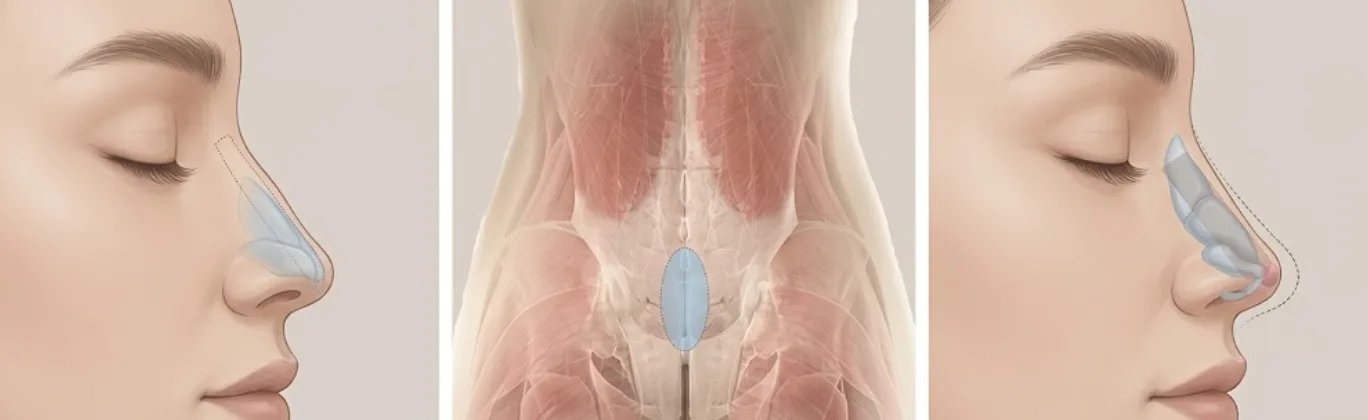
Illustration: instead of an implant, the bridge and tip are built from the patient's own tissue, shaped into the nasal framework (blue). The dashed line shows the original contour.
That all-cartilage construction shapes the whole timeline. With a firm silicone implant, the bridge reads 'set' the moment the splint comes off. With your own cartilage there is no rigid scaffold, so the bridge behaves more like the tip. It looks changed early but softer, and it settles gradually into its line. For this nose, 'result' is a gentle curve that the bridge and tip travel together.
The pattern on this page is simple: the nose looks changed within the first week or two, then keeps refining for the better part of a year. Swelling hides the detail of the new ear-cartilage bridge and septal tip, but the shape is already there underneath, and it shows itself as the tissues calm and the grafts settle.
The first days and weeks
What you see in the first days and weeks
A splint protects the new cartilage framework after surgery, and at Garnet the dressing is checked on day 1 and day 3. The splint usually comes off around the end of the first week, when the nose sutures are removed at about seven days, and most patients then see a changed, more defined side view. The nose is still swollen and stiff at that point, the septal-cartilage tip looks rounded, and numbness is common. Your surgeon sets the exact day the splint and sutures come out.
In weeks one and two the swelling and any bruising under the eyes reach their peak, then start to fade. The ear-cartilage bridge reads soft at this stage, without the instant firmness of an implant, because the graft is still settling. A slightly fuller, higher or wider look than the final nose is expected now. The early swelling exaggerates the work before it has had time to relax.
Once the first few weeks have passed, much of the surface puffiness over the bridge and tip has gone, and the nose begins to look like itself in photos and in the mirror. This tracks closely with the wider implant-free rhinoplasty recovery timeline, which covers activity, dressings and what is normal at each stage. Recovery and results move together. If you are still puffy around the eyes, that is the soft-tissue side of the same process.
How an all-cartilage nose settles
How an all-cartilage nose settles over the months
Over months one to three, deeper swelling keeps draining and the nose slims. The bridge and tip both lose their rounded, puffy look and start to show definition, and because both are cartilage they settle in step; the bridge does not race ahead. Somewhere in this window many patients feel their all-cartilage nose has become a recognisable, natural shape, though it is still not final.
By three to six months the ear-cartilage bridge and septal tip are usually most of the way there. Swelling too slight to notice from day to day is still leaving, so the bridge line and tip sharpen a little more. The last refinement, deep tip swelling and the final settling of the grafts, can take up to about twelve months. That is why surgeons describe a rhinoplasty result in terms of a year.
Dr. Baek reviews your cartilage nose himself at 1, 3 and 6 months, comparing each stage with your own pre-surgery photos, so progress is judged on your nose and your healing. If a small refinement is ever considered later, that is a separate conversation covered on the revision and correction page, and it is one only sensibly had once the nose has fully settled.
The ear donor site
The ear where the bridge cartilage came from
Because the bridge is built from ear cartilage, there is a second, smaller recovery running alongside the nose. The cartilage is taken from the bowl of the ear through a hidden incision, and at Garnet the ear sutures come out at about ten days, a few days later than the nose sutures at seven. The ear can feel tender, firm or a little numb for the first weeks, which is normal.
This donor recovery does not change how the nose settles, but it is part of your overall timeline, so it is worth knowing about. The ear incision typically fades to a quiet line tucked in the natural fold, and the firmness eases over the following weeks. The scars and healing page covers where both the nose and ear incisions sit and how they settle.
None of this changes the destination for the nose. It simply means there are two areas healing on slightly different clocks. If you are weighing the trade-offs of using your own cartilage against a bridge built with an implant, that comparison is set out on the implant-free vs implant rhinoplasty page.
When it is the final result
When can you call it the final result?
As a guide for an ear-and-septal-cartilage nose: a clearly changed profile in week one once the splint is off, an everyday nose you recognise by about three months, and the settled shape by roughly six to twelve months, with the tip refining last. Follow-up photos matter here, because the eye gets used to slow change and it is easy to forget the starting point.
Your own pace depends on how much swelling your nose holds and how fast it clears, how thick your skin is, whether this was a first or a more complex operation, and how carefully you protect the grafts from pressure and knocks. With an all-cartilage nose the whole shape settles gently and together, so patience over the first months is especially worthwhile.
Your own expectations are best set by a pre-assessment of your nose, your skin and your cartilage plan. You can send photos and ask what is realistic for your skin and timeline in an international-patient consultation before you decide to travel.
Follow-up at Garnet
How Garnet tracks your result
Garnet is a single-surgeon clinic in Apgujeong, Seoul. Dr. In-Soo Baek is a board-certified plastic surgeon (Korean medical licence no. 77407) and the only operating surgeon. He consults, performs the surgery himself and reviews every follow-up. For a results question that unfolds over a year, that continuity is the point: the surgeon who built your bridge and tip from your own cartilage is the same one assessing how it settles at 1, 3 and 6 months.
Because the clinic caps the day at two surgeries, your follow-up is unhurried, and there is no push toward more procedures. Garnet is registered with Korea's foreign-patient programme, so international patients can have these milestone reviews done remotely with photos after returning home. That helps because an all-cartilage nose keeps settling long after you fly back.
Thinking about travelling for an implant-free nose? Begin with a no-obligation read on your own bridge, tip and cartilage. You can do that in an international-patient consultation before planning anything.
Dr. In-Soo Baek
Director & sole operating surgeon
Korean medical licence no. 77407
Operate on what you came for. Trained at Korea University Medical Center. Every case planned, performed and reviewed by the same hands.
1Operating surgeon
~2Surgeries per day
7Registered techniques
Board-certified plastic surgeon
Plastic surgery training at Korea University College of Medicine & graduate school
Korean Society of Plastic and Reconstructive Surgeons member, in its facial-contour, eye & rhinoplasty groups
Consults, operates and follows up each case himself
Peer-reviewed papers behind the facts on this page. Each describes findings in its own study group — not results at Garnet — and none predicts your own outcome.
Xiang X et al. The Treatment of Alar Base Depression in Rhinoplasty with Diced Autologous Cartilage or Mass Cartilage: A Systematic Review. Aesthetic Plastic Surgery. 2024. doi:10.1007/s00266-024-04008-y
Liyanage D et al. A Systematic Review and Meta-Analysis of Autologous vs Irradiated Homologous Costal Cartilage Grafts for Dorsal Augmentation Rhinoplasty. Aesthetic Surgery Journal Open Forum. 2024. doi:10.1093/asjof/ojae122
Chen H et al. Complications Associated with Autologous Costal Cartilage Used in Rhinoplasty: An Updated Meta-Analysis. Aesthetic Plastic Surgery. 2022. doi:10.1007/s00266-022-03075-3
FAQ
Common questions
When will I see the final results of implant-free rhinoplasty?
The new profile is visible as soon as the splint comes off in the first week, a believable everyday nose appears by about three months, and the settled, final shape emerges over roughly six to twelve months as the grafted cartilage settles and deep swelling clears. An all-cartilage nose settles gently and together, with no single moment when it snaps into place.
What do I see right after implant-free rhinoplasty?
Once the splint is removed, the side profile is already changed, but because the bridge is your own ear cartilage it reads soft at first, without the instant set of an implant. The nose is swollen and stiff, the tip looks rounded, and it is normal for the whole nose to look a little fuller and higher than it ultimately will.
How long until implant-free rhinoplasty looks natural?
Most patients feel the nose looks like a natural, recognisable version of itself between one and three months, once the bulk of the swelling has drained. The very final, most refined look, especially at the tip, keeps developing toward six to twelve months as the cartilage settles.
Does an all-cartilage bridge settle differently from an implant?
Yes. A firm silicone implant reads 'set' the moment the splint comes off, while a bridge built from your own ear cartilage has no rigid scaffold, so it settles more gently and gradually along with the tip over the months. The end shape is stable; it simply arrives at a softer pace.
When does implant-free rhinoplasty swelling go down?
Surface swelling over the bridge and tip mostly fades in the first few weeks, and the nose slims noticeably between months one and three. Deep swelling, mainly in the septal-cartilage tip, can keep clearing for up to about twelve months, so the shape goes on refining through the year.
When do the ear sutures come out?
Because the bridge cartilage is taken from the ear, there is a small ear donor recovery too. At Garnet the ear sutures come out at about ten days, a few days after the nose sutures at seven. The ear can feel tender or firm for the first weeks, which is normal.
Will the ear affect how my nose settles?
No. The ear donor site heals on its own clock and does not change how the nose settles. It simply means two areas are healing at once. The ear incision usually fades to a quiet line in the natural fold, and the firmness eases over the following weeks.
What affects how fast I see implant-free rhinoplasty results?
Your swelling and how fast it clears, the thickness of your nasal skin, whether it was a first or more complex operation, and how well you keep pressure off the cartilage grafts. These factors mostly change the speed, and much less the end shape.
How long should I wait before judging my result?
Try not to judge the bridge and tip during the swollen first weeks. By about three months a fair view is possible, and the settled result comes at six to twelve months. Comparing follow-up photos with your pre-surgery pictures shows the slow change best.
Will Dr. Baek keep reviewing my all-cartilage nose after I fly home?
At Garnet, yes. The same board-certified surgeon who performed your rhinoplasty reviews your result at 1, 3 and 6 months, and as an international patient you can send photos at each milestone so the bridge and tip are assessed remotely through Korea's foreign-patient programme support.
My mom recently had a brow lift and lower blepharoplasty with Dr. Baek, and our experience has been wonderful so far. The Garnet team was incredibly kind and welcoming, with Kelly assisting us as our English consultant—she made everything…
I’m so happy I chose this clinic for my lower blepharoplasty. I was traveling from abroad by myself, so I was a little nervous, but from the beginning I felt comfortable and truly cared for. Everyone was kind, patient, and professional…
Came in for an in-person consult and ended up choosing Garnet and Dr.Baek for my non-incisional DES and tiplasty/alarplasty. I communicated with Kelly (English consultant) from the start till now (3 weeks post-op). She really help me feel…
My under-eyes have been sagging and folding for years... I tried to cover it up with makeup, but it actually got stuck in the wrinkles and made it stand out even more. While going for consultations, I noticed that the bigger the hospital…
Send photos and your question before you travel. An English-speaking coordinator reviews every enquiry and replies with guidance on whether surgery is appropriate, the likely plan and timing.
✓ Reviewed by the clinic coordinator, not a bot
✓ Photo-based pre-assessment before you fly
✓ Foreign-patient scheduling & after-care
✓ One surgeon for consultation, surgery and follow-up
Prefer to chat now? Reach the coordinator directly:









 T S7 months ago



