Lateral canthoplasty opens the outer corner of the eye, and much of its work is done through the conjunctiva, the lining inside the lid, with little cutting of the outer skin. That gives it a distinctive recovery: external bruising is often light, but the white of the eye can look pink or bloodshot for a while, and the outer corner stays a little swollen and tight as it settles. This guide maps that timeline for a standard lateral canthoplasty and flags the signs worth an urgent call.
The short answer
Lateral canthoplasty opens the outer corner, often with an accompanying lower-corner opening. Much of it is done through a conjunctival (inside-the-lid) incision, so external swelling is contained and skin bruising is often light.
The white of the eye can look pink or bloodshot from small surface vessels, and the outer corner feels tight and a little swollen; fine sutures come out at around day 7.
Most external puffiness and any light bruising settle over the first one to two weeks, while the outer-corner shape and any eye redness keep refining over roughly one to three months.
Head elevation, gentle cooling early, rest, leaving the eye alone and avoiding rubbing, alcohol and blood thinners all bring swelling down faster, and the surgeon reviews progress at 1, 3 and 6 months.
Why the outer corner swells after lateral canthoplasty
A lateral canthoplasty opens the outer corner of the eye to lengthen it horizontally, and at Garnet it is done with an accompanying lower-corner opening so the eye lengthens without looking narrowed. A key part of the technique is that much of the work reaches the corner through a conjunctival incision in the lining on the inside of the lid. There is no long cut across the outer skin. That inside approach is why the swelling and any bruising behave differently from surgery done entirely from the outside.
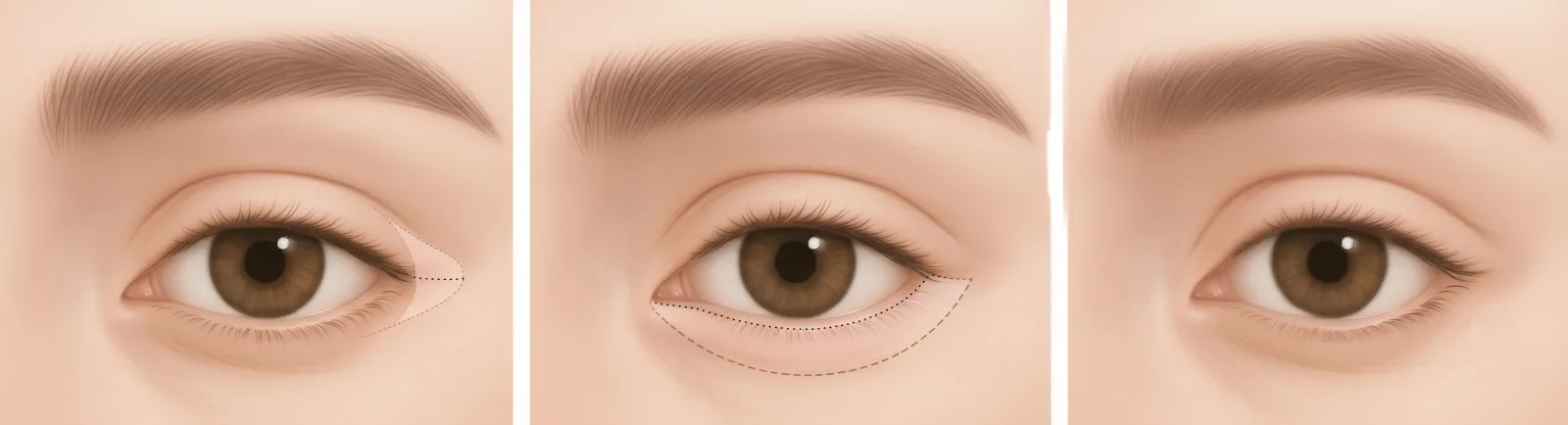
Illustration: the outer corner is extended and the lower-lid line gently lowered along the dotted lines, softening the angle of the eye.
Because the tissue at the outer corner and lower lid is handled directly, it responds with local swelling and tightness right at the corner, and small surface vessels on the white of the eye can leak a little, leaving the sclera looking pink or bloodshot. This redness of the eye white looks alarming but is a normal, surface-level bruise of the conjunctiva that clears on its own. The two eyes can swell and redden slightly unevenly, which is expected and does not predict an asymmetric result.
Understanding this makes the early weeks far less alarming. A tight, slightly swollen corner and a pink eye white are the tissue settling. The refined outer-corner look is therefore judged over weeks to months. We map the full arc in the recovery timeline and cover how the incision heals in scars and healing.
Timeline
Day-by-day: how long does lateral canthoplasty swelling last?
Days 1–7: the outer corner is tightest and most swollen in the first few days, and any redness of the eye white is often most noticeable early on. Fine sutures hold the corner, and mild stinging, watering or a gritty feeling in the eye is normal. This is the window to be strict about head elevation, gentle cooling and rest, and to keep your hands away from the corner. The sutures come out at around day 7, and the corner usually looks a little less bulky within a day or two afterwards.
Weeks 1–3: after the sutures are removed the external puffiness eases and the outer corner starts to look more like its intended shape, though it stays a little tight and firm. Any light skin bruising fades over the first couple of weeks, so most people feel comfortable in everyday settings within one to two weeks. The redness of the eye white typically takes a bit longer than the skin to clear, often into the second or third week, which is normal for a conjunctival bruise.
Months 1–3: the residual tightness at the corner and any remaining eye-white pinkness fade gradually. Much of the visible settling happens over the first month, and the fine outer-corner detail (how open and natural it looks) keeps refining through roughly one to three months as the tissue relaxes and the small incision matures. It is normal for the corner to feel slightly firmer than the surrounding skin for a while as it settles.
Bruising
Bruising, and why the eye white looks red
Bruising after lateral canthoplasty splits into two kinds. External skin bruising is often light, because much of the surgery is done through the conjunctiva on the inside of the lid, with no broad outer-skin cut. Some people get a faint shadow at the outer corner or lower lid, and others get almost none. Where it does appear it tends to be localised and fades over the first one to two weeks, with gravity carrying the colour slightly downward over the first days.
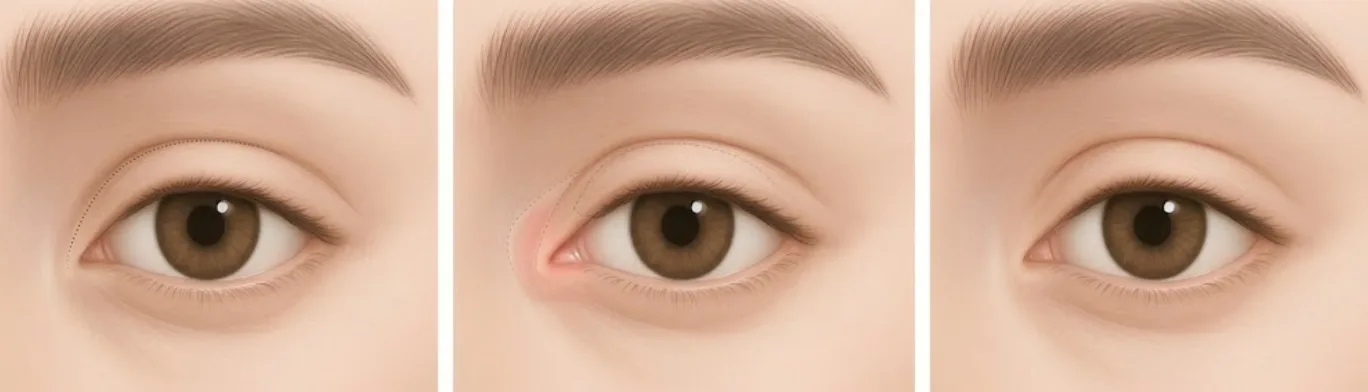
Illustration: the skin fold covering the inner corner is released along the dotted line so the inner corner opens slightly while the eye keeps its own shape.
The redder-looking part is on the eye itself. Small vessels on the white of the eye can leak during surgery, leaving a patch of the sclera pink or bloodshot: a subconjunctival bruise. It looks dramatic but is harmless and does not usually hurt, and like any bruise it changes colour and clears on its own, usually over one to three weeks, a little slower than the skin. There is nothing to do but let it resolve; artificial tears can ease any grittiness on your surgeon's advice, and you should never rub the eye to try to clear it.
A few everyday factors make bruising more likely: blood-thinning medication and supplements such as fish oil, high-dose vitamin E, ginkgo and certain anti-inflammatories; alcohol around the time of surgery; and rubbing or straining. Telling the surgeon about every medication and supplement before the outer-corner surgery, and following the pre-surgery guidance, keeps bruising down. We cover the comfort side in pain and anaesthesia, and the inner-corner companion operation in epicanthoplasty.
Reduce it
How to bring lateral canthoplasty swelling and bruising down faster
The measures that genuinely help are simple and worth doing consistently. Keep your head elevated, including sleeping propped up for the first several nights, so fluid drains away from the eyes and does not pool at the outer corners. The corner is usually puffiest first thing in the morning, and sleeping propped up reduces that. Cool the area gently near the outer corner in the first 48 hours as your surgeon directs, never pressing on the incision and never applying ice directly to the skin.
Leave the eye alone and rest. The single most useful habit after lateral canthoplasty is not disturbing the healing corner: no rubbing, no picking, no eye makeup or contact lenses until your surgeon clears them, and keeping the area clean as instructed. Avoid strenuous activity, heavy lifting, bending over and anything that raises blood pressure for the first two to three weeks, since all of it feeds swelling and can make the eye white redder. Skip alcohol and smoking, which slow healing and worsen swelling, stay hydrated and keep salt low.
Beyond that, follow the specifics your surgeon gives you: how to care for the corner, when artificial tears or ointment help, and when eye makeup, lenses and exercise are safe again. None of these are dramatic alone, but together they shorten the time the corner and eye white look healing, which matters most for international patients healing within a planned trip. If you are still deciding whether outer-corner opening suits your eye shape, our overview of who it is for sets expectations first.
What's normal
What's normal, and what's worth an urgent call
Normal, expected recovery: a tight, slightly swollen outer corner for the first weeks; a pink or bloodshot patch on the white of the eye that clears over one to three weeks; mild stinging, watering or a gritty feeling; light skin bruising at the corner or lower lid; and slight unevenness between the two sides that evens out as swelling settles. None of this needs intervention. It is a lateral canthoplasty healing as it should, with the outer-corner shape refining over weeks to months.
What warrants an urgent call is anything that breaks sharply from that path: heavy or persistent bleeding; rapidly increasing swelling or severe, escalating pain not eased by simple measures; spreading redness, warmth, pus-like discharge or fever suggesting infection; a sudden change in vision, double vision or pain deep in the eye (beyond surface grittiness); the wound edges pulling apart; or the lower lid pulling down noticeably with the eye not closing fully. If the corner or eye white changes suddenly and sharply, instead of the slow, steady fading described above, contact the clinic without delay.
After a lateral canthoplasty, what reassures most is direct access to the surgeon who opened your outer corner. If you can send a photo and get a same-person answer on whether your corner and eye white are healing on track, or be told to come in, you are not left guessing, which is especially valuable once you have travelled home.
At Garnet
How Garnet manages swelling and after-care
Garnet is a single-surgeon clinic in Apgujeong, Seoul. Dr. In-Soo Baek is a board-certified plastic surgeon (Korean medical licence no. 77407) and the only operating doctor; he performs the lateral canthoplasty and reviews your recovery himself, so the person assessing your swelling is the person who did the surgery. The clinic keeps the day unhurried, with clear after-care guidance for an operation whose outer-corner detail settles over weeks to months.
Aftercare covers exactly the measures above (elevation, gentle cooling, leaving the eye alone, rest and what to avoid), and the suture removal at around day 7 doubles as a check that the corner is settling on track. Garnet runs structured follow-up at one, three and six months, which suits the corner's refining timeline, and for international patients much of this happens by messenger: you send a photo and the same surgeon confirms your recovery is on course or flags anything that needs attention.
If you are still deciding, start with a no-obligation online assessment: send clear photos and the surgeon will give a realistic view of what recovery would look like for you, including how much swelling and eye redness to expect and how long to stay.
Dr. In-Soo Baek
Director & sole operating surgeon
Korean medical licence no. 77407
Operate on what you came for. Trained at Korea University Medical Center. Every case planned, performed and reviewed by the same hands.
1Operating surgeon
~2Surgeries per day
7Registered techniques
Board-certified plastic surgeon
Plastic surgery training at Korea University College of Medicine & graduate school
Korean Society of Plastic and Reconstructive Surgeons member, in its facial-contour, eye & rhinoplasty groups
Consults, operates and follows up each case himself
Peer-reviewed papers behind the facts on this page. Each describes findings in its own study group — not results at Garnet — and none predicts your own outcome.
Chae SW et al. Cosmetic Lateral Canthoplasty: Lateral Canthoplasty to Lengthen the Lateral Canthal Angle and Correct the Outer Tail of the Eye. Archives of Plastic Surgery. 2016. doi:10.5999/aps.2016.43.4.321
Georgescu D. Surgical preferences for lateral canthoplasty and canthopexy. Current Opinion in Ophthalmology. 2014. doi:10.1097/icu.0000000000000094
Taban M et al. Aesthetic Lateral Canthoplasty. Ophthalmic Plastic & Reconstructive Surgery. 2010. doi:10.1097/iop.0b013e3181baa23f
FAQ
Common questions
How long does swelling last after lateral canthoplasty?
The outer corner is tightest in the first few days and eases once the sutures come out at around day seven. Most external puffiness settles over the first one to two weeks, while the corner stays a little tight and firm for several weeks. The fine outer-corner shape keeps refining over roughly one to three months as the tissue relaxes.
Why is the white of my eye red after lateral canthoplasty?
Because much of the surgery is done through the conjunctiva inside the lid, small surface vessels on the white of the eye can leak, leaving a pink or bloodshot patch called a subconjunctival bruise. It looks dramatic but is harmless and usually does not hurt, and it clears on its own, usually over one to three weeks. Do not rub the eye to try to speed it.
How much skin bruising should I expect?
Often light. Because the incision is largely on the inside of the lid, external bruising tends to be modest: a faint shadow at the outer corner or lower lid for some, almost none for others. What appears shifts from dark to green-yellow and most clears within one to two weeks. Disclosing your medications beforehand keeps it down.
How can I reduce swelling and bruising after lateral canthoplasty?
Keep your head elevated (sleeping propped up for the first several nights), cool gently near the corner in the first 48 hours, and leave the eye alone, with no rubbing and no makeup or lenses until cleared. Avoid strenuous activity, straining and bending for two to three weeks, skip alcohol and smoking, stay hydrated and keep salt low. Artificial tears can ease grittiness on your surgeon's advice.
Is swelling after lateral canthoplasty normal?
Yes. A tight, slightly swollen outer corner, a bloodshot patch on the eye white, mild stinging or watering, light skin bruising and slight unevenness between the sides are all normal early on. What warrants an urgent call is heavy bleeding, rapidly increasing swelling or severe pain, signs of infection, any change in vision, or the lower lid pulling down with the eye not closing.
When should I urgently contact the clinic?
Call without delay if you have heavy or persistent bleeding, rapidly increasing swelling or severe pain not eased by simple measures, spreading redness, warmth, pus-like discharge or fever, a sudden change in vision or double vision, deep pain inside the eye, or the lower lid pulling down so the eye will not close fully. A sudden, marked change at the outer corner or in the eye is the reason to seek prompt review.
Will the outer corner look over-opened at first?
It can. In the early weeks the outer corner may look a little over-opened or tight because swelling and the fresh incision exaggerate the change. This softens as the tissue relaxes, and the natural open look settles over roughly one to three months. If it still looks off to you at your follow-ups, raise it with the surgeon who operated.
When can I wear eye makeup and contact lenses again?
Not until your surgeon clears them, because both can irritate the healing corner and the eye surface and introduce bacteria. Most people are asked to keep eye makeup and lenses off for at least the first week or two, sometimes longer near the corner itself. Your surgeon gives you the exact timing for your case at the suture check and follow-ups.
When is it safe to fly home after lateral canthoplasty?
Most international patients stay through the suture removal at around day seven so the surgeon can confirm the corner is healing before travelling. The eye white may still look a little pink and the corner a little tight, and both keep settling after you land. Stay hydrated, avoid rubbing your eyes and skip alcohol on the flight; your surgeon confirms the right timing for you.
How does Garnet check my swelling is settling normally?
Garnet runs structured follow-up at one, three and six months with the same board-certified surgeon who performed the procedure, plus the suture check at around day seven. For international patients much of this is by messenger: you send a photo and the same surgeon confirms your corner and eye white are healing on track or asks you to come in.
My mom recently had a brow lift and lower blepharoplasty with Dr. Baek, and our experience has been wonderful so far. The Garnet team was incredibly kind and welcoming, with Kelly assisting us as our English consultant—she made everything…
I’m so happy I chose this clinic for my lower blepharoplasty. I was traveling from abroad by myself, so I was a little nervous, but from the beginning I felt comfortable and truly cared for. Everyone was kind, patient, and professional…
Came in for an in-person consult and ended up choosing Garnet and Dr.Baek for my non-incisional DES and tiplasty/alarplasty. I communicated with Kelly (English consultant) from the start till now (3 weeks post-op). She really help me feel…
My under-eyes have been sagging and folding for years... I tried to cover it up with makeup, but it actually got stuck in the wrinkles and made it stand out even more. While going for consultations, I noticed that the bigger the hospital…
Send photos and your question before you travel. An English-speaking coordinator reviews every enquiry and replies with guidance on whether surgery is appropriate, the likely plan and timing.
✓ Reviewed by the clinic coordinator, not a bot
✓ Photo-based pre-assessment before you fly
✓ Foreign-patient scheduling & after-care
✓ One surgeon for consultation, surgery and follow-up
Prefer to chat now? Reach the coordinator directly:








 T S7 months ago



