After lateral canthoplasty the outer corner of your eye changes shape, but the version you see in the first days is not the version you keep. Swelling, tightness and a slightly over-open corner all settle over weeks and months, so knowing the timeline keeps you from judging the result too early.
The short answer
An early impression of the new outer-corner shape appears within the first one to two weeks, after sutures come out at about 7 days, but it is still swollen.
Most visible swelling eases over the first month, and the corner looks more natural through months two and three.
The settled, final outer-corner shape is fair to judge at around three to six months, once firmness and residual swelling have resolved.
Garnet's structured 1, 3 and 6-month follow-ups with the same board-certified surgeon are timed to these stages.
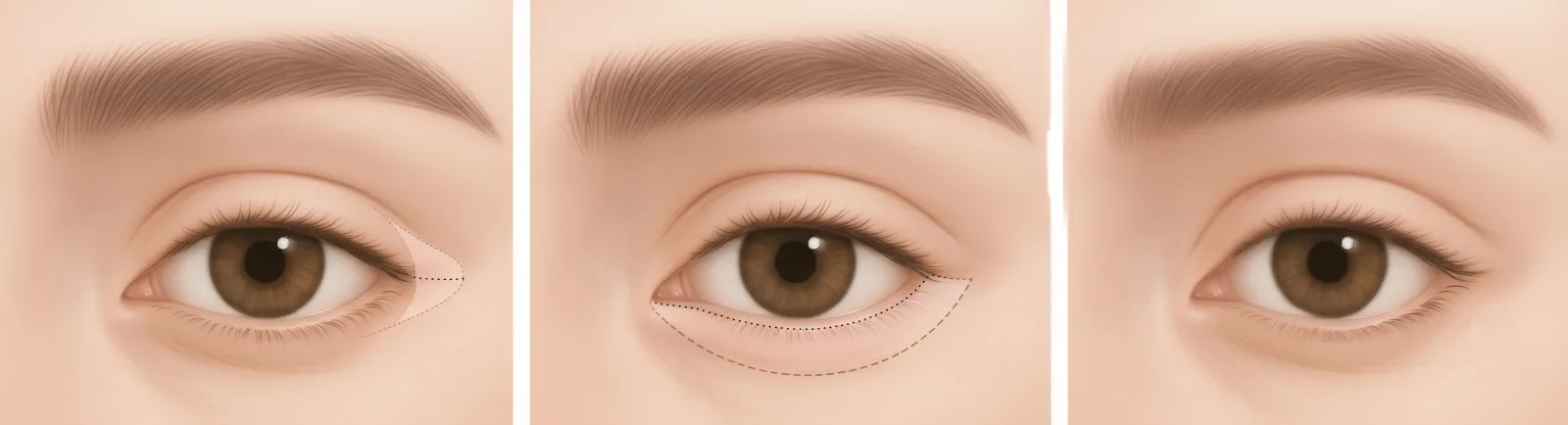
Lateral canthoplasty reshapes the outer corner of the eye to make it look longer and more open. At Garnet the trademarked Wide angle™ technique works through a conjunctival incision and adds a lower-canthal (bottom) opening, so the corner is widened outward and slightly downward instead of just being extended sideways. The "result" you are waiting for is that settled outer-corner shape, and crucially how it looks in repose, when you smile, and how it balances with the other eye.
Illustration: the outer corner is extended and the lower-lid line gently lowered along the dotted lines, softening the angle of the eye.
Because the change is at the corner, the result reads differently depending on swelling. Early on the corner can look more open or rounder than it will finally be, simply because the tissue is full. As swelling resolves the corner refines, the shape tightens up, and the line of the eye looks more natural. That is why the timing of a lateral canthoplasty result comes in layers: an early shape soon, a natural look within weeks, and a settled result over months.
If you also want to understand where the healing sits and whether anything shows, read scars and healing, and for the day-by-day course of swelling and bruising see the recovery timeline. The procedure itself is covered on the lateral canthoplasty page.
First two weeks
The first two weeks: an early shape, still swollen
In the first few days the outer corner is swollen and may look pink, and the eye can feel tight or gritty because part of the incision is on the inner conjunctival lining. This is the least representative stage of the result, and it is normal for the corner to look more open or fuller than you expect. Bruising around the corner is common and fades over the early weeks.
Sutures are removed at about 7 days. Once they are out, the corner usually looks noticeably calmer, and you get your first genuine sense of the new shape. It is still carrying swelling, though, so treat it as a preview of the outer corner. Many international patients time their stay so suture removal happens in Korea; you can read about scheduling that in how long to stay in Korea.
By the end of the second week most people look presentable enough to return to normal social settings, even though close inspection still shows some fullness and pinkness at the corner. The shape is emerging, the obvious swelling is receding, and the eye is starting to look like itself again, but the final corner is still weeks away.
Weeks to 3 months
From a few weeks to three months: the natural look arrives
Through the first month the corner steadily refines. The fullness that made it look over-open settles, firmness eases, and the outer corner begins to sit in its more natural position. This is usually when patients stop feeling self-conscious in photos and start to see the change they came for, even though it is not yet final.
Between roughly one and three months, two things resolve that matter for the result: residual deep swelling at the corner, and any temporary asymmetry between the eyes that healed at slightly different rates. It is completely normal for one corner to settle a little ahead of the other, and comparing them at week two leads people to worry unnecessarily. The eyes tend to even out as the months pass.
By around the three-month mark the result looks close to settled for most people: the corner shape is clear, the eye looks longer and more open in a natural way, and the area feels soft. Any external healing line, where present, is fading. For how that fading progresses specifically, see scars and healing; for how this compares to reshaping the inner corner, see epicanthoplasty results.
Final result
When the lateral canthoplasty result is truly final
The fair point to judge the final outer-corner shape is around three to six months. By then residual swelling has gone, the tissue has softened, colour has faded toward your normal tone, and the corner has reached a stable position. Earlier than this, you are looking at a result still in motion, which is why it is unhelpful (and often discouraging) to assess it in the first weeks.
Judging early also risks chasing a problem that is not really there. A corner that looks slightly over-open at two weeks frequently looks exactly right at three months once the fullness is gone. Conversely, genuine concerns about symmetry or shape are best discussed at the later follow-ups, when what you are seeing is the settled tissue and no longer the swelling. If a refinement is ever warranted, that conversation belongs at the mature stage; see revision and correction.
Set expectations as a gradual curve: an early shape in the first two weeks, a natural everyday look by the first month, and a settled final result by three to six months. Garnet's follow-up schedule is built around exactly this curve so the surgeon assesses the corner at the right times, after each stage of settling.
Your timeline
What affects how fast you see your result
Timelines vary between people, and a few factors explain most of the difference. How much swelling you carry and how quickly it clears is individual; some people de-swell faster than others. The extent of the corner change matters too: a larger widening simply has more to settle than a subtle one. And aftercare plays a part: keeping the area protected, not rubbing the corner, and following your surgeon's guidance all help the result emerge cleanly.
Daily habits also shift the early weeks. Sleeping with your head slightly elevated, managing salt intake, and avoiding strenuous activity in the first stretch can reduce how long swelling lingers. None of these change the final result, but they can make the in-between weeks look better sooner. The full set of practical aftercare points sits in the recovery timeline.
What does not vary is the principle: the outer corner needs months to declare itself. If you are planning a trip around a specific event, build in margin and talk it through before you book. You can do that in an online consultation, where the surgeon can give you a realistic timeline for your specific case.
At Garnet
How Garnet follows your result over time
Garnet is a single-surgeon clinic in Apgujeong, Seoul. Dr. In-Soo Baek, a board-certified plastic surgeon (Korean medical licence no. 77407), is the only operating doctor. He consults, performs the Wide angle™ canthoplasty and reviews every follow-up himself. For a result that settles over months, that continuity is the point: the surgeon who shaped the corner is the one assessing whether it is maturing as planned.
Follow-ups are structured at 1, 3 and 6 months, which map directly onto the result curve: the early-natural stage, the close-to-settled stage, and the final stage. The clinic caps the day at two surgeries so each case has unhurried time, and is registered with Korea's foreign-patient programme. If you fly home before six months, the same surgeon can continue to review your progress photos by messenger.
If you want a realistic, procedure-specific answer to "when will I see my result" for your own eyes, the most useful step is to ask before you travel. You can send photos for a no-obligation pre-assessment through an online assessment, or read how the corner heals in scars and healing.
Dr. In-Soo Baek
Director & sole operating surgeon
Korean medical licence no. 77407
Operate on what you came for. Trained at Korea University Medical Center. Every case planned, performed and reviewed by the same hands.
1Operating surgeon
~2Surgeries per day
7Registered techniques
Board-certified plastic surgeon
Plastic surgery training at Korea University College of Medicine & graduate school
Korean Society of Plastic and Reconstructive Surgeons member, in its facial-contour, eye & rhinoplasty groups
Consults, operates and follows up each case himself
Peer-reviewed papers behind the facts on this page. Each describes findings in its own study group — not results at Garnet — and none predicts your own outcome.
Glat PM et al. Evolution of the Lateral Canthoplasty: Techniques and Indications. Plastic & Reconstructive Surgery. 1997. doi:10.1097/00006534-199711000-00003
Kim YJ et al. Cosmetic Lateral Canthoplasty: Preserving the Lateral Canthal Angle. Archives of Plastic Surgery. 2016. doi:10.5999/aps.2016.43.4.316
FAQ
Common questions
When will I see the final results of lateral canthoplasty?
The settled, final outer-corner shape is fair to judge at around three to six months, once swelling has gone, the tissue has softened and the corner has stabilised. You will see an early shape within the first one to two weeks and a natural everyday look by the first month, but the first weeks are still swollen and do not show the final result.
How does the result of lateral canthoplasty change over time?
Early on the corner can look more open or fuller because of swelling; as the fullness settles the corner refines and looks more natural. Through one to three months residual swelling and any temporary asymmetry resolve, and by three to six months the corner reaches its stable, final shape.
When is the swelling gone after lateral canthoplasty?
Most visible swelling eases over the first month, with the corner looking more natural through months two and three. Deeper residual swelling at the corner can take up to about three months to fully settle, which is why the final result is judged at three to six months.
Why does my corner look over-open right after surgery?
That is usually swelling, and the corner is not yet in its final shape. A corner that looks slightly over-open at one to two weeks commonly looks exactly right by three months once the fullness resolves. This is why judging the result in the first weeks tends to cause unnecessary worry.
When can I return to normal social activity?
Most people look presentable enough for normal social settings by about the end of the second week, after sutures come out at around 7 days. Close inspection may still show some fullness and pinkness, but the obvious swelling has receded by then.
Is it normal for one eye to settle faster than the other?
Yes. The two corners often heal at slightly different rates, so temporary asymmetry in the first weeks is common and usually evens out over the following months. Symmetry is best assessed at the later follow-ups, not in the early swollen stage.
What can I do to see my result sooner?
Keeping the area protected, not rubbing the corner, sleeping with your head slightly elevated, managing salt intake and avoiding strenuous activity early can all reduce how long swelling lingers. These help the in-between weeks look better sooner, though they do not change the final result.
How long should I stay in Korea to see early results?
Many patients stay long enough for suture removal at about 7 days, by which point the early shape is visible. The natural everyday look arrives over the following weeks at home, with the final result at three to six months reviewed by follow-up. See our how long to stay in Korea guide for planning.
When would a revision be considered if I am unhappy?
Refinements are considered only once the result is mature, generally after the three to six-month settling period, because earlier appearances are still affected by swelling. Genuine concerns about shape or symmetry are discussed at the later follow-ups; see our revision and correction page.
Who assesses whether my result settled correctly?
At Garnet the same board-certified surgeon who operated reviews your result at structured 1, 3 and 6-month follow-ups and can continue to check progress photos by messenger if you have flown home, so the person who shaped the corner is the one judging how it settled.
My mom recently had a brow lift and lower blepharoplasty with Dr. Baek, and our experience has been wonderful so far. The Garnet team was incredibly kind and welcoming, with Kelly assisting us as our English consultant—she made everything…
I’m so happy I chose this clinic for my lower blepharoplasty. I was traveling from abroad by myself, so I was a little nervous, but from the beginning I felt comfortable and truly cared for. Everyone was kind, patient, and professional…
Came in for an in-person consult and ended up choosing Garnet and Dr.Baek for my non-incisional DES and tiplasty/alarplasty. I communicated with Kelly (English consultant) from the start till now (3 weeks post-op). She really help me feel…
My under-eyes have been sagging and folding for years... I tried to cover it up with makeup, but it actually got stuck in the wrinkles and made it stand out even more. While going for consultations, I noticed that the bigger the hospital…
Want a realistic timeline for your own eyes? Send photos for a no-obligation pre-assessment of what lateral canthoplasty could achieve and how it would settle.
Send photos and your question before you travel. An English-speaking coordinator reviews every enquiry and replies with guidance on whether surgery is appropriate, the likely plan and timing.
✓ Reviewed by the clinic coordinator, not a bot
✓ Photo-based pre-assessment before you fly
✓ Foreign-patient scheduling & after-care
✓ One surgeon for consultation, surgery and follow-up
Prefer to chat now? Reach the coordinator directly:









 T S7 months ago



