A mini facelift is a short-incision lift that refreshes the lower face and jawline, and it travels well: the procedure itself is contained, and most of the trip is recovery and suture care. If you are coming to Korea from abroad, the questions that matter are practical ones: how to be assessed before you book a flight, how long to stay, and who looks after you once you are home.
The short answer
Most international patients plan around 10 to 14 days in Korea — long enough for surgery, sutures out at about day 10, and a final review before flying.
You can start with an online consultation from home: send clear photos and your history, and the surgeon gives a pre-assessment of your jawline and lower face before you commit to travel.
Sutures from a mini facelift's short pre- and post-auricular incision typically come out at around day 10, which is the main date your trip is built around.
At a single-surgeon clinic the same board-certified surgeon consults, operates and reviews your recovery, including remote follow-up by messenger after you return home.
Before you book a flight, the first step is an online consultation. You send clear, well-lit photos of your face (front, both three-quarter angles and profile, ideally relaxed and without heavy expression) along with a short history: your age, what bothers you about the lower face and jawline, any previous surgery, and your general health. From this the surgeon can tell you whether a mini facelift is the right operation for you, or whether a different approach would serve you better.
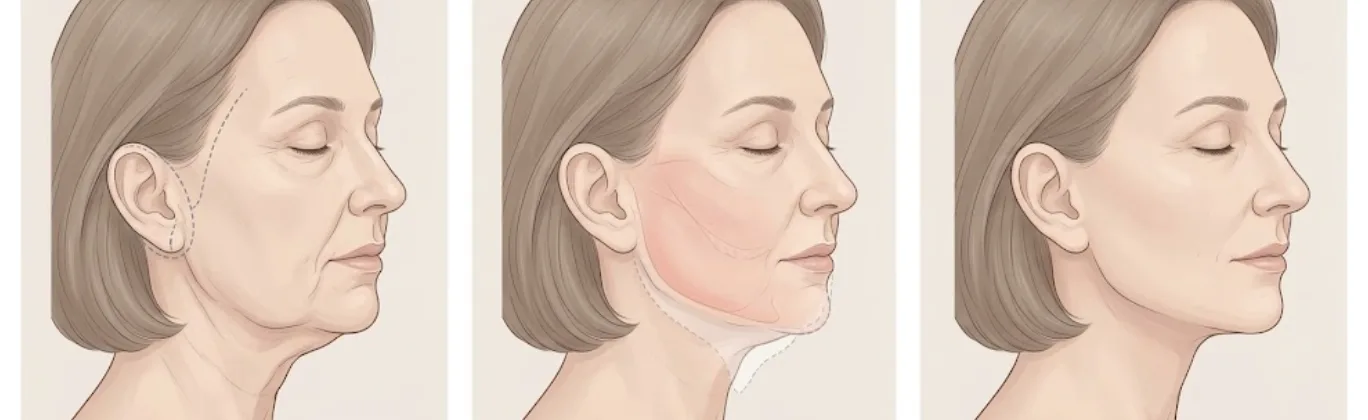
Illustration: through a shorter incision in front of the ear (dotted line), the lower face and jawline (shaded) are lifted.
This matters more for a mini facelift than people expect. The procedure uses a short pre- and post-auricular incision and a superficial dissection that targets the nasolabial fold and early jowl. It is well suited to mild-to-moderate sagging, but it is not a substitute for a fuller lift if your laxity is more advanced. A pre-assessment tells you which applies before you spend money on flights. If you want the full overview of the operation first, read the parent guide on the mini facelift and how it differs from a full facelift.
A good online consultation is a conversation about your face. You should come away knowing what is realistic for your face, roughly how long you would need to stay, and what the recovery asks of you. That is enough to decide calmly whether to plan the trip at all.
How long to stay
How long should you stay in Korea?
For a mini facelift, most international patients plan for roughly 10 to 14 days in Korea. The single date that anchors everything is suture removal, which for a mini facelift is typically around day 10. You want to be in Seoul for that appointment and for a final check afterwards, so you do not fly out with sutures still in.
A workable shape for the stay is a consultation and in-person assessment in the first day or two, surgery shortly after, the bulk of the visible swelling and bruising settling over the following week, sutures out at about day 10, and a final review a day or two later before you fly. Building in a small buffer is wise. It gives room for the clinic to see you again if anything needs watching, and it means you are not rushing to the airport the morning after your sutures come out. For the general principle across procedures, see how long to stay in Korea for surgery.
If your schedule is tight, discuss it openly at the online consultation. Sometimes the surgeon can arrange the in-person assessment and surgery close together to shorten the front end of the trip, but suture removal and a safe flying window are not things to compress. It is better to plan a realistic stay than to book a short one and feel pressured to leave too early.
Trip timeline
Your trip in Seoul, step by step
Days 1–2: arrival and in-person assessment. Even after a thorough online consult, you meet the surgeon in person before surgery. He examines your skin quality, the degree and pattern of sagging, and confirms the plan and the incision design with you. This is also the moment to ask anything still on your mind and to confirm, in writing, that the surgeon you are speaking with is the one who will operate.
Surgery day. The mini facelift is performed through the short pre- and post-auricular incision, with the dissection kept superficial and focused on the nasolabial fold and jawline. You rest afterwards; the first day or two bring the most swelling and tightness, which is normal and expected.
Days 3–9: settling. Bruising and swelling ease over the first week. You keep the head elevated, follow the wound-care and cold-compress instructions, avoid bending and strenuous activity, and eat softer foods while the cheeks feel tight. Most people feel presentable enough to move around Seoul quietly within several days, though full settling of fine swelling takes longer. For the detailed day-by-day, see the mini facelift recovery timeline.
Suture removal
Suture removal and the window before you fly
Suture removal is the appointment your whole trip is planned around. For a mini facelift, sutures from the pre- and post-auricular incision typically come out at around day 10. By then the incision lines, which sit in and behind the natural creases at the ear, have begun to settle, and removing the sutures on schedule helps them heal as quietly as possible.
Try to keep at least a short window after suture removal before your flight. A final review lets the surgeon confirm the wounds are healing well, give you scar-care guidance for the months ahead, and clear you to travel. Long-haul flights involve immobility and pressure changes, so it is worth checking your specific flying date with the surgeon. The general rule of thumb is covered in when can I fly after plastic surgery.
Before you leave, make sure you have written aftercare instructions, a clear point of contact, and an understanding of what is normal versus what needs attention. Knowing exactly who to message if you have a question on the plane or in the days after you land removes a lot of the anxiety of recovering far from your surgeon.
Remote follow-up
Follow-up after you fly home
Recovery from a mini facelift continues well after you have left Korea. Residual swelling keeps softening for weeks, the incision lines mature over months, and the final, settled result takes time to appear. Good after-care does not end at the airport; it continues remotely.
At a single-surgeon clinic, the surgeon who operated on you is the one who reviews your progress afterwards. You can send photos by messenger so he can check how the incisions and contour are settling, answer questions, and tell you when it is safe to resume the activities you have been holding off on. If anything looks unusual, you get guidance early, including when to seek local care. Garnet structures formal follow-ups at 1, 3 and 6 months, which maps neatly onto how a facelift result actually evolves.
This continuity is the practical reason the single-surgeon model suits international patients. There is no handover between a consulting doctor and an operating doctor, and no uncertainty about who knows your case once you are home. It is the same surgeon throughout. You can read more about why that matters in what a single-surgeon clinic is.
At Garnet
How Garnet supports international patients
Every mini facelift at Garnet, a single-surgeon clinic in Apgujeong, is done by one surgeon. Dr. In-Soo Baek is a board-certified plastic surgeon (Korean medical licence no. 77407) and the only operating doctor. He handles the consultation, performs the short-incision lift himself, and reviews every follow-up. The clinic caps the day at two surgeries, so each case has unhurried time, and Garnet is registered with Korea's foreign-patient programme.
For an international patient, the trip is coordinated end to end: an online pre-assessment before you travel, an in-person consultation and surgery once you arrive, suture care and a final review timed around your flight, and structured follow-ups at 1, 3 and 6 months, with remote check-ins by messenger once you are home. A dedicated coordinator stays with you from the first consultation through recovery.
If you are weighing a mini facelift from abroad, the sensible first move is the online consultation: send photos for an assessment, find out whether the procedure suits your face, and get a realistic picture of the stay before you plan anything.
Dr. In-Soo Baek
Director & sole operating surgeon
Korean medical licence no. 77407
Operate on what you came for. Trained at Korea University Medical Center. Every case planned, performed and reviewed by the same hands.
1Operating surgeon
~2Surgeries per day
7Registered techniques
Board-certified plastic surgeon
Plastic surgery training at Korea University College of Medicine & graduate school
Korean Society of Plastic and Reconstructive Surgeons member, in its facial-contour, eye & rhinoplasty groups
Consults, operates and follows up each case himself
Peer-reviewed papers behind the facts on this page. Each describes findings in its own study group — not results at Garnet — and none predicts your own outcome.
Chaudhry O et al. Lateral SMASectomy. Clinics in Plastic Surgery. 2019. doi:10.1016/j.cps.2019.06.003
Jeevan R et al. Travelling abroad for aesthetic surgery: Informing healthcare practitioners and providers while improving patient safety. Journal of Plastic, Reconstructive & Aesthetic Surgery. 2011. doi:10.1016/j.bjps.2010.04.022
Mohammadi S et al. A Comparison Between Two Methods of Face-Lift Surgery in Nine Cadavers: SMAS (Superficial Musculo-Aponeurotic System) Versus MACS (Minimal Access Cranial Suspension). Aesthetic Plastic Surgery. 2015. doi:10.1007/s00266-015-0543-3
Ramírez B et al. Aesthetic Surgical Tourism: Physiological Changes During Flight That May Affect Patient Safety and Outcomes. Plastic and Reconstructive Surgery - Global Open. 2026. doi:10.1097/gox.0000000000007568
FAQ
Common questions
How do international patients get a mini facelift in Korea?
It usually starts with an online consultation: you send clear photos and your history, and the surgeon gives a pre-assessment of whether a mini facelift suits you. If it does, you plan a trip of roughly 10 to 14 days for the in-person assessment, surgery, suture removal at around day 10, and a final review before flying home.
How long should I stay in Korea for a mini facelift?
Most patients plan around 10 to 14 days. The anchor is suture removal, which for a mini facelift is typically around day 10, followed by a final check before you fly. Building in a short buffer is sensible so you are not rushing to the airport right after your sutures come out.
Can I start with an online consultation for a mini facelift?
Yes. An online consultation lets the surgeon review your photos and history and tell you whether a mini facelift is the right operation before you book a flight. It is the recommended first step, and an assessment that is willing to say the procedure may not suit you is a good sign.
When do the sutures come out after a mini facelift?
Sutures from the short pre- and post-auricular incision typically come out at around day 10. This is the main date your trip is planned around, so you want to be in Seoul for it and for a final review afterwards.
When can I fly home after a mini facelift?
Plan to keep at least a short window after suture removal before flying, and confirm your specific date with the surgeon at your final review. Long-haul flights involve immobility and pressure changes, so the flying date is set for you individually.
Who looks after my recovery once I return home?
At a single-surgeon clinic the surgeon who operated on you reviews your recovery afterwards. You can send photos by messenger so he can check how the incisions and contour are settling, with structured follow-ups at 1, 3 and 6 months and clear guidance on what to watch for.
Will I see the final result before I leave Korea?
No, and that is normal. A mini facelift looks tight and a little swollen early on; residual swelling keeps softening for weeks and the incision lines mature over months. The settled result appears gradually, which is why remote follow-up after you go home matters.
Is a mini facelift enough for my degree of sagging?
A mini facelift suits mild-to-moderate laxity of the lower face and jawline; it is not a substitute for a fuller lift if your sagging is more advanced. The online consultation exists precisely to answer this for your face before you travel.
Does the same surgeon operate and follow me up at Garnet?
Yes. Garnet is a single-surgeon clinic, so Dr. In-Soo Baek, a board-certified plastic surgeon, consults, performs the surgery himself and reviews every follow-up, including remote check-ins after you return home. There is no handover to a different operating doctor.
Does Garnet treat international patients?
Yes. Garnet is registered with Korea's foreign-patient programme and coordinates the consultation, scheduling, suture care and after-care for visitors from abroad, with a dedicated coordinator alongside you from consult to recovery.
My mom recently had a brow lift and lower blepharoplasty with Dr. Baek, and our experience has been wonderful so far. The Garnet team was incredibly kind and welcoming, with Kelly assisting us as our English consultant—she made everything…
I’m so happy I chose this clinic for my lower blepharoplasty. I was traveling from abroad by myself, so I was a little nervous, but from the beginning I felt comfortable and truly cared for. Everyone was kind, patient, and professional…
Came in for an in-person consult and ended up choosing Garnet and Dr.Baek for my non-incisional DES and tiplasty/alarplasty. I communicated with Kelly (English consultant) from the start till now (3 weeks post-op). She really help me feel…
My under-eyes have been sagging and folding for years... I tried to cover it up with makeup, but it actually got stuck in the wrinkles and made it stand out even more. While going for consultations, I noticed that the bigger the hospital…
Considering a mini facelift from abroad? Send photos for a no-obligation pre-assessment, and we'll tell you whether it suits your face and roughly how long you'd need to stay.
Send photos and your question before you travel. An English-speaking coordinator reviews every enquiry and replies with guidance on whether surgery is appropriate, the likely plan and timing.
✓ Reviewed by the clinic coordinator, not a bot
✓ Photo-based pre-assessment before you fly
✓ Foreign-patient scheduling & after-care
✓ One surgeon for consultation, surgery and follow-up
Prefer to chat now? Reach the coordinator directly:









 T S7 months ago



