A neck lift tightens the deeper platysma muscle and redrapes the skin to sharpen the jawline and clean up the under-chin, but the neck is a demanding area and results are not always even. Bands can return, one side can settle differently, or the correction can fall short of what was hoped. Revision is its own decision: sometimes the answer is a focused midline tightening, sometimes a fuller re-do, and very often simply waiting while swelling and early firmness resolve. This page sets out what neck lift revision really involves and when patience serves you better.
The short answer
Most early concerns after a neck lift (firmness, a ridged or banded feel, mild asymmetry and a heavy under-chin) settle over weeks to months as swelling falls, the skin redrapes and the deeper repair softens.
Genuine revision reasons include platysmal bands that return, a jawline or under-chin that stayed under-corrected, a persistent contour irregularity, or a scar around the ear or under the chin that heals poorly.
The fix is matched to the problem: a focused midline platysma tightening for a returning band, versus a fuller re-lift when the deeper support did not hold or too little was done the first time.
A careful assessment may conclude that the right answer is to wait, to correct one specific issue, or that the original laxity always needed a more complete lift than was performed.
A neck lift works on two layers at once: the platysma muscle underneath is tightened, often with a corset-style midline stitching, and the skin is redraped and trimmed through incisions under the chin and around the ear. Because the neck moves constantly and the deeper repair carries most of the load, the outcome depends heavily on how firmly the platysma was tightened and how the skin settles over it. When that goes slightly off, people come back with a familiar set of concerns.
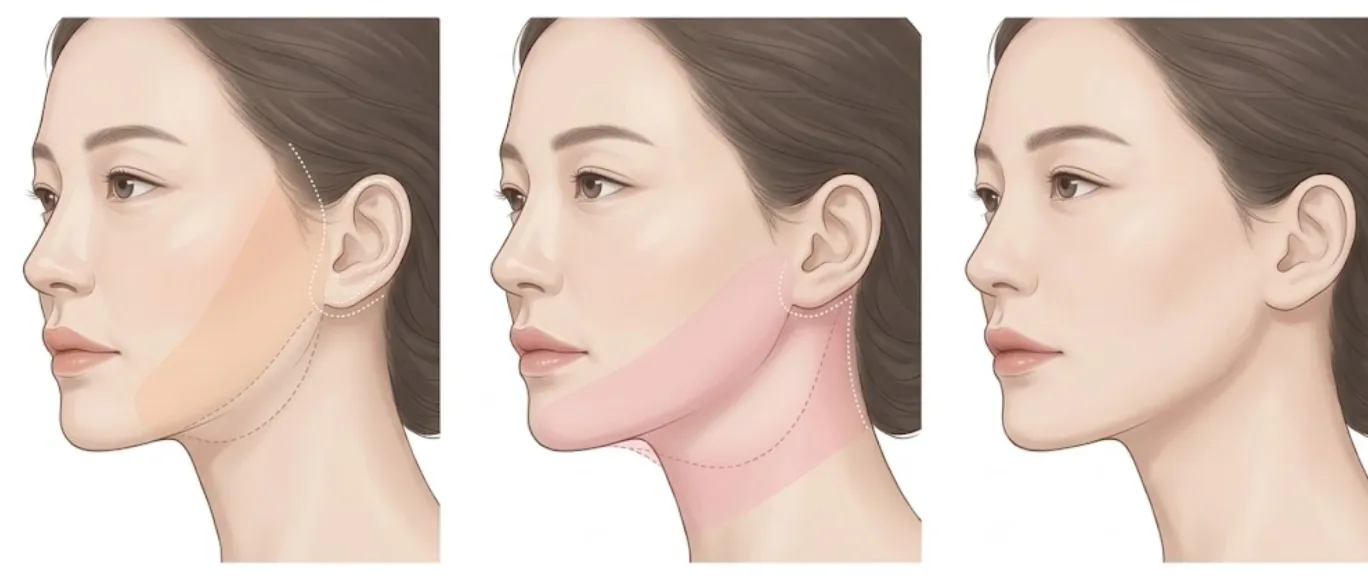
Illustration: through a fine line around the ear (dotted), the sagging lower face and neck are lifted up and back toward the ear (shaded); the dashed outline shows the old contour.
The most common are the return of vertical platysmal bands (the cords that stand out when you tense the neck) or a jawline that stayed softer than hoped because the deeper tightening relaxed or was conservative to begin with. Others notice a fullness under the chin that never fully cleared, an unevenness between the two sides, a contour dip or ridge along the repair, or a scar around the ear or under the chin that widened or stayed visible. Each of these has a different cause and a different answer.
Sort out which of these concerns applies to your neck first, because each one points to a different plan. Firmness and a banded feel in the first weeks usually need nothing but time; a band that clearly returns once everything has settled may need a focused midline re-tightening; and a jawline that was always going to need a more complete lift raises a fair question about whether enough was done the first time. That question is best answered before operating again.
What settles
What settles in the neck on its own, and what does not
Most of what alarms people in the first weeks after a neck lift is normal and temporary. Firmness, tightness on turning the head, numbness under the chin and a ridged or corded feel along the midline are all part of the early picture as the deeper repair heals and swelling gathers under the skin. A neck that feels stiff and looks slightly bunched at two weeks can smooth out substantially over the following months, and the page on neck lift swelling and bruising walks through what is expected and over what timeframe.
Asymmetry in the early phase is just as misleading. Two sides of a neck rarely swell or settle at exactly the same rate, so a result that looks uneven at three weeks can even out by three months. Judging the final jawline before the skin has fully redraped and the deeper tightening has softened leads people to chase a problem that would have resolved on its own. For that reason a careful surgeon will usually ask you to wait and reassess before reopening the area.
What does not reliably settle on its own is a platysmal band that clearly stands out again once the neck is calm, a jawline that stayed frankly under-corrected, a fixed contour dip or ridge, a persistent fullness under the chin, or a scar that has widened or stayed raised. These are the concerns where revision is reasonably considered, and the first step is simply telling them apart from the normal settling above.
Bands or re-lift
Returning bands, contour irregularity or a fuller re-lift
Neck revision is not one operation but a spectrum, and matching the response to the problem is the whole skill. At the more focused end, a single platysmal band that has re-formed at the midline can often be corrected with a targeted re-tightening: the muscle edges are re-approximated through the under-chin incision, reinforcing the corset without a full re-lift of the whole neck. A localised contour dip or a small residual pocket of fullness can sometimes be smoothed with a limited touch-up instead of a complete re-operation.
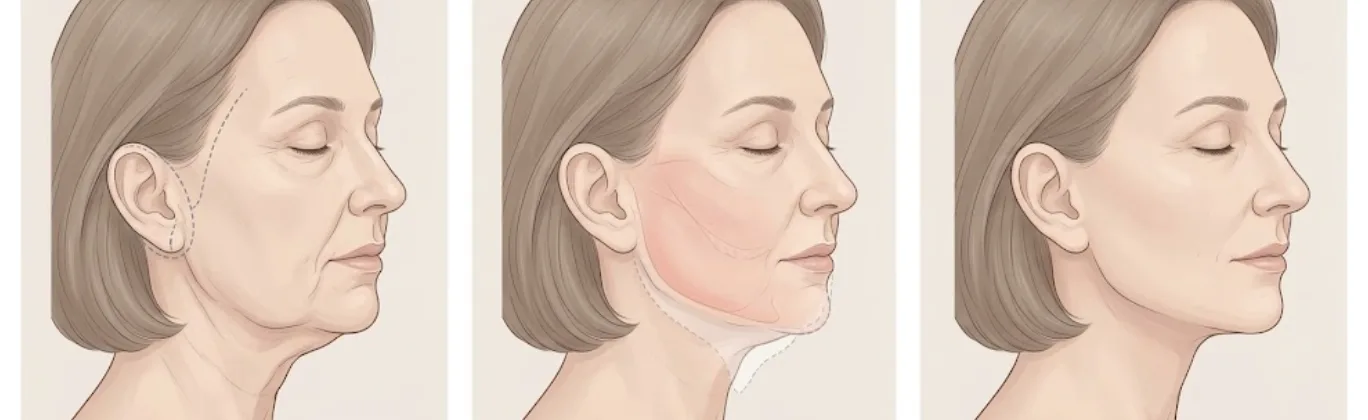
Illustration: through a shorter incision in front of the ear (dotted line), the lower face and jawline (shaded) are lifted.
A poorly healed scar around the ear or under the chin is addressed on its own terms: it is revised, re-closed and given time. It is not a reason to redo the whole lift. Persistent asymmetry, by contrast, is judged carefully: sometimes it is corrected by tightening the weaker side to match, and sometimes it reflects uneven swelling that is still resolving and should be left alone.
At the heavier end is a fuller re-lift: where the deeper platysma tightening genuinely did not hold, or the original procedure was too conservative for the degree of laxity, the sound option is a more complete SMAS-platysma neck lift that releases and re-fixes the deeper layer properly. If the neck was always going to need that, repeating a lighter version tends to disappoint again. Because the jawline and neck are managed together, a revision plan may draw on the same tools as a mini facelift where the lower face contributes to the sagging. Choosing between these is exactly what a careful assessment is for.
Timing
When to wait on a neck lift revision, and when to act
Timing is the most important decision in neck revision, and for most concerns the answer is to wait. In the first months firmness, banding, tightness and minor unevenness are still resolving, and the deeper repair is still softening and settling into its final position. Operating into freshly tightened, inflamed tissue to fix something that would have settled anyway makes a clean correction harder and risks trading one irregularity for another.
As a general principle, a surgeon prefers to let an earlier neck lift settle before deciding on revision, often for several months, and sometimes closer to a year for judging whether the deeper support truly held and the scars have matured. Sutures come out at 10 to 14 days, but that is only the start of healing; the jawline and scars keep refining for far longer. A calm, mature neck, assessed after the swelling has gone, is what allows a targeted, minimal correction.
The clear exceptions are reviewed promptly: a wound-healing problem, an expanding collection under the skin, signs of infection, or a scar that is clearly breaking down. For a band that has genuinely returned or a jawline that is frankly under-corrected, there is less urgency and more room to plan. The page on how long a neck lift lasts explains the normal arc, so you can tell a settling result from one that has truly under-delivered before deciding to operate again.
Technique
What a careful neck lift re-do involves
A careful revision begins with working out what was done before (whether the platysma was tightened at the midline, whether a corset stitching was used, how the skin was redraped, and how long ago), because that shapes what is safe to do next. For a returning band, the surgeon reopens the under-chin access, identifies the muscle edges through scar tissue, and re-approximates them with a firmer midline repair, checking the contour as the neck is redraped. This is more focused than a full re-lift and works largely through the existing incisions.
When the plan is a fuller re-lift, the field has already been operated on, so dissection is more deliberate: scar tissue is respected, the deeper platysma-SMAS layer is released and re-fixed for durable hold, and the two sides are balanced against each other as they are tightened. Revision generally reuses the original incision lines under the chin and around the ear without adding new ones, and existing scars are often revised at the same time so the neck heals into cleaner lines.
A scar-only revision is simpler still: the widened or raised scar is excised and re-closed carefully, then given months to mature, and the neck lift scars and healing page covers how those lines settle over time. Revision surgery on the neck is more demanding than a first lift because the tissue planes are scarred and less forgiving, so it is best done by an experienced surgeon on a settled, mature neck. The goal is to solve the specific problem with the smallest appropriate step.
At Garnet
How Garnet approaches neck lift revision
Garnet is a single-surgeon clinic in Apgujeong, Seoul. Dr. In-Soo Baek, a board-certified plastic surgeon (Korean medical licence no. 77407), is the clinic's only operating doctor, and every neck revision is assessed, planned and operated on by him, with his own reviews at 1, 3 and 6 months. For revision, that continuity matters: the surgeon who examines your earlier neck lift is the one accountable for the plan and the result.
Revision assessment at Garnet is deliberately unhurried and candid. That includes being willing to say that an early band or asymmetry needs more time and no surgery yet, that a single returning cord can be corrected with a focused midline re-tightening, or that the original laxity always needed a more complete lift than was performed. There is no consultation or CT fee and no pressure to book same day, because a sound revision decision on the neck should never be rushed.
If you are considering correcting an earlier neck lift from abroad, you can begin without travelling. Send your surgical history and photos for a pre-assessment, and read the neck lift international patient guide for how stay length and remote follow-up at one, three and six months are handled.
Dr. In-Soo Baek
Director & sole operating surgeon
Korean medical licence no. 77407
Operate on what you came for. Trained at Korea University Medical Center. Every case planned, performed and reviewed by the same hands.
1Operating surgeon
~2Surgeries per day
7Registered techniques
Board-certified plastic surgeon
Plastic surgery training at Korea University College of Medicine & graduate school
Korean Society of Plastic and Reconstructive Surgeons member, in its facial-contour, eye & rhinoplasty groups
Consults, operates and follows up each case himself
Peer-reviewed papers behind the facts on this page. Each describes findings in its own study group — not results at Garnet — and none predicts your own outcome.
Bitner JB et al. Direct Submentoplasty for Neck Rejuvenation. Archives of Facial Plastic Surgery. 2007. doi:10.1001/archfaci.9.3.194
Gu JT et al. Direct Neck Lift for Men. Facial Plastic Surgery Clinics of North America. 2024. doi:10.1016/j.fsc.2024.02.004
Jacono AA et al. Vertical Neck Lifting. Facial Plastic Surgery Clinics of North America. 2014. doi:10.1016/j.fsc.2014.01.006
FAQ
Common questions
Can a neck lift be revised or corrected?
Often, yes, but it depends on the concern. A returning platysmal band can be re-tightened at the midline, a contour irregularity smoothed, a poorly healed scar revised, and a frankly under-corrected jawline addressed with a fuller re-lift. Revision on the neck is more demanding than the first operation because the tissue is scarred, so it should follow a careful assessment on a settled neck.
My neck feels tight and ridged after a neck lift. Do I need revision?
Usually not. Firmness, a corded or ridged feel along the midline, tightness on turning the head and numbness under the chin are all common in the first weeks and months as the deeper repair heals and swelling resolves. Most of it softens as the neck settles. A band that clearly stands out again once everything has calmed down can be assessed, but operating too early risks correcting something that would have settled on its own.
My platysmal bands came back after a neck lift. What can be done?
A band that re-forms at the midline once the neck has settled can often be corrected with a focused re-tightening, re-approximating the muscle edges through the existing under-chin incision to reinforce the corset, without a full re-lift. Whether that alone is enough depends on how much of the sagging is muscle versus skin, which is what an assessment on a calm, mature neck is for.
What does neck lift revision involve?
It depends on the problem. A returning band is corrected by re-approximating the platysma through the under-chin access; a contour dip may need a limited touch-up; a scar is excised and re-closed on its own; and an under-corrected jawline may need a fuller SMAS-platysma re-lift that releases and re-fixes the deeper layer. Revision generally reuses the original incision lines, so new scars are not usually added.
When is neck lift revision needed?
For early firmness, banding and mild asymmetry, revision is rarely needed because they usually settle over weeks to months. Genuine reasons include a platysmal band that clearly returns, a jawline that stayed under-corrected, a fixed contour irregularity, persistent under-chin fullness, or a scar that widened. A wound-healing problem, infection or an expanding collection is reviewed promptly.
How long should I wait before revising a neck lift?
For most concerns, until the neck has settled and the scars have matured: often several months, and sometimes closer to a year before judging whether the deeper support truly held. Sutures come out at 10 to 14 days, but healing continues well beyond that. Assessing a calm, mature neck avoids chasing swelling-related problems that resolve on their own. Wound-healing problems and infection are the exceptions, reviewed promptly.
Will revision leave new scars on my neck?
Usually not new ones. Neck lift revision generally works through the original incision lines under the chin and around the ear without adding fresh scars, and an old scar that healed poorly is often revised at the same time so the neck settles into cleaner lines. As with any surgery, realistic expectations matter: revision refines and corrects, it does not erase that the area was operated on.
My jawline is still soft after a neck lift. Was too little done?
Possibly, but not necessarily. A jawline can look soft in the early months simply because swelling and firmness are still resolving. If it stays under-corrected once the neck is fully settled, it may mean the deeper tightening relaxed or the original procedure was conservative for the degree of laxity. In that case a more complete re-lift that properly re-fixes the platysma-SMAS layer is the appropriate step. An assessment on a mature neck tells the two apart.
Is neck lift revision more difficult than the first operation?
Yes, generally. The tissue planes are scarred and less forgiving after a first lift, blood supply to the skin is more delicate, and the muscle edges are harder to identify, so a revision is more demanding and benefits from being done on a settled, mature neck by an experienced surgeon. That is also why the smallest appropriate step is preferred: a focused correction whenever the problem allows, with a wholesale re-operation kept for when it does not.
Can I get a neck lift revision assessment from abroad before travelling?
Yes. You can send the history of your first neck lift and current photos for a pre-assessment online before committing to travel, so you have a realistic view of what revision could and could not achieve, and whether the right step is to wait, correct one specific issue, or plan a fuller re-lift, before booking a trip.
My mom recently had a brow lift and lower blepharoplasty with Dr. Baek, and our experience has been wonderful so far. The Garnet team was incredibly kind and welcoming, with Kelly assisting us as our English consultant—she made everything…
I’m so happy I chose this clinic for my lower blepharoplasty. I was traveling from abroad by myself, so I was a little nervous, but from the beginning I felt comfortable and truly cared for. Everyone was kind, patient, and professional…
Came in for an in-person consult and ended up choosing Garnet and Dr.Baek for my non-incisional DES and tiplasty/alarplasty. I communicated with Kelly (English consultant) from the start till now (3 weeks post-op). She really help me feel…
My under-eyes have been sagging and folding for years... I tried to cover it up with makeup, but it actually got stuck in the wrinkles and made it stand out even more. While going for consultations, I noticed that the bigger the hospital…
Considering correcting or refining an earlier neck lift? Send your history and photos for a no-obligation pre-assessment, including a frank view on whether revision is the right step or whether waiting for the neck to settle serves you better.
Send photos and your question before you travel. An English-speaking coordinator reviews every enquiry and replies with guidance on whether surgery is appropriate, the likely plan and timing.
✓ Reviewed by the clinic coordinator, not a bot
✓ Photo-based pre-assessment before you fly
✓ Foreign-patient scheduling & after-care
✓ One surgeon for consultation, surgery and follow-up
Prefer to chat now? Reach the coordinator directly:








 T S7 months ago



