Revision rhinoplasty is a different problem from a first nose job. Scar tissue, depleted cartilage and an altered blood supply make the work harder, and that is exactly the situation where rib (costal) cartilage earns its place, because it can supply the volume and structural strength a difficult nose needs. This page goes deep on rib cartilage specifically for correction and revision: why it is chosen, what can go wrong, when to operate, and how to be assessed properly before you commit.
The short answer
Rib cartilage is most often chosen for revision when septal and ear cartilage have already been used or are insufficient, because it supplies abundant, strong structural material.
Common reasons to revise include collapse or loss of projection, a deviated or short nose, and contour problems left by previous surgery; rib lets the surgeon rebuild the framework instead of patching it.
Most surgeons wait roughly a year after the previous operation so scar tissue settles and the tissues recover, unless an urgent problem forces earlier action.
Warping is the main rib-specific risk; careful carving, balanced sectioning and fixation reduce it, but no surgeon can promise it will never occur.
In a first-time rhinoplasty, surgeons usually have softer, more convenient material to work with: the patient's own septal cartilage, sometimes ear cartilage. The trouble with a nose that has been operated on before is that this material has often already been harvested, scarred or weakened. A revision case may also need far more structural support than a primary case, because previous surgery can leave the framework collapsed, over-resected or held up only by an implant that now needs removing.
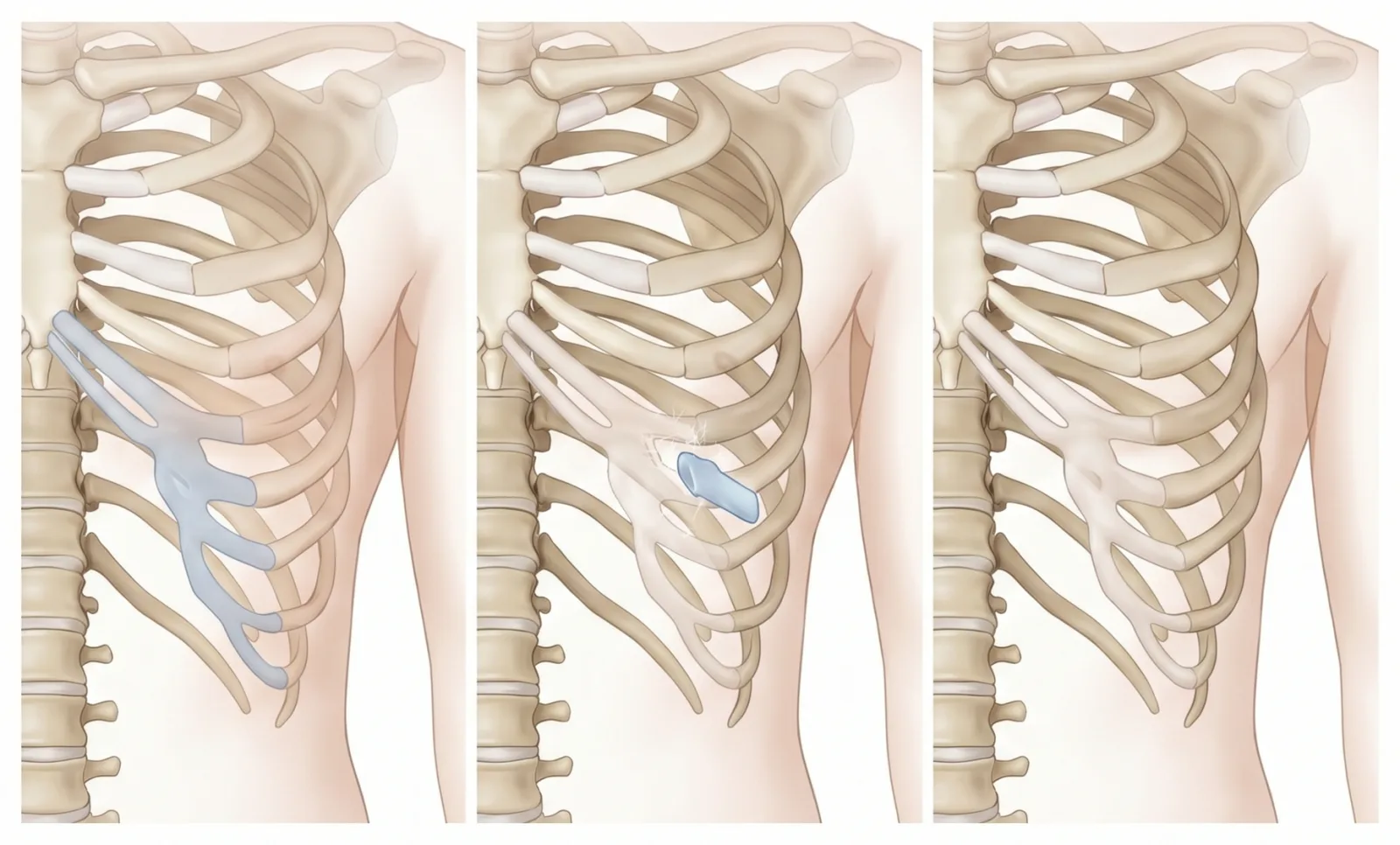
Illustration: where rib cartilage (blue) sits on the chest wall, and the small segment taken to build a stronger nasal framework.
Rib cartilage answers that specific shortage. The chest provides a long, strong segment of costal cartilage that can be carved into the grafts a difficult nose needs: a dorsal graft to rebuild the bridge, a strut to support the tip, spreader grafts to widen a pinched mid-vault. It is autologous (your own tissue) and integrates as living cartilage, which is why it is a workhorse material when softer sources are gone. Where a patient's own rib is unsuitable, processed donor (irradiated costal) cartilage can be discussed as an alternative.
Rib is not automatically the answer for every revision. A minor touch-up may need only a small amount of ear cartilage, and rib carries a chest donor site that simpler revisions do not justify. The decision turns on how much structural material the nose actually needs, which the assessment settles. If you are weighing materials, the rib versus ear cartilage comparison covers the trade-offs.
What it corrects
The problems rib cartilage revision is used to correct
The commonest reason patients seek a rib-based correction is loss of structure: a bridge that has lost height, a tip that has dropped or lost projection, or a nose that looks short and over-rotated after previous surgery removed too much support. Rib supplies the bulk and rigidity to restore a stable framework where smaller grafts would not hold the shape. A deviated or twisted nose, sometimes the result of an asymmetric first operation, is another classic indication, because a straight, strong rib graft can re-establish a central axis.
Illustration: the previous implant (outlined) is removed and the framework is rebuilt with the patient's own cartilage for support.
Contour problems are a second group: visible irregularities, a graft that has shifted or shows under the skin, or the typical signs of an ageing or extruding implant in a nose that was originally built with silicone. Removing an old implant often leaves a deficit that has to be filled with sturdy autologous material, and rib is well suited to that rebuild. This is closely related to general revision rhinoplasty, where rib is one of several material choices the surgeon weighs.
What rib revision is not is a guarantee of a particular look. Revised tissue is less predictable than virgin tissue, the skin may be thinned or scarred, and results refine over a longer period than a primary nose. A frank discussion covers what is realistically achievable for your specific nose, without promising an outcome. For how the recovery itself unfolds, see the rib cartilage recovery timeline.
Warping
Warping and the risks specific to rib grafts
The risk most associated with rib cartilage is warping: the tendency of carved costal cartilage to bend or twist as it settles, because rib has internal stresses that can release after it is shaped. In a revision nose, where the surgeon is relying on rib for the main structure, a warped graft can pull the result off-centre over months. Surgeons manage this with technique: carving balanced, concentric sections so the stresses cancel, soaking and observing the cartilage before fixing it, and using internal fixation (such as a buried wire or pin) to hold a straight graft. These measures lower the risk; none removes it entirely, which is why no responsible surgeon promises a graft will never warp.
Other rib-specific considerations include the chest donor site, where cartilage is taken. This adds a second area of healing and a small scar, covered in detail in the scars and healing page. As with any major rhinoplasty there are the usual surgical risks of bleeding, infection, asymmetry and the chance of needing further adjustment. Revision tissue, with its scarring and altered blood supply, can heal less predictably than a first operation.
Pain and anaesthesia for a rib case differ from a simpler nose because of the chest harvest; the pain and anaesthesia page explains how the donor site is managed. The key point for revision patients is that these risks are weighed against the alternative (leaving a structurally compromised nose as it is), and that the right material choice is one a board-certified plastic surgeon makes case by case.
Timing
When to consider revision after a previous nose surgery
Timing matters more in revision than in primary surgery. After a previous operation the nose is swollen, the tissues are inflamed and scar tissue is still maturing. Operating into that environment is harder and the result less predictable. As a general guide, surgeons commonly wait around a year from the previous surgery before a planned revision, so swelling has resolved and the tissues have softened and settled. For a complex rib rebuild this patience is part of getting a stable result.
There are exceptions. An exposed or infected implant, a graft that is extruding, or a breathing problem that will not improve may force earlier intervention, and those situations are assessed urgently. But for the great majority (a result you are unhappy with cosmetically), the advice is usually to let the nose finish settling first, because operating too early can mean re-revising later. Many patients use this window to plan properly, including an online consultation from abroad.
If you had your first surgery elsewhere, bring whatever records you can: operative notes, what material was used, whether an implant is in place. That information shapes the plan: a nose with a silicone implant, a nose with depleted septal cartilage and a nose that has already had one rib graft are three different problems. The more the surgeon knows going in, the more accurate the assessment of what rib revision can and cannot do for you.
Assessment
What a careful revision assessment looks like
A good revision consultation starts by understanding what was done before and what is bothering you now, before any talk of results. The surgeon examines the skin quality, the remaining cartilage, the position of any implant and how the nose moves and breathes, then explains what is realistically correctable and what the limits are for your tissue. For some noses the realistic answer is that a modest improvement is achievable; for others, that waiting longer or choosing a different material is wiser. That candour is the point of the visit.
At a single-surgeon clinic the person who assesses you is the person who will operate and follow you up, so nothing is lost in translation between a consultation and the operating room. You should leave knowing which grafts are planned, why rib was chosen over ear or septal cartilage for your case, what the chest donor site involves, and how the surgeon will manage the warping risk. Revision is detailed work, and the plan should feel specific to your nose.
Because revision patients are often nervous after a disappointing first result, an unhurried, no-pressure assessment matters. You can send photographs and your history for an initial opinion before you travel, then confirm the plan in person. The aim is a clear, realistic agreement on what the surgery is trying to achieve. See also how to verify a board-certified surgeon for what to check before you book.
At Garnet
How revision rib cartilage rhinoplasty works at Garnet
Garnet is a single-surgeon clinic in Apgujeong, Seoul. Dr. In-Soo Baek is a board-certified plastic surgeon (Korean medical licence no. 77407) and the only operating doctor. He consults, performs the surgery himself and reviews every follow-up. For a revision rib case that continuity matters: the surgeon who judges which grafts your nose needs is the one who carves and fixes them, and the same surgeon reviews how the result settles at structured follow-ups at 1, 3 and 6 months.
The clinic caps the day at 2 surgeries, which suits the unhurried, detailed nature of revision rib work. Assessment is candid by design: if rib is not the right answer, or the timing is wrong, you will be told so and not booked. Garnet is registered with Korea's foreign-patient programme and coordinates consultation, scheduling and after-care for international visitors, including remote follow-up once you return home.
If you are considering correcting a previous nose, you can begin with a no-obligation pre-assessment: send photographs and, if you have them, your previous operative details. The surgeon can give an early, candid view of whether rib revision is appropriate for your nose before you plan any travel.
Prices
Price at Garnet
Revision rhinoplasty
From₩4,000,000 + VATExcluding VAT (10% VAT is added at payment)Book now
Same price as Korean patients. Prices shown exclude 10% VAT; your written quote, issued after the in-person consultation, shows the full amount payable.
Dr. In-Soo Baek
Director & sole operating surgeon
Korean medical licence no. 77407
Operate on what you came for. Trained at Korea University Medical Center. Every case planned, performed and reviewed by the same hands.
1Operating surgeon
~2Surgeries per day
7Registered techniques
Board-certified plastic surgeon
Plastic surgery training at Korea University College of Medicine & graduate school
Korean Society of Plastic and Reconstructive Surgeons member, in its facial-contour, eye & rhinoplasty groups
Consults, operates and follows up each case himself
Peer-reviewed papers behind the facts on this page. Each describes findings in its own study group — not results at Garnet — and none predicts your own outcome.
Fedok FG et al. The Use of Costal Cartilage in Rhinoplasty. Facial Plastic Surgery Clinics of North America. 2024. doi:10.1016/j.fsc.2024.06.009
Luan CW et al. Complications associated with irradiated homologous costal cartilage use in rhinoplasty: A systematic review and meta-analysis. Journal of Plastic, Reconstructive & Aesthetic Surgery. 2022. doi:10.1016/j.bjps.2022.02.026
Drake VE et al. An update on rib grafting in rhinoplasty: which rib is right?. Current Opinion in Otolaryngology & Head & Neck Surgery. 2022. doi:10.1097/moo.0000000000000807
FAQ
Common questions
Can a previous rib cartilage rhinoplasty be corrected?
Yes, in most cases a previous rib cartilage rhinoplasty can be revised, though revision tissue is more scarred and less predictable than a first operation. The approach depends on what was done before and what material remains; sometimes additional rib cartilage is needed, and the surgeon assesses this case by case without promising a specific result.
What does rib cartilage rhinoplasty revision involve?
It involves opening the nose, removing or adjusting previous grafts or implants as needed, and rebuilding the framework with grafts carved from rib (costal) cartilage, for example to restore bridge height, support the tip or straighten the nose. Because rib is harvested from the chest, the procedure includes a second, small donor site that also needs to heal.
Why is rib cartilage chosen for revision over ear or septal cartilage?
Revision noses have often already used the septal and ear cartilage, or need more structural material than those sources can provide. Rib supplies a long, strong segment of cartilage that can rebuild a collapsed or over-resected framework. For minor revisions, ear cartilage may still be enough; the choice depends on how much support your nose actually needs.
How long should I wait after my previous nose surgery before a revision?
Surgeons commonly advise waiting around a year after the previous operation so swelling resolves and scar tissue softens and settles, which makes a planned revision safer and more predictable. Urgent problems such as an exposed implant or a breathing issue may be assessed earlier, but most cosmetic revisions are best done once the nose has finished settling.
What is warping, and how is it managed in rib revision?
Warping is the tendency of carved rib cartilage to bend or twist as it settles, because rib has internal stresses. Surgeons reduce the risk by carving balanced sections, observing the cartilage before fixing it, and using internal fixation to hold a straight graft. These measures lower but do not eliminate the risk, so no responsible surgeon guarantees a graft will never warp.
Will I need a chest scar for a rib revision?
Yes. Because the cartilage is harvested from the chest, there is a small donor-site scar in addition to the nasal healing. It is usually placed in a discreet location and fades over time. The scars-and-healing page covers placement and how the donor site recovers in more detail.
Can rib revision fix a nose built with a silicone implant?
Often, yes. Removing an old or problematic implant typically leaves a structural deficit that needs filling with sturdy material, and rib cartilage is well suited to rebuilding the bridge or tip after implant removal. The surgeon assesses the skin, remaining cartilage and implant position to plan what the rebuild requires.
Is revision rib rhinoplasty more difficult than a first operation?
Generally yes. Scar tissue, an altered blood supply and depleted cartilage make revision technically harder and the result less predictable than a primary case. This is precisely why strong, abundant rib cartilage is often the chosen material, and why an experienced, candid assessment of what is achievable matters so much.
Can I be assessed for a rib revision before travelling to Korea?
Yes. You can send photographs and, if you have them, your previous operative records for an online pre-assessment, so the surgeon can give an early, candid view of whether rib revision suits your nose before you commit to travel. The plan is then confirmed in person at consultation.
Who performs the revision at Garnet?
Garnet is a single-surgeon clinic, so the same board-certified plastic surgeon, Dr. In-Soo Baek, consults, performs the operation and reviews your follow-ups at 1, 3 and 6 months. For complex revision work, that continuity means the surgeon who plans your grafts is the one who carves and places them.
My mom recently had a brow lift and lower blepharoplasty with Dr. Baek, and our experience has been wonderful so far. The Garnet team was incredibly kind and welcoming, with Kelly assisting us as our English consultant—she made everything…
I’m so happy I chose this clinic for my lower blepharoplasty. I was traveling from abroad by myself, so I was a little nervous, but from the beginning I felt comfortable and truly cared for. Everyone was kind, patient, and professional…
Came in for an in-person consult and ended up choosing Garnet and Dr.Baek for my non-incisional DES and tiplasty/alarplasty. I communicated with Kelly (English consultant) from the start till now (3 weeks post-op). She really help me feel…
My under-eyes have been sagging and folding for years... I tried to cover it up with makeup, but it actually got stuck in the wrinkles and made it stand out even more. While going for consultations, I noticed that the bigger the hospital…
If you are unhappy with a previous nose surgery, send photographs and any operative details for a no-obligation pre-assessment of whether rib revision is right for you.
Send photos and your question before you travel. An English-speaking coordinator reviews every nose revision enquiry and replies with guidance on whether surgery is appropriate, the likely plan and timing.
✓ Reviewed by the clinic coordinator, not a bot
✓ Photo-based pre-assessment before you fly
✓ Foreign-patient scheduling & after-care
✓ One surgeon for consultation, surgery and follow-up
Prefer to chat now? Reach the coordinator directly:









 T S7 months ago



