Rib cartilage rhinoplasty leaves 2 scars: a donor-site scar on the chest, where the cartilage is harvested, and the small columella scar of an open rhinoplasty on the nose. It is fair to want a clear picture of both before you decide. This page sets out where each scar sits, how visible it is, and how both heal, from suture removal through the months of maturing that follow.
The short answer
There are two scars: the chest (rib) donor-site scar where cartilage is harvested, and the nasal scar from the open rhinoplasty incision across the columella.
The chest donor scar is placed in a discreet location and is usually a single line; it fades over months but, like any scar, does not vanish completely.
Healing follows two timelines: nasal sutures are typically removed around 7 days, and the chest donor sutures around 10 days.
How a scar finally settles depends partly on your own skin and healing; aftercare and protecting the scars from the sun help them mature well.
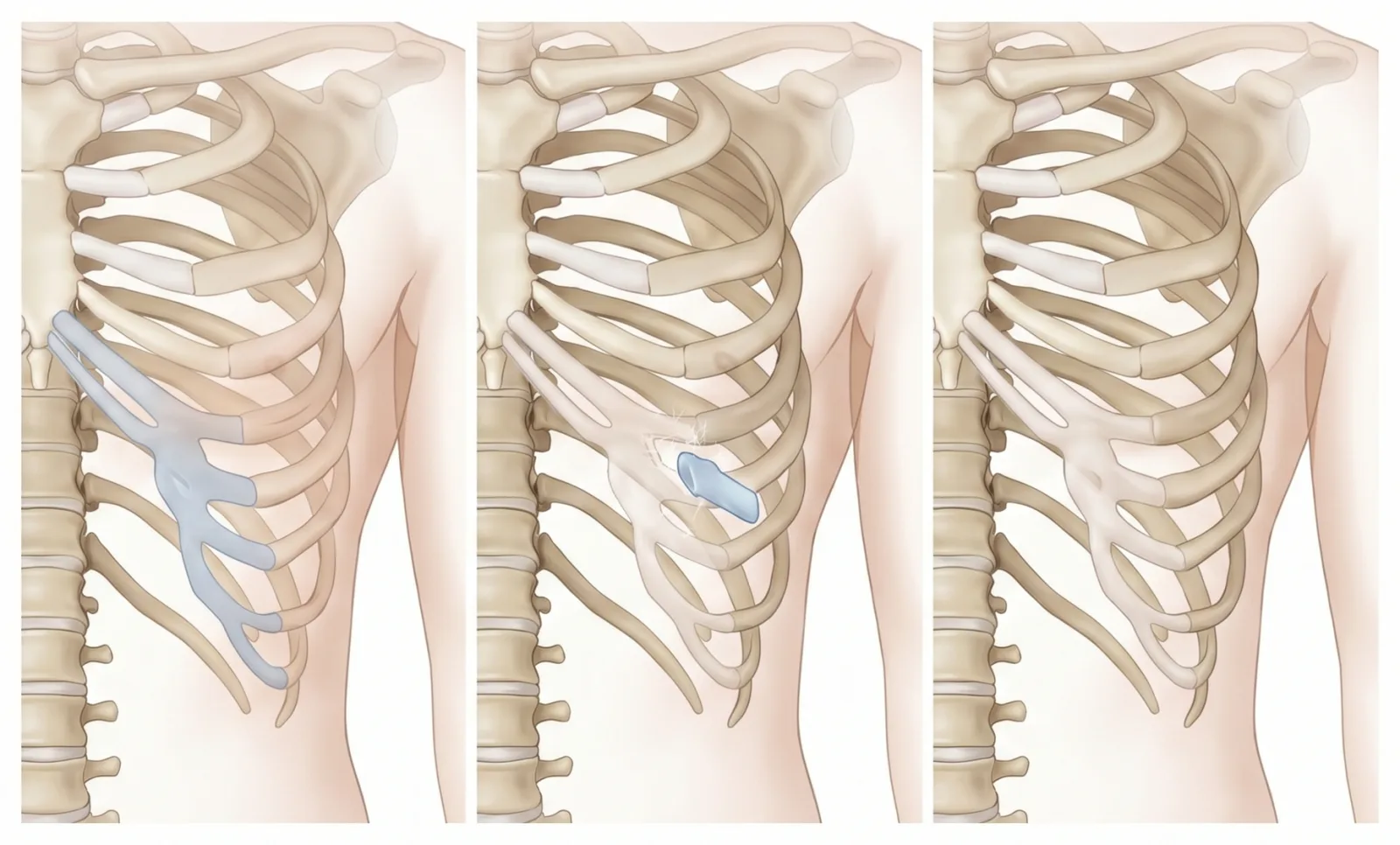
Most nose operations leave one area of healing. Rib cartilage rhinoplasty leaves two, and that is worth knowing up front. The first is the nasal scar, because rib cases are performed as an open rhinoplasty: a small incision across the columella (the strip of skin between the nostrils) so the surgeon can place and fix the structural grafts precisely. The second is the chest donor-site scar, where a segment of costal cartilage is harvested to build those grafts.
Illustration: where rib cartilage (blue) sits on the chest wall, and the small segment taken to build a stronger nasal framework.
That second scar is the trade-off for the structural strength rib provides. Rib is chosen when a nose needs strong, abundant material: a revision, a depleted nose, or a build that septal or ear cartilage cannot support. The donor scar is the cost of access to that material, which is why it matters to understand it clearly before deciding. If you are weighing whether you need rib at all, the rib versus ear cartilage comparison sets out the alternative, where the donor scar is behind the ear instead.
The good news is that both scars are planned to be discreet, and both fade considerably as they mature. The sections below cover each one specifically (where it sits, how visible it is, and how it heals), so your decision rests on a realistic picture of the chest and nasal scars.
Chest scar
The chest (rib) donor-site scar
The donor scar sits on the chest, where a section of rib cartilage is taken. It is generally a single line, placed in a discreet location and kept as short as the harvest allows. In the early weeks it is a firmer, pinker line; over the following months it typically softens and fades to a paler, flatter mark. As with any scar it does not disappear entirely, and exactly how it settles depends partly on your own skin and healing tendency.
Some people scar more readily than others, and a scar on the torso behaves differently from a facial scar. If you have a history of raised or thickened scars, tell the surgeon at consultation, because it affects both the placement plan and the aftercare advice. The donor-site sutures are typically removed around 10 days after surgery, a little later than the nasal sutures, which is part of why an international stay is planned around the chest site. See rib cartilage rhinoplasty for international patients.
In the first days the donor site is sore, particularly with coughing, laughing or twisting, more so than it is visible. That discomfort settles over the early weeks and is managed during your stay; the pain and anaesthesia page explains how the donor site is handled. The scar itself is the longer-term consideration, and it is one that fades steadily with time and care.
Nasal scar
The nasal incision scar
Because rib cases are open rhinoplasties, there is a small incision across the columella, the narrow strip of skin between the nostrils, along with incisions inside the nose that leave no external mark. The columellar scar is tiny and, once healed and matured, is usually inconspicuous in normal face-to-face conversation, because it sits on the underside of the nose. Nasal sutures are typically removed around 7 days after surgery.
In the first weeks the columellar line can look pink or slightly raised, which is normal as it heals; it softens and pales over the following months as the scar matures. The nose as a whole stays swollen well beyond suture removal, and a rib nose in particular refines over many months, so the early appearance is not the final one. For how that broader settling unfolds, the recovery timeline walks through it stage by stage.
It is worth keeping the two scars in proportion to each other. For most patients the columellar scar becomes the less noticeable of the two over time, simply because of where it sits and how small it is, while the chest donor scar is the one people most often ask about beforehand. Both are part of the trade-off rib involves, and both are planned to settle discreetly.
Healing
How the scars heal over time
Scar healing happens in overlapping phases. In the first week or two the incisions are closed and the sutures are still in or just removed: the nose around day 7, the chest around day 10. The lines look their freshest and pinkest at this stage. Over the following weeks the scars begin to flatten and the redness starts to fade, although they remain immature and can still look more obvious than they eventually will.
From roughly six weeks through several months the scars enter the longer remodelling phase, gradually softening, flattening and paling toward their final appearance. This is slow and not linear (a scar can look slightly worse before it looks better), and full maturation of a scar generally takes many months. Patience is part of the process, and judging a scar too early gives a misleadingly harsh impression of where it will end up.
Two timelines run in parallel: the visible scars maturing, and the deeper structural healing of the rib grafts in the nose as swelling resolves and the shape settles. They are related but separate, and both reward time. The surgeon reviews both at structured follow-ups, which is where any concern about how a scar is settling is best raised.
Aftercare
Helping the scars settle well
You cannot fully control how you scar, but aftercare genuinely helps. Following the surgeon's wound-care instructions, keeping the sites clean, and not putting tension on the healing incisions in the early weeks all support a tidier result. Avoiding heavy lifting and vigorous activity early protects the chest donor site in particular, since strain across the torso pulls on that scar while it is fresh.
Sun protection matters more than people expect: a fresh scar exposed to sun can darken and stay discoloured, so keeping both the chest and the nose protected once healed is worth the effort. Where appropriate the surgeon may advise scar-care measures such as silicone-based products during the maturing phase; follow the specific guidance you are given, because it is tailored to how your scars are settling.
If you live abroad, this is exactly the kind of thing a remote follow-up is for. You can send photographs of how a scar is maturing and get advice on whether it is on track or whether a measure would help. Garnet reviews scarring as part of structured follow-ups at 1, 3 and 6 months, including by messenger after you return home.
At Garnet
How scars and healing are handled at Garnet
Garnet is a single-surgeon clinic in Apgujeong, Seoul. Dr. In-Soo Baek, a board-certified plastic surgeon (Korean medical licence no. 77407), is the only operating doctor, so he harvests the rib, builds the nose and sees you at every follow-up. The same surgeon who plans where the chest harvest and columellar incision sit is the one who reviews how both scars settle, with structured follow-ups at 1, 3 and 6 months.
At consultation the surgeon discusses scar placement openly, including any personal tendency to scar, and explains realistically how the donor and nasal scars are expected to look and fade. He does not promise they will be invisible; the aim is a clear picture so there are no surprises. The clinic caps the day at two surgeries, which keeps the surgical and after-care attention unhurried.
Garnet is registered with Korea's foreign-patient programme, so for visitors from abroad the scar follow-up continues remotely by messenger once you return home. You can begin with a no-obligation online pre-assessment — send photographs and any previous nose-surgery details, and the surgeon can talk you through the scarring rib involves before you decide whether it is right for you.
Dr. In-Soo Baek
Director & sole operating surgeon
Korean medical licence no. 77407
Operate on what you came for. Trained at Korea University Medical Center. Every case planned, performed and reviewed by the same hands.
1Operating surgeon
~2Surgeries per day
7Registered techniques
Board-certified plastic surgeon
Plastic surgery training at Korea University College of Medicine & graduate school
Korean Society of Plastic and Reconstructive Surgeons member, in its facial-contour, eye & rhinoplasty groups
Consults, operates and follows up each case himself
Peer-reviewed papers behind the facts on this page. Each describes findings in its own study group — not results at Garnet — and none predicts your own outcome.
Pfaff MJ et al. Cadaveric Costal Cartilage Grafts in Rhinoplasty and Septorhinoplasty: A Systematic Review and Meta-Analysis of Patient-Reported Functional Outcomes and Complications. Journal of Craniofacial Surgery. 2021. doi:10.1097/scs.0000000000007400
Yoo SH et al. Rib cartilage in Asian rhinoplasty: new trends. Current Opinion in Otolaryngology & Head & Neck Surgery. 2019. doi:10.1097/moo.0000000000000547
Liang X et al. A systematic review and meta-analysis of comparison between autologous costal cartilage and alloplastic materials in rhinoplasty. Journal of Plastic, Reconstructive & Aesthetic Surgery. 2018. doi:10.1016/j.bjps.2018.03.017
FAQ
Common questions
Where are the scars after rib cartilage rhinoplasty?
There are two: a chest (rib) donor-site scar where the cartilage is harvested, placed in a discreet location and usually a single line; and a nasal scar from the open rhinoplasty incision across the columella, the strip of skin between the nostrils. Additional incisions inside the nose leave no external mark.
Will rib cartilage rhinoplasty scars be visible?
Both scars are planned to be discreet and fade considerably as they mature. The columellar nasal scar is tiny and usually inconspicuous in normal conversation. The chest scar is more often asked about beforehand; it softens and pales over months but, like any scar, does not disappear entirely. How well it settles depends partly on your own skin.
How do rib cartilage rhinoplasty scars heal over time?
They heal in phases: freshest and pinkest in the first weeks while sutures are in or newly removed, then flattening and fading over the following weeks, then a longer remodelling phase over several months toward their final appearance. Full scar maturation generally takes many months, and a scar can look slightly worse before it improves.
When are the sutures removed?
Nasal sutures are typically removed around 7 days after surgery, and the chest (rib) donor-site sutures around 10 days. The donor site heals a little later than the nose, which is why an international stay is usually planned around the chest suture removal.
Is the chest scar painful or just visible?
In the first days the donor site is more sore than visible, particularly with coughing, laughing or twisting, and that discomfort settles over the early weeks with pain management during your stay. The scar itself is the longer-term consideration, and it fades steadily with time and care without ongoing pain.
Can I do anything to make the scars fade better?
Yes. Following the surgeon's wound-care instructions, avoiding tension and heavy lifting on the healing sites early, and protecting the scars from the sun all help. The surgeon may advise scar-care measures such as silicone-based products during the maturing phase; follow the specific guidance you are given, as it is tailored to how your scars are settling.
What if I tend to scar badly or get raised scars?
Tell the surgeon at consultation if you have a history of raised or thickened scars, because it affects both the placement plan and the aftercare advice. People scar differently and a torso scar behaves differently from a facial one, so an open discussion of your own healing tendency is part of planning the procedure.
How does the nasal scar compare with the chest scar?
For most patients the columellar nasal scar becomes the less noticeable of the two over time, because it is tiny and sits on the underside of the nose. The chest donor scar is the one people most often ask about beforehand. Both are planned to settle discreetly and both fade as they mature.
Can my scars be followed up after I return home?
Yes. Garnet is registered with Korea's foreign-patient programme and reviews scarring as part of structured follow-ups at 1, 3 and 6 months, including by messenger after you return home. You can send photographs of how a scar is maturing and get advice on whether it is on track or whether a measure would help.
Who plans where the scars go at Garnet?
Garnet is a single-surgeon clinic, so the same board-certified plastic surgeon, Dr. In-Soo Baek, plans the chest harvest and columellar incision, performs the operation, and reviews how both scars settle at follow-up. There is no hand-off between the surgeon who plans the incisions and the one who places them.
My mom recently had a brow lift and lower blepharoplasty with Dr. Baek, and our experience has been wonderful so far. The Garnet team was incredibly kind and welcoming, with Kelly assisting us as our English consultant—she made everything…
I’m so happy I chose this clinic for my lower blepharoplasty. I was traveling from abroad by myself, so I was a little nervous, but from the beginning I felt comfortable and truly cared for. Everyone was kind, patient, and professional…
Came in for an in-person consult and ended up choosing Garnet and Dr.Baek for my non-incisional DES and tiplasty/alarplasty. I communicated with Kelly (English consultant) from the start till now (3 weeks post-op). She really help me feel…
My under-eyes have been sagging and folding for years... I tried to cover it up with makeup, but it actually got stuck in the wrinkles and made it stand out even more. While going for consultations, I noticed that the bigger the hospital…
Want a clear picture of the chest and nasal scarring before you decide? Send photographs for a no-obligation pre-assessment and we will talk you through what rib cartilage rhinoplasty involves.
Send photos and your question before you travel. An English-speaking coordinator reviews every enquiry and replies with guidance on whether surgery is appropriate, the likely plan and timing.
✓ Reviewed by the clinic coordinator, not a bot
✓ Photo-based pre-assessment before you fly
✓ Foreign-patient scheduling & after-care
✓ One surgeon for consultation, surgery and follow-up
Prefer to chat now? Reach the coordinator directly:









 T S7 months ago



