Rib cartilage rhinoplasty is one of the more involved nose operations, because the cartilage is harvested from the chest as well as shaping the nose. For an international patient that means planning around two healing sites, the nose and the chest donor site, and a stay long enough to have both sets of sutures removed before you fly home. This page covers exactly how to plan the trip: stay length, the online consultation, what happens in Seoul, and how follow-up continues remotely afterwards.
The short answer
Plan your stay around the longer of the two healing sites: nasal sutures come out at about a week, while the chest (rib) donor sutures are typically removed around ten days.
Most patients start with an online consultation, sending photographs and any previous nose-surgery records for a pre-assessment before booking travel.
A single-surgeon clinic means the surgeon who assesses you online is the one who operates and reviews you afterwards, which is useful continuity for a remote patient.
Follow-up continues after you return home by messenger, with structured reviews at 1, 3 and 6 months and clear guidance on what to watch for.
Why rib cartilage rhinoplasty needs more planning than a standard nose
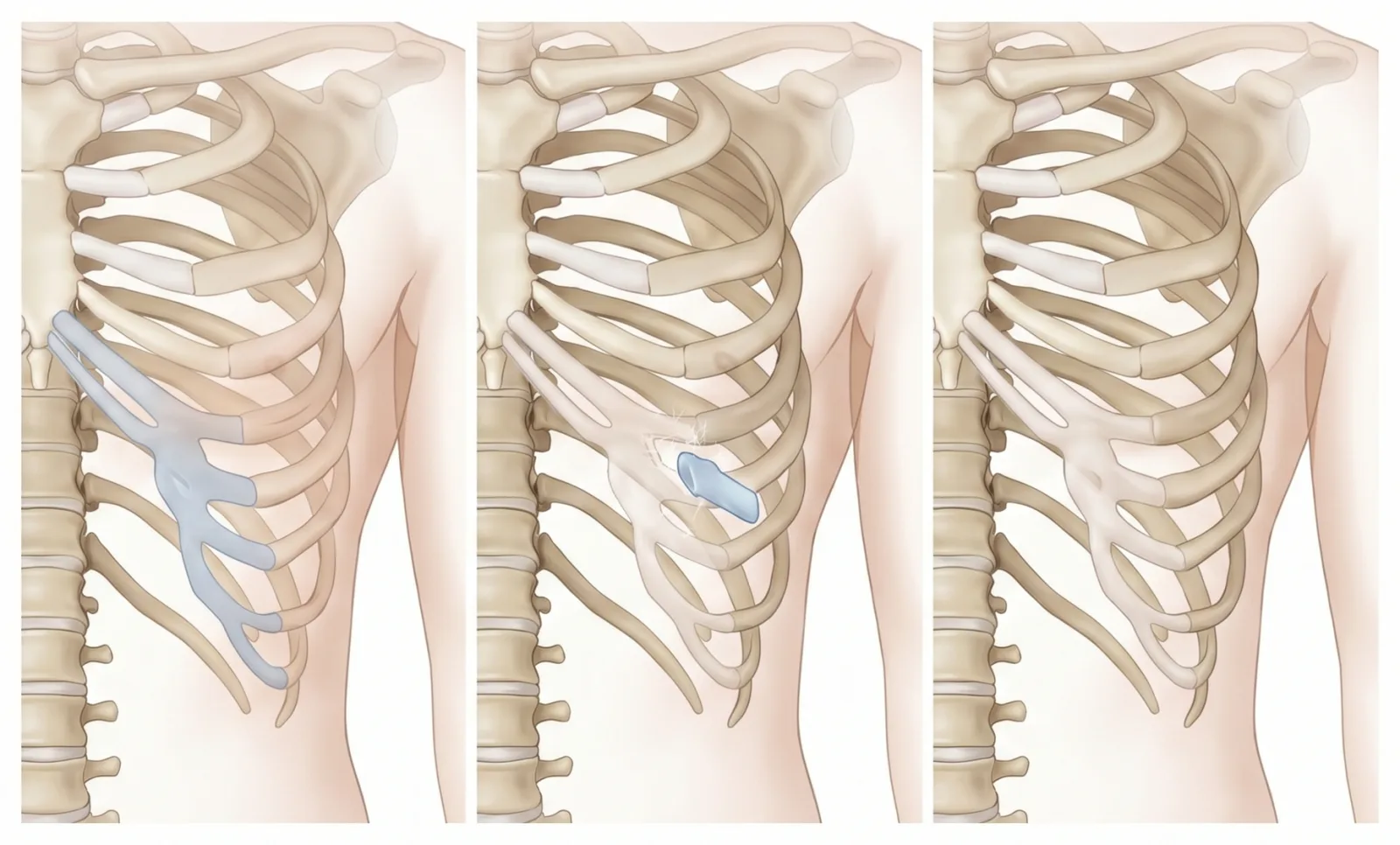
A standard nose operation has one area to heal. Rib cartilage rhinoplasty has two: the nose itself and the chest, where a segment of costal cartilage is harvested to build the nasal framework. For an international patient that second site changes the planning, because the donor area has its own sutures, its own healing timeline and its own comfort considerations during the early days.
Illustration: where rib cartilage (blue) sits on the chest wall, and the small segment taken to build a stronger nasal framework.
Rib is chosen when the nose needs strong, abundant structural material: often a revision, a depleted nose, or a build that requires more support than septal or ear cartilage can provide. That structural advantage is exactly why the operation is worth planning carefully around. It is autologous (your own tissue), and where a patient's own rib is unsuitable, processed donor cartilage may be discussed as an alternative.
The practical upshot is that you should budget your trip around the longer of the two healing sites and arrange your consultation in advance, ideally remotely. The sections below set out realistic stay length, how the online consultation works, and what happens once you are in Seoul. If you are still deciding whether rib is the right material, the rib versus ear cartilage comparison is a good place to weigh it up.
Stay length
How long to stay in Korea for rib cartilage rhinoplasty
The deciding factor is suture removal. Nasal sutures are typically removed around seven days after surgery, while the chest (rib) donor-site sutures are usually removed at about ten days. Because you want both sets removed before flying, the chest site is what sets your minimum stay. Most international patients plan for roughly ten to twelve days in Korea, allowing a day or two of margin around the donor-site suture removal and a final review with the surgeon.
Plan the first day or two for arrival and your in-person consultation, then surgery, then the bulk of the stay for healing and the two suture-removal visits. Swelling and bruising are heaviest in the first week and ease over the following weeks, so you will not look fully settled when you leave. That is normal, and the nose continues to refine for months. Building in a little buffer is wise in case the surgeon prefers to keep an eye on the donor site slightly longer.
If you want a fuller picture of how recovery unfolds beyond the trip itself, see the recovery timeline. For general guidance on flying after surgery and choosing where to recover, the guides on how long to stay in Korea are a useful complement to the procedure-specific timing here.
Online consult
Starting with an online consultation from abroad
Almost every international rib case begins remotely. You send clear photographs of your nose from several angles and, if you have had previous surgery, whatever records you can, such as operative notes and what material was used. From that the surgeon can give an early opinion on whether rib cartilage is the right material for your nose, what the operation would aim to achieve, and what the realistic limits are. This happens before you book any travel, so you are not committing to a flight on a guess.
An online consultation is also where the practicalities get settled: the likely stay length for your case, what the chest donor site involves, and the scarring you should expect, covered in the scars and healing page. A pre-assessment may also conclude that rib is not necessary for you, or that a different timing is wiser. That is useful information to have before you spend money on travel.
The in-person consultation in Seoul then confirms the plan: the surgeon examines you directly, checks skin quality and breathing, and finalises which grafts are needed. For more on how the remote process works in general, see online consultation from abroad.
In Seoul
Your time in Seoul, step by step
A typical trip runs: arrival and in-person consultation, then surgery, then a recovery period in Seoul with two suture-removal milestones: the nose at about a week and the chest donor site at about ten days. The clinic coordinates scheduling around your flights, and a dedicated coordinator stays with you from consultation through recovery, which removes a lot of the friction of navigating a medical trip in another country.
During the stay you will manage two healing areas. The nose is splinted and tender; the chest donor site is sore, particularly when coughing, laughing or moving in the first days, and you will be given guidance and pain management for it. The pain and anaesthesia page explains how the donor site is handled. Plan a calm, low-activity stay; this is not the trip for sightseeing marathons.
Garnet is in Apgujeong in central Seoul, a short walk from Apgujeong Station, which keeps travel to and from review appointments simple while you are healing. The guide on recovering in Seoul covers choosing accommodation and what the recovery days are practically like.
After home
Follow-up after you return home
You will fly home before your nose has fully settled, and that is expected. By the time you leave, both sets of sutures are out and the surgeon is satisfied the early healing is on track, but a rib nose continues to refine over many months. The point of leaving with a clear after-care plan is so you know exactly what is normal, what is not, and when to make contact.
Follow-up continues remotely. At a single-surgeon clinic the same surgeon who operated reviews your progress by messenger, with structured check-ins at 1, 3 and 6 months. You send photographs at the agreed points and raise anything you are unsure about; the surgeon advises whether a finding is part of normal settling or something to have looked at locally. That continuity is one of the practical advantages of a single-surgeon model for a patient who lives abroad.
If a question does arise that needs hands-on care where you live, the surgeon can guide you on what to seek locally. The aim is that distance does not mean being left on your own. The relationship continues past the trip itself, which is exactly what an international rib patient needs.
At Garnet
How Garnet looks after international rib patients
Garnet is a single-surgeon clinic in Apgujeong, Seoul. Dr. In-Soo Baek is a board-certified plastic surgeon (Korean medical licence no. 77407) and the only operating doctor — he consults, performs the surgery himself and reviews every follow-up. For an international rib patient that means the surgeon you speak to online is the one who carves your grafts and the one who reviews your healing at 1, 3 and 6 months, with no hand-off in between.
The clinic is registered with Korea's foreign-patient programme and coordinates consultation, scheduling and after-care for visitors from abroad, including remote follow-up once you return home. A dedicated coordinator stays with you from the first online message through your recovery in Seoul, and the day is capped at two surgeries so each case has unhurried time.
You can start without committing to travel: send photographs and any previous nose-surgery records for a no-obligation online pre-assessment. The surgeon can give an early view of whether rib cartilage rhinoplasty suits your nose and roughly how long you would need to stay, so you can plan the trip with realistic expectations.
Dr. In-Soo Baek
Director & sole operating surgeon
Korean medical licence no. 77407
Operate on what you came for. Trained at Korea University Medical Center. Every case planned, performed and reviewed by the same hands.
1Operating surgeon
~2Surgeries per day
7Registered techniques
Board-certified plastic surgeon
Plastic surgery training at Korea University College of Medicine & graduate school
Korean Society of Plastic and Reconstructive Surgeons member, in its facial-contour, eye & rhinoplasty groups
Consults, operates and follows up each case himself
Peer-reviewed papers behind the facts on this page. Each describes findings in its own study group — not results at Garnet — and none predicts your own outcome.
Pfaff MJ et al. Cadaveric Costal Cartilage Grafts in Rhinoplasty and Septorhinoplasty: A Systematic Review and Meta-Analysis of Patient-Reported Functional Outcomes and Complications. Journal of Craniofacial Surgery. 2021. doi:10.1097/scs.0000000000007400
Keramidas E et al. Flying Following Breast Augmentation. How Safe is it? An Evidence-Based Report of 20 Years of Experience. Aesthetic Plastic Surgery. 2026. doi:10.1007/s00266-026-06028-2
Yoo SH et al. Rib cartilage in Asian rhinoplasty: new trends. Current Opinion in Otolaryngology & Head & Neck Surgery. 2019. doi:10.1097/moo.0000000000000547
Maltezou HC et al. Challenges with medical tourism. Current Opinion in Critical Care. 2024. doi:10.1097/mcc.0000000000001148
FAQ
Common questions
How do international patients get rib cartilage rhinoplasty in Korea?
Most begin with an online consultation, sending photographs and any previous nose-surgery records for a pre-assessment before booking travel. If rib cartilage is appropriate, the plan is confirmed at an in-person consultation in Seoul, then surgery follows, with a stay long enough to have both the nasal and chest sutures removed before flying home.
How long should I stay in Korea for rib cartilage rhinoplasty?
Plan around the longer healing site: nasal sutures come out at about a week and the chest (rib) donor-site sutures at about ten days. Most international patients budget roughly ten to twelve days in Korea, which covers the consultation, surgery, both suture removals and a final review, with a little margin in case the donor site needs watching slightly longer.
Can I start with an online consultation for rib cartilage rhinoplasty?
Yes. You send clear photographs from several angles and, if you have had previous surgery, your operative records, and the surgeon gives an early opinion on whether rib cartilage is right for your nose and what the operation would aim to achieve. The plan is then confirmed in person in Seoul before surgery.
Why does rib cartilage rhinoplasty need a longer stay than a standard nose?
Because the cartilage is harvested from the chest, there are two healing sites: the nose and the chest. The chest donor-site sutures are typically removed later than the nasal sutures, so the donor site sets the minimum stay. You want both sets removed before flying, which makes the trip a little longer than a standard rhinoplasty.
How does follow-up work after I return home?
Follow-up continues remotely. At a single-surgeon clinic the same surgeon who operated reviews your progress by messenger, with structured check-ins at 1, 3 and 6 months. You send photographs at agreed points, and the surgeon advises whether what you see is normal settling or something to have checked locally, and can guide you on local care if needed.
Will I look fully recovered before I fly home?
No, and that is normal. By the time you leave, both sets of sutures are out and the early healing is on track, but swelling settles over weeks and a rib nose continues to refine for months. You fly home with a clear after-care plan describing what is normal and when to make contact.
Is the chest donor site a problem when travelling home?
The donor site is sore in the early days, especially with coughing or movement, but it settles over the first weeks and the sutures are removed before you fly. You will be given guidance and pain management for it during your stay. Planning a calm, low-activity recovery instead of a busy trip makes the travel home easier.
Do I need to bring records from a previous nose surgery?
If you have had previous nose surgery, bringing operative notes and details of what material was used is very helpful, because it shapes the plan. A nose with an implant, a depleted nose and a nose that has already had a rib graft are different problems. The more the surgeon knows, the more precise the pre-assessment can be.
Does Garnet treat international patients for rib cartilage rhinoplasty?
Yes. Garnet is registered with Korea's foreign-patient programme and coordinates consultation, scheduling and after-care for visitors from abroad, including remote follow-up after you return home. A dedicated coordinator stays with you from the first online message through recovery in Seoul.
Where is Garnet, and is it easy to reach for review appointments?
Garnet is in Apgujeong in central Seoul, a short walk from Apgujeong Station, which keeps travel to and from review appointments simple while you are healing. Its central location is convenient for a patient who is recovering nearby and attending two suture-removal visits during the stay.
My mom recently had a brow lift and lower blepharoplasty with Dr. Baek, and our experience has been wonderful so far. The Garnet team was incredibly kind and welcoming, with Kelly assisting us as our English consultant—she made everything…
I’m so happy I chose this clinic for my lower blepharoplasty. I was traveling from abroad by myself, so I was a little nervous, but from the beginning I felt comfortable and truly cared for. Everyone was kind, patient, and professional…
Came in for an in-person consult and ended up choosing Garnet and Dr.Baek for my non-incisional DES and tiplasty/alarplasty. I communicated with Kelly (English consultant) from the start till now (3 weeks post-op). She really help me feel…
My under-eyes have been sagging and folding for years... I tried to cover it up with makeup, but it actually got stuck in the wrinkles and made it stand out even more. While going for consultations, I noticed that the bigger the hospital…
Planning a rib cartilage rhinoplasty trip from abroad? Send photographs for an online pre-assessment and we will help you plan a realistic stay before you book.
Send photos and your question before you travel. An English-speaking coordinator reviews every enquiry and replies with guidance on whether surgery is appropriate, the likely plan and timing.
✓ Reviewed by the clinic coordinator, not a bot
✓ Photo-based pre-assessment before you fly
✓ Foreign-patient scheduling & after-care
✓ One surgeon for consultation, surgery and follow-up
Prefer to chat now? Reach the coordinator directly:









 T S7 months ago



