Round eye correction repositions the lower lid to reduce roundness and give the eye a natural almond shape, and that structural change is designed to last. The lower lid is a delicate, support-dependent area, though, so it helps to know how the result settles and how it ages.
The short answer
Round eye correction is a structural change to the lower-lid position and shape, so the improvement is designed to last.
It repositions and supports the lid without relying on tension across the skin, so the settled result holds well over the years.
No surgery stops ageing: the lower lid is a support-sensitive area, so over a long horizon some natural laxity can gently return, from an improved starting point.
When a further adjustment is considered, it is usually about fine-tuning the settled position, once healing is fully complete.
How long a round eye correction result typically lasts
Round eye correction reshapes the lower lid, reducing an overly round, exposed look and any lower-lid retraction to restore a more natural almond shape. It works by repositioning and supporting the lid itself, so the improvement is a lasting structural change. Once the lid has been corrected and has fully healed, that is essentially the shape it holds.
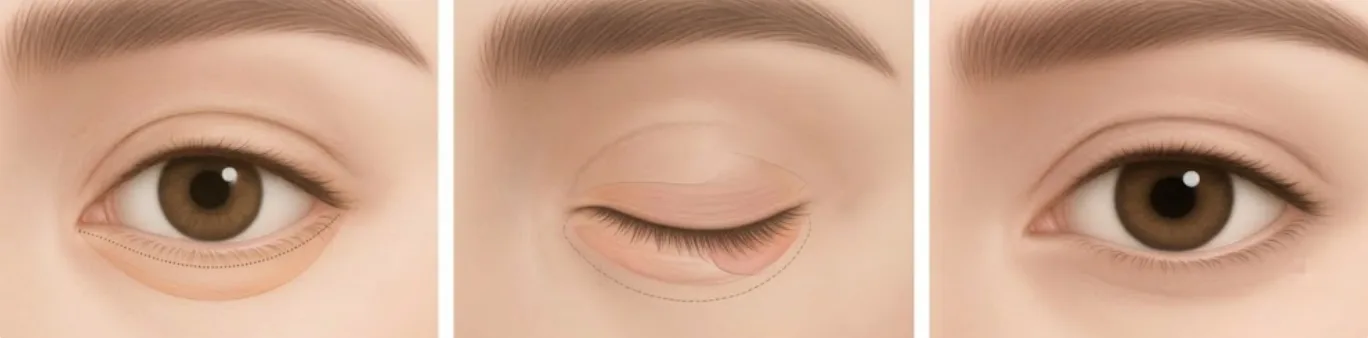
Illustration: the rounded, open lower-lid line is outlined and gently brought back toward a calmer, more natural eye shape.
So the useful way to think about a round eye correction is not as something that "lasts X years and stops," but as a durable resetting of the lower-lid position, from which you then age naturally. It does not fade the way a non-surgical treatment wears off; the change is built into the lid's corrected position and support.
The caveat is that the lower lid is one of the most delicate, support-dependent areas of the face, so a realistic view of settling and long-term ageing is worth having. This is why round eye correction is a precise procedure best judged individually. Our candidacy guide covers whose lid shape suits it, and how the method is tailored to each case.
Why lasting
Why the correction is a lasting change
The durability comes from the nature of the correction. Round eye correction addresses the lower-lid position and its support, reducing roundness or retraction so the lid sits in a more natural, almond contour. It repositions and reinforces the lid without depending on tension pulling across the skin, so no constant force works to undo it in the way a skin-tightening lift can relax.
Once the corrected lid has healed, it rests in its new position. That is why the settled result is a good guide to what you keep for the coming years; the look in the first weeks is not. The improvement is structural, so it is lasting: a genuine change to the lid's shape and support.
This also means the precision of the initial surgery is what you are really investing in. The lower lid rewards careful, conservative judgement, and a correction made thoughtfully, respecting the lid's natural support, is what ages well. The lasting result is decided during surgery and refined through healing; nothing needs topping up afterwards.
Settling
Early settling versus the true result
There is an important nuance: the lid you see in the first weeks is not yet the final one. Immediately after surgery there is swelling, and the lower lid is settling into its corrected position as the tissue heals. A round eye correction typically looks its truest a few months out, once the swelling has fully resolved and the lid has taken its settled shape. This early change is the result maturing.
Judging longevity from the first weeks is therefore misleading, because normal settling is part of how the lid reaches its final position. The genuine, lasting result is best assessed after healing is complete, which is what the follow-up visits are for: telling normal early settling apart from anything that might need attention. Our recovery timeline walks through this stage by stage.
So when people ask whether their lid is "changing back" in the early period, the answer is almost always that it is simply settling into its true, corrected position, which is then the lasting one. This is why patience through the first few months, guided by the surgeon, is part of getting the right read on the result.
With age
How the lower lid behaves as you age
No surgery stops the clock, and the lower lid is a support-sensitive area, so it is worth knowing how it ages. Once the correction has settled, it tends to hold well, and you age forward from an improved lid position. But over a long horizon the lower lid, like the rest of the eye area, naturally loses a little support and elasticity, and some gentle laxity can return with the years, from a much-improved starting point.
It is important to distinguish this from the correction failing. The structural change that reshaped the lid does not simply reverse; rather, the surrounding tissues continue their natural ageing. For most people this means they enjoy the corrected, more natural eye shape for a long time and age gracefully from that improved point.
How gradually any laxity returns depends on the individual: age at surgery, tissue quality and lifestyle all play a part. Protecting the skin from heavy sun and general good skin care will not freeze the result, but support the area's ageing gently over time. The key point is that the corrected shape is your baseline, and the lower lid simply keeps ageing naturally around it.
Adjustment
When a further adjustment is considered
Because the correction is a lasting structural change, a further procedure is rarely about the result "wearing off." When an adjustment is considered, it is usually about the settled position: refining the lid contour once it has fully healed, or, much later, addressing age-related laxity in the surrounding area. These are questions of fine-tuning, and durability is seldom the issue.
Timing is essential, especially for the lower lid. It is best not to judge whether anything needs adjusting until the lid has fully settled, several months on, because early appearances change as healing completes. If, after that, someone wishes to refine the shape, it is a considered decision made together with the surgeon. Our revision guide explains what is and is not usually advisable in this delicate area.
A well-judged round eye correction, allowed to settle fully, generally gives a lasting result the patient is happy to keep. Where a refinement is chosen, it is about precision. An unhurried, conservative first surgery that respects the lid's support is the best way to avoid needing one.
At Garnet
Garnet's approach to a lasting lid correction
Garnet is a single-surgeon clinic in Apgujeong, Seoul. Dr. In-Soo Baek is a board-certified plastic surgeon (Korean medical licence no. 77407) and the only operating doctor. He consults, performs the round eye correction himself, and reviews every follow-up. The clinic caps the day at two surgeries so each delicate lower-lid case has the unhurried, careful time it needs; round eye correction is one of the clinic's certified methods.
Because so much of the lasting result depends on precise, conservative judgement of the lower lid and its support, the single-surgeon model is directly relevant to how well the correction holds: the same surgeon assesses your lid, performs the correction, and follows your healing at 1, 3 and 6 months (and by messenger after you fly home), which helps the lid settle as intended without over- or under-correction. Garnet is registered with Korea's foreign-patient programme for international visitors.
If you would like to know how a corrected lower lid would settle and hold for your eyes specifically, the ideal first step is a no-obligation online assessment. Send photos and get a realistic answer about both the shape and how it will last before you plan any travel.
Dr. In-Soo Baek
Director & sole operating surgeon
Korean medical licence no. 77407
Operate on what you came for. Trained at Korea University Medical Center. Every case planned, performed and reviewed by the same hands.
1Operating surgeon
~2Surgeries per day
7Registered techniques
Board-certified plastic surgeon
Plastic surgery training at Korea University College of Medicine & graduate school
Korean Society of Plastic and Reconstructive Surgeons member, in its facial-contour, eye & rhinoplasty groups
Consults, operates and follows up each case himself
Peer-reviewed papers behind the facts on this page. Each describes findings in its own study group — not results at Garnet — and none predicts your own outcome.
Stanciu NA et al. Revision Blepharoplasty. Clinics in Plastic Surgery. 2013. doi:10.1016/j.cps.2012.06.006
Lassus C. An easy canthoplasty. Aesthetic Plastic Surgery. 1996. doi:10.1007/bf02275533
McCord CD et al. The Correction of Lower Lid Malposition Following Lower Lid Blepharoplasty. Plastic and Reconstructive Surgery. 1993. doi:10.1097/00006534-199311000-00011
FAQ
Common questions
How long does round eye correction last?
Round eye correction repositions and supports the lower lid to restore a more natural almond shape, so the improvement is a lasting structural change. Once the lid has settled, that shape holds well over the years. The lower lid is a support-sensitive area, so some gentle laxity can return with age, from a much-improved starting point.
Is round eye correction permanent?
The correction is a lasting change and, for most people, holds well long term, because it repositions and reinforces the lid without relying on tension. That said, no surgery stops ageing; the lower lid and surrounding skin still mature over the years. So the corrected shape stays as your baseline while the area ages naturally around it.
Will my eyes look round again after correction?
The structural change that reshaped the lid doesn't simply reverse, so the corrected almond shape is lasting. What can happen over a long horizon is gentle, age-related laxity in the surrounding tissues. That is a separate process from the correction, and it starts from a much-improved shape; the original roundness does not simply return.
Why does the lid look different in the first weeks?
Immediately after surgery there's swelling, and the lower lid is still settling into its corrected position. The lid typically looks its truest a few months out, once swelling has fully resolved. This early change is the result maturing, which is why the true, lasting result is best judged after healing is complete.
Does round eye correction change with age?
The corrected shape stays as your baseline, but the lower lid keeps ageing naturally. It slowly loses a little support and elasticity, so some laxity can return over a long horizon. How soon this shows varies with age at surgery, tissue quality and lifestyle. Many people enjoy the corrected shape for a long time and age gracefully from there.
Will I ever need it adjusted or redone?
Most people who have a well-judged round eye correction, allowed to settle fully, keep a result they're happy with. When an adjustment is considered, it's usually about refining the settled contour or, much later, addressing age-related laxity. It is a matter of precision. Any decision is made once healing is fully complete.
How soon can I judge the final result?
It's best to wait until the lid has fully settled, several months after surgery, before judging the final shape. This is especially true for the delicate lower lid. Early appearances change as swelling resolves and the lid takes its position, so decisions about the result are made once it has matured, which the 1-, 3- and 6-month follow-ups are for.
Does having the same surgeon help the result last well?
It helps. When the same board-certified surgeon assesses your lid, performs the correction and follows your healing at one, three and six months, the lid is more likely to settle as intended without over- or under-correction, which matters a great deal in this delicate area. It also makes any later refinement easier, because the surgeon already knows your eyes.
Can I get a view of the likely result before travelling?
Yes. In an online consultation from abroad you can send photos, and the surgeon can explain how a corrected lower lid would settle and hold for your eyes specifically, taking your lid shape and support into account, before you commit to any travel.
My mom recently had a brow lift and lower blepharoplasty with Dr. Baek, and our experience has been wonderful so far. The Garnet team was incredibly kind and welcoming, with Kelly assisting us as our English consultant—she made everything…
I’m so happy I chose this clinic for my lower blepharoplasty. I was traveling from abroad by myself, so I was a little nervous, but from the beginning I felt comfortable and truly cared for. Everyone was kind, patient, and professional…
Came in for an in-person consult and ended up choosing Garnet and Dr.Baek for my non-incisional DES and tiplasty/alarplasty. I communicated with Kelly (English consultant) from the start till now (3 weeks post-op). She really help me feel…
My under-eyes have been sagging and folding for years... I tried to cover it up with makeup, but it actually got stuck in the wrinkles and made it stand out even more. While going for consultations, I noticed that the bigger the hospital…
Want to know how a corrected lower lid would settle and hold for your eyes? Send photos for a no-obligation pre-assessment of the shape and its longevity before you plan a trip.
Send photos and your question before you travel. An English-speaking coordinator reviews every enquiry and replies with guidance on whether surgery is appropriate, the likely plan and timing.
✓ Reviewed by the clinic coordinator, not a bot
✓ Photo-based pre-assessment before you fly
✓ Foreign-patient scheduling & after-care
✓ One surgeon for consultation, surgery and follow-up
Prefer to chat now? Reach the coordinator directly:









 T S7 months ago



