Round eye correction works on the lower lid and outer corner to reduce a rounded, over-open look or lower-lid retraction and restore a more almond eye shape. Because it re-supports the delicate lower lid, its recovery is watched closely: the lid stays tight and a little swollen at first, the eye can feel dry or over-exposed for a time, and the settled shape appears gradually. This guide maps the lower-lid timeline and flags the signs worth an urgent call. The exact technique is tailored to each eye, so your surgeon's own instructions always take precedence.
The short answer
Round eye correction re-supports the lower lid and outer corner to reduce a rounded look or lower-lid retraction, so swelling concentrates along the lower lid and corner and does not spread across the face.
The lower lid feels tight and looks a little swollen or pulled at first, and the eye can feel dry or slightly over-exposed while the lid re-drapes. Much of the visible swelling settles over the first couple of weeks.
The final eye shape keeps refining over roughly one to three months as the lower lid regains support and any incision settles; the exact healing schedule depends on the tailored technique, so follow your surgeon's specific timing.
Head elevation, gentle cooling early, rest, eye lubrication as advised and avoiding rubbing, alcohol and blood thinners all bring swelling down faster, and the surgeon reviews progress at 1, 3 and 6 months.
Why the lower lid swells after round eye correction
A round eye correction reshapes and re-supports the lower lid and outer corner to soften a rounded, over-open eye or to lift a lower lid that sits too low. Because it works directly on the thin, mobile tissue of the lower lid, the most delicate part of the eye area, that tissue responds with local swelling and tightness right along the lid and corner. This is a tailored operation with no single fixed technique, so the precise approach is chosen for your eye, and your surgeon's specific after-care instructions always take precedence over any general timeline.
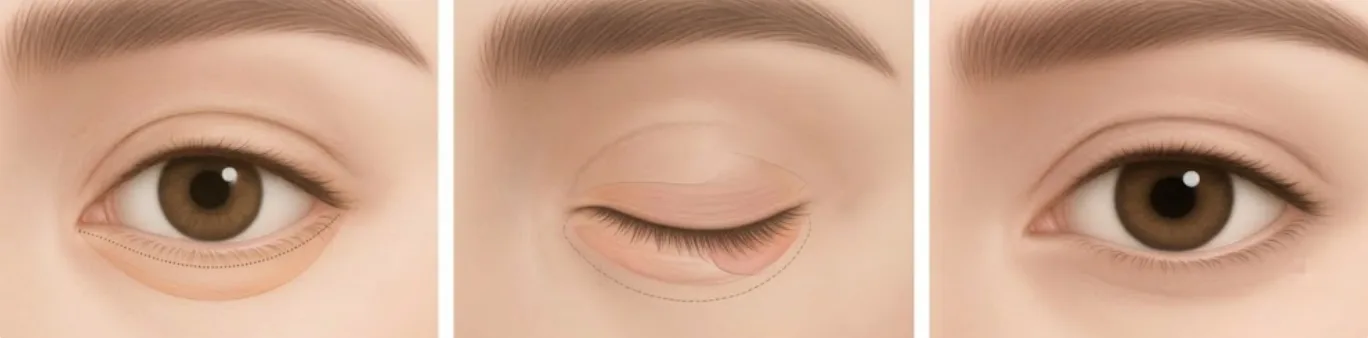
Illustration: the rounded, open lower-lid line is outlined and gently brought back toward a calmer, more natural eye shape.
The important thing to understand is where the swelling sits and why it lingers. The lower lid has little slack, so even a small amount of swelling makes it feel tight and look a little pulled or swollen, and the eye can feel dry or slightly over-exposed while the lid re-drapes into its new, better-supported position. The two eyes can swell and settle at slightly different rates, which is normal and does not predict an asymmetric result.
Understanding this makes the early weeks far less alarming. A tight, slightly swollen lower lid is the tissue re-supporting and settling. That is why the corrected eye shape is judged over weeks to months. We map the full arc in the recovery timeline and explain the approach in the method explained.
Timeline
Week-by-week: how long does the swelling last?
Week 1: the lower lid is tightest and most swollen in the first few days, and the eye may feel dry, gritty or over-exposed as the lid settles. Mild watering, a pulling sensation and tightness are normal. This is the window to be strict about head elevation, gentle cooling and rest, to lubricate the eye exactly as your surgeon advises, and to keep your hands away from the lid. Any sutures are removed on the schedule your surgeon sets for your tailored procedure, which doubles as an early check that the lid is settling.
Weeks 1–3: after the first week the puffiness along the lower lid eases and the eye shape starts to look more like its intended, less-rounded form, though the lid stays a little tight and firm. Any light bruising fades over the first couple of weeks, so most people feel comfortable in everyday settings within one to two weeks. The lid can still look slightly over-corrected or pulled at this stage, which is expected as swelling settles and not the final result.
Months 1–3: the residual tightness along the lid and any remaining fullness fade gradually. Much of the visible settling happens over the first month, and the fine detail (how almond and supported the eye looks, and how any dryness resolves) keeps refining through roughly one to three months as the lower lid regains its support. It is normal for the lid to feel slightly firmer than the surrounding skin for a while, and for the corrected shape to reveal itself slowly.
Bruising
Bruising: where it spreads, and how long
Bruising after round eye correction concentrates around the lower lid and outer corner, because that is where the tissue is handled. How much appears varies a lot between people — some get a clear shadow across the lower lid that spreads slightly onto the upper cheek, others get very little. With gravity the colour settles downward over the first days, so a bruise can appear a little lower on the cheek than where it started. The redness of the eye white can also look pink for a time if surface vessels were disturbed, which clears on its own.
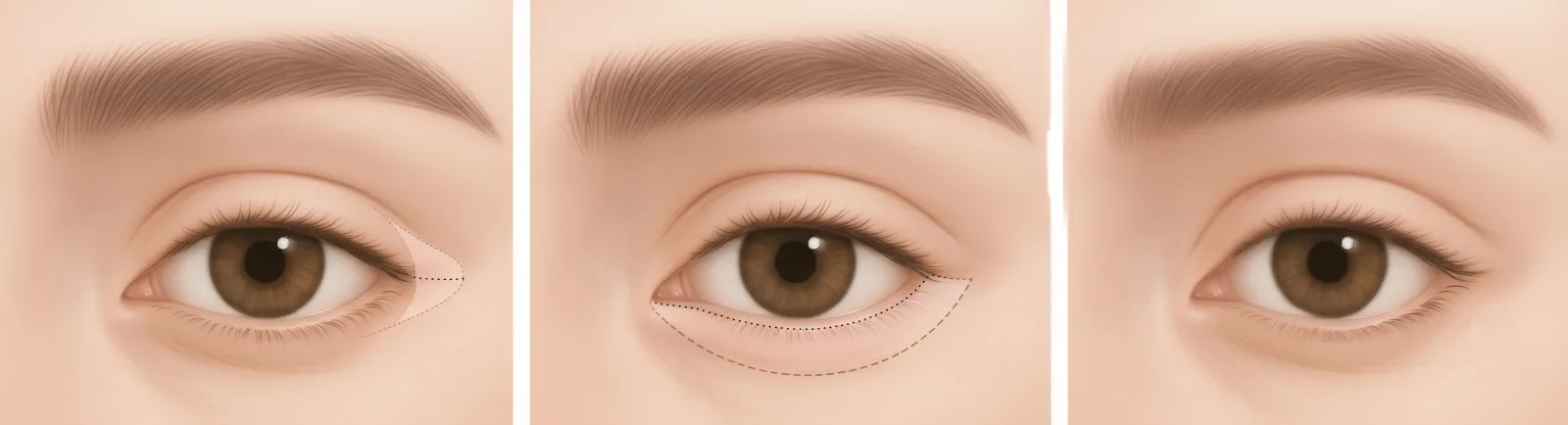
Illustration: the outer corner is extended and the lower-lid line gently lowered along the dotted lines, softening the angle of the eye.
Like any bruise it changes colour as it clears — from dull red or purple through green and yellow before fading. Most bruising around the lower lid settles within about one to two weeks, in step with the visible swelling. Keeping your head elevated and cooling gently near the lid in the first 48 hours both help limit how far it spreads and how long it lasts; once it has faded enough, makeup can usually cover what remains, on your surgeon's timing and never rubbed over a fresh incision.
A few everyday factors make lower-lid bruising worse: blood-thinning medication and supplements such as fish oil, high-dose vitamin E, ginkgo and certain anti-inflammatories; alcohol around the time of surgery; and rubbing or straining. The simplest way to keep lower-lid bruising down is to disclose every medication and supplement at your consultation and follow the pre-surgery guidance. We cover the comfort side in pain and anaesthesia, and if you are combining eye work, the outer-corner operation is covered in lateral canthoplasty.
Reduce it
How to bring swelling and bruising down faster
The measures that genuinely help are simple and worth doing consistently. Keep your head elevated, including sleeping propped up for the first one to two weeks, so fluid drains away from the eyes and does not pool along the lower lids. Swelling is almost always worse on waking, and elevation blunts that. Cool the area gently near the lower lid in the first 48 hours as your surgeon directs, never pressing on the lid or incision and never applying ice directly to the skin.
Protect the eye and rest. Because the lower lid is doing delicate re-supporting work, leaving it alone matters: no rubbing, no pulling at the lid, no eye makeup or contact lenses until your surgeon clears them, and lubricating the eye with drops or ointment exactly as advised if it feels dry or over-exposed. For the first 2 to 3 weeks, keep away from strenuous activity, heavy lifting, bending over and anything else that raises blood pressure, because each of these adds to lower-lid swelling. Skip alcohol and smoking, which slow healing and worsen lower-lid swelling; drink enough water and keep salt low.
Beyond that, follow the specifics your surgeon gives you: how to care for the lid and any incision, when and how to lubricate the eye, and when eye makeup, lenses and exercise are safe again. None of these are dramatic alone, but together they shorten the visible recovery, which matters most for international patients healing within a planned trip. If you are still weighing round eye correction, our overview of who it is for sets expectations before you commit.
What's normal
What's normal, and what's worth an urgent call
Normal, expected recovery: a tight, slightly swollen lower lid for the first weeks; a dry, gritty or over-exposed feeling in the eye that eases as the lid settles; light bruising across the lower lid or upper cheek; some pinkness of the eye white; and slight unevenness between the two sides that evens out as swelling settles. None of this needs intervention. It is a round eye correction healing as it should, with the corrected shape refining over weeks to months.
What warrants an urgent call is anything that breaks sharply from that path: heavy or persistent bleeding; rapidly increasing swelling or severe, escalating pain not eased by simple measures; spreading redness, warmth, pus-like discharge or fever suggesting infection; a sudden change in vision or double vision; the lower lid pulling down noticeably so the eye cannot close fully, or the eye staying persistently dry and painful; or the wound edges pulling apart. Sudden, marked change, as opposed to the slow, steady fading described above, is the reason to contact the clinic without delay.
For a healing lower lid, the most useful reassurance is being able to reach the surgeon who actually performed the operation. If you can send a photo and get a same-person answer on whether your lid and eye shape are healing on track, or be told to come in, you are not left guessing, which is especially valuable once you have travelled home.
At Garnet
How Garnet manages swelling and after-care
Garnet is a single-surgeon clinic in Apgujeong, Seoul. Dr. In-Soo Baek is a board-certified plastic surgeon (Korean medical licence no. 77407) and the only operating doctor, and he plans the round eye correction, performs it and reviews your recovery himself, so the person assessing your swelling is the person who did the surgery. Because this is a tailored operation on the delicate lower lid, that continuity matters: the surgeon sets the after-care schedule to your specific procedure and keeps the day unhurried.
Aftercare covers exactly the measures above (elevation, gentle cooling, eye lubrication, protecting the lid, rest and what to avoid), and any suture removal on your surgeon's schedule doubles as a check that the lid is settling on track. Garnet runs structured follow-up at one, three and six months, which suits the lid's re-supporting timeline, and for international patients much of this happens by messenger: you send a photo and the same surgeon confirms your recovery is on course or flags anything that needs attention.
If you are still deciding on round eye correction, start with a no-obligation online assessment: send clear photos and the surgeon will give a realistic view of what recovery would look like for you, including how much swelling and bruising to expect and how long to stay.
Dr. In-Soo Baek
Director & sole operating surgeon
Korean medical licence no. 77407
Operate on what you came for. Trained at Korea University Medical Center. Every case planned, performed and reviewed by the same hands.
1Operating surgeon
~2Surgeries per day
7Registered techniques
Board-certified plastic surgeon
Plastic surgery training at Korea University College of Medicine & graduate school
Korean Society of Plastic and Reconstructive Surgeons member, in its facial-contour, eye & rhinoplasty groups
Consults, operates and follows up each case himself
Peer-reviewed papers behind the facts on this page. Each describes findings in its own study group — not results at Garnet — and none predicts your own outcome.
Hahn S et al. Lower Lid Malposition. Facial Plastic Surgery Clinics of North America. 2016. doi:10.1016/j.fsc.2015.12.006
Pascali M et al. Tarsal Sling: An Essential Stitch to Prevent Scleral Show in Lower Blepharoplasty. Aesthetic Surgery Journal. 2015. doi:10.1093/asj/sju018
Stanciu NA et al. Revision Blepharoplasty. Clinics in Plastic Surgery. 2013. doi:10.1016/j.cps.2012.06.006
FAQ
Common questions
How long does swelling last after round eye correction?
The lower lid is tightest in the first days and eases over the first week or two. Most visible puffiness settles within about two weeks, while the lid stays a little tight and firm for several weeks. The corrected eye shape keeps refining over roughly one to three months as the lower lid regains support. Your surgeon's tailored timeline takes precedence.
Why does my lower lid feel tight and my eye dry afterwards?
Round eye correction re-supports the lower lid, which has little slack, so even mild swelling makes it feel tight and the eye can feel dry or over-exposed while the lid re-drapes into its new position. This eases as swelling settles over the first weeks. Lubricating the eye exactly as your surgeon advises helps; persistent, painful dryness is worth raising promptly.
How long does bruising last after round eye correction?
Bruising concentrates around the lower lid and outer corner and can spread slightly onto the upper cheek. It shifts colour from dark to green-yellow as it fades, and most clears within about one to two weeks, in step with the swelling. Once your surgeon clears it, makeup can usually cover what remains. Disclosing your medications beforehand keeps bruising down.
How can I reduce swelling and bruising after round eye correction?
Keep your head elevated (sleeping propped up for the first week or two), cool gently near the lower lid in the first 48 hours, lubricate the eye as advised, and leave the lid alone: no rubbing, no makeup or lenses until cleared. Hold off strenuous activity for 2 to 3 weeks and skip alcohol and smoking; drinking enough water and eating less salt also help the lower lid settle.
Is swelling after round eye correction normal?
Yes. A tight, slightly swollen lower lid, a dry or over-exposed feeling, light bruising across the lower lid, some pinkness of the eye white and slight unevenness between the sides are all normal early on. What warrants an urgent call is heavy bleeding, rapidly increasing swelling or severe pain, signs of infection, any change in vision, or the lower lid pulling down so the eye will not close.
When should I urgently contact the clinic?
Call without delay if you have heavy or persistent bleeding, rapidly increasing swelling or severe pain not eased by simple measures, spreading redness, warmth, pus-like discharge or fever, a sudden change in vision or double vision, the lower lid pulling down so the eye will not close fully, or persistent painful dryness. Any sudden, marked change around the lower lid is the reason to seek prompt review.
Will the eye look over-corrected at first?
It can. In the early weeks the lower lid may look slightly over-corrected, pulled or tight, because swelling and the re-supporting work exaggerate the change. This softens as the tissue settles, and the intended almond shape reveals itself over roughly one to three months. If the lower lid still looks off to you at your follow-ups, raise it with the surgeon who operated.
When can I wear eye makeup and contact lenses again?
Not until your surgeon clears them, because both can irritate the healing lower lid and the eye surface and introduce bacteria. Most people are asked to keep eye makeup and lenses off for at least the first week or two, sometimes longer given the lid work. Your surgeon gives you the exact timing for your case at your follow-ups.
When is it safe to fly home after round eye correction?
Most international patients stay until the surgeon confirms the lower lid is settling and any sutures are out, which is set to your tailored procedure. The lid may still feel a little tight and the eye a little dry, and both keep settling after you land. Stay hydrated, lubricate the eye as advised, avoid rubbing and skip alcohol on the flight; your surgeon confirms the right timing.
How does Garnet check my swelling is settling normally?
Garnet runs structured follow-up at one, three and six months with the same board-certified surgeon who planned and performed the procedure, plus any suture check on your schedule. For international patients much of this is by messenger: you send a photo and the same surgeon confirms your lid and eye shape are healing on track or asks you to come in.
My mom recently had a brow lift and lower blepharoplasty with Dr. Baek, and our experience has been wonderful so far. The Garnet team was incredibly kind and welcoming, with Kelly assisting us as our English consultant—she made everything…
I’m so happy I chose this clinic for my lower blepharoplasty. I was traveling from abroad by myself, so I was a little nervous, but from the beginning I felt comfortable and truly cared for. Everyone was kind, patient, and professional…
Came in for an in-person consult and ended up choosing Garnet and Dr.Baek for my non-incisional DES and tiplasty/alarplasty. I communicated with Kelly (English consultant) from the start till now (3 weeks post-op). She really help me feel…
My under-eyes have been sagging and folding for years... I tried to cover it up with makeup, but it actually got stuck in the wrinkles and made it stand out even more. While going for consultations, I noticed that the bigger the hospital…
Send photos and your question before you travel. An English-speaking coordinator reviews every round eye correction enquiry and replies with guidance on whether surgery is appropriate, the likely plan and timing.
✓ Reviewed by the clinic coordinator, not a bot
✓ Photo-based pre-assessment before you fly
✓ Foreign-patient scheduling & after-care
✓ One surgeon for consultation, surgery and follow-up
Prefer to chat now? Reach the coordinator directly:








 T S7 months ago



