Stem cell fat grafting takes fat from the abdomen or thigh, supplements it with a stromal fraction from your own tissue and places it where the face has lost volume. The graft is living tissue, so its take is never fully even or predictable. Some of the transferred fat survives and some resorbs, and the final volume can end up too full, too flat, or slightly lumpy or uneven. Correcting it is a separate decision: a little more fat where it resorbed, a reduction of an over-full pocket, or, very often, several months of waiting while the graft stabilises. This page sets out what revising a fraction-supplemented graft involves and when waiting is the better choice.
The short answer
Most early concerns after a stem cell fat graft (over-fullness, firmness, small lumps, one side fuller than the other) change substantially over 3 to 6 months as swelling resolves and part of the transferred fat resorbs.
A fraction-supplemented graft may genuinely need revising when it over-corrected and stayed too full, when too little fat survived in one area, when a lump or contour irregularity can be felt, or when the sides stay uneven after the graft has stabilised.
The fix is matched to the problem: a conservative top-up graft for an area that under-took, or reduction for an over-full pocket (fine liposuction, or careful dissolving for small deposits).
An assessment may conclude that the graft needs more time to settle, that one specific area needs refining, or that the volume goal was never realistic for a single session. No one can promise how a revision graft will survive.
Why people consider a stem cell fat grafting revision
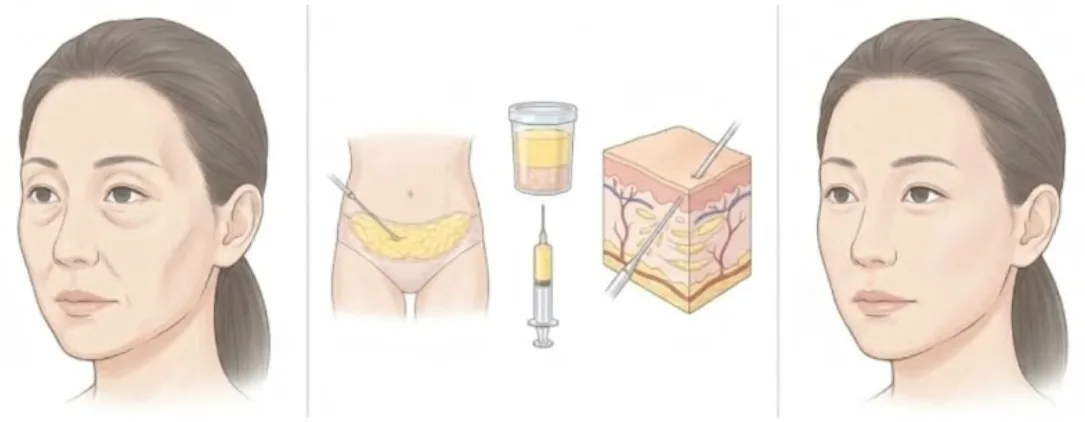
Stem cell fat grafting harvests fat from the abdomen or thigh, processes it with a stromal fraction from your own tissue, and reinjects it as tiny parcels through cannula entry points into hollowed areas of the face. Each parcel has to establish its own blood supply to survive, so the take is never uniform. A portion of every graft resorbs over the first months, and survival varies with the area, the technique and how a particular face heals. Uneven settling after a stem cell graft tends to produce the same handful of concerns.
Illustration: the patient's own fat is taken, processed, and re-placed beneath the skin where volume has been lost.
Top of the list are a cheek, temple or under-eye area left too full, and a spot left too flat because most of the fat resorbed and the hollow came back. Some patients feel small firm lumps under the skin, see a bumpy contour, or find that one side held more graft than the other. Occasionally the whole face looks fuller than intended and reads as heavy, which is the opposite of the subtle restoration that was planned.
Each of these concerns leads to a different plan, so they are worth telling apart. The method itself has a limit too: adding a stromal fraction does not remove the unpredictability of how fat survives, and no version of the procedure can promise an even take. Early fullness and firmness usually need time, since part of the graft will resorb. A hollow that persists once the graft has stabilised may need a careful top-up, and an over-full or lumpy area needs reducing.
What settles
What settles on its own after a stem cell graft
Most of what alarms people in the first weeks and months after a stem cell fat graft is normal and temporary. The graft is deliberately over-filled to allow for resorption, so the face looks fuller than the final result and can feel firm, slightly lumpy or uneven as swelling and the transferred fat settle. A cheek or temple that looks over-done at three weeks can look natural by three months as part of the graft resorbs and swelling falls, and the page on stem cell fat grafting swelling and bruising walks through what is expected and over what timeframe.
Early unevenness between the sides misleads in the same way. Left and right rarely swell or resorb at the same pace, so a face that looks lopsided at 1 month after the graft can look balanced by month 3 or 4. Judging the volume before the graft has stabilised leads people to chase a hollow that has not finished filling, or a fullness that has not finished resorbing, which would have resolved anyway. So Dr. Baek will usually suggest waiting and looking again later.
Some problems do not reliably fade: a true hollow where too little of the supplemented fat survived, a firm lump or nodule that stays, a fixed irregularity in the contour, or an area that is still heavy after the graft has clearly stabilised. Revision is reasonably considered for these. The first step is telling them apart from the normal resorption described above, and that takes months.
Add or reduce
When to add fat and when to reduce volume
Revising a fraction-supplemented graft covers a range of small operations, and the skill lies in matching the response to the problem. Where the graft under-took and a hollow returned, the usual answer is a top-up: a smaller, targeted graft into that area, placed conservatively because a revision graft resorbs too and over-filling again repeats the problem. A top-up has no guarantee of surviving better than the first graft, so it is done in modest steps.
An area that was over-corrected and stayed too full calls for reduction. Soft, spread-out fullness can often be refined with fine cannula liposuction, which takes out a small amount of the grafted fat and smooths the contour. A small, well-defined deposit may be reduced with careful dissolving where appropriate. A firm nodule that persists is assessed separately; some soften with time and some are best removed.
Lasting unevenness is corrected by working toward balance: adding to the flatter side, reducing the fuller side, or both, with the two sides planned together. Throughout, revision refines an existing stem cell graft in small, deliberate steps. The aim is a smooth, balanced contour without a dramatic change, and the smallest correction that solves the problem is preferred over another full session.
Timing
When to wait and when to act
Timing is the most important decision in revising a stem cell fat graft, and for most concerns the answer is to wait longer than people expect. The supplemented fat keeps resorbing for months, so its final volume cannot be known in the first weeks. Adding fat to an area that is still resorbing, or removing fat from one that is still settling, means operating on a moving target and can over-shoot in the opposite direction.
The usual approach is to let the graft stabilise before deciding on revision, commonly for around 3 to 6 months, until resorption has largely finished and the surviving volume is clear. A stabilised face can be corrected in a small, accurate step; a freshly grafted, swollen one invites guesswork. With fat grafts, going back in too soon reliably makes the outcome worse.
There are few urgent scenarios. A firm, tender or growing lump, redness, or signs of infection are reviewed promptly and are never left to settle. For the far more common question of whether a hollow will fill or a fullness will resolve, patience is the tool: the page on how long stem cell fat grafting lasts explains the normal arc of survival, so you can tell a graft that is still settling from one that has genuinely under- or over-delivered before deciding to touch it.
Technique
What a careful re-do involves
A careful revision starts with the history of the first graft: which areas were grafted, roughly how much, and how long ago. That shapes what is safe to do next. For an under-corrected area, the surgeon harvests a small amount of fresh fat, processes it, and places a conservative top-up through cannula entry points into the specific hollow, leaving the fat that already took undisturbed. Cannula access needs no incisions, so this does not usually add visible scars.
An over-full area is reduced. Fine, controlled cannula liposuction takes out a measured amount of the grafted fat and smooths the contour, or careful dissolving reduces a small, well-defined deposit where appropriate. A nodule that persists gets its own plan. The grafted fat sits in tissue that has already healed once, so the surgeon works slowly and checks the contour step by step, avoiding one large change.
Both can happen in one session, for example adding to a flat cheek while refining a fuller one so the sides match. Recovery from a revision resembles a smaller version of the original, with the same slow settling to allow for, and the stem cell fat grafting recovery timeline covers that pattern. Good revision depends on judgement more than force. The goal is to move an existing result toward a smooth, balanced contour with the smallest appropriate step, and no one can promise how the new graft will survive.
At Garnet
How Garnet approaches stem cell fat grafting revision
Facial fat grafting is a large part of the work at Garnet, a single-surgeon clinic in Apgujeong, Seoul. The only operating doctor is Dr. In-Soo Baek, a board-certified plastic surgeon (Korean medical licence no. 77407). He examines each stem cell graft revision himself, plans and performs it, and reviews every follow-up, with structured reviews at 1, 3 and 6 months. The surgeon who examines your earlier graft is therefore accountable for both the plan and the result.
Revision assessment at Garnet is deliberately unhurried and plain-spoken. Dr. Baek explains that a stromal fraction does not make fat survival predictable or even, and that no version of the procedure can guarantee how a graft will take. He will also tell you when an early over-fullness simply needs time to resorb, when a returned hollow can be topped up conservatively, or when a lumpy area should be refined instead of re-grafted. There is no consultation or CT fee and no pressure to book same day.
If you are considering correcting an earlier stem cell fat graft from abroad, you can begin without travelling. Send the history of your first graft and current photos for a pre-assessment, and read the stem cell fat grafting international patient guide for how stay length and remote follow-up are handled. Revision is usually best timed several months after the original graft.
Real Results
Before & After
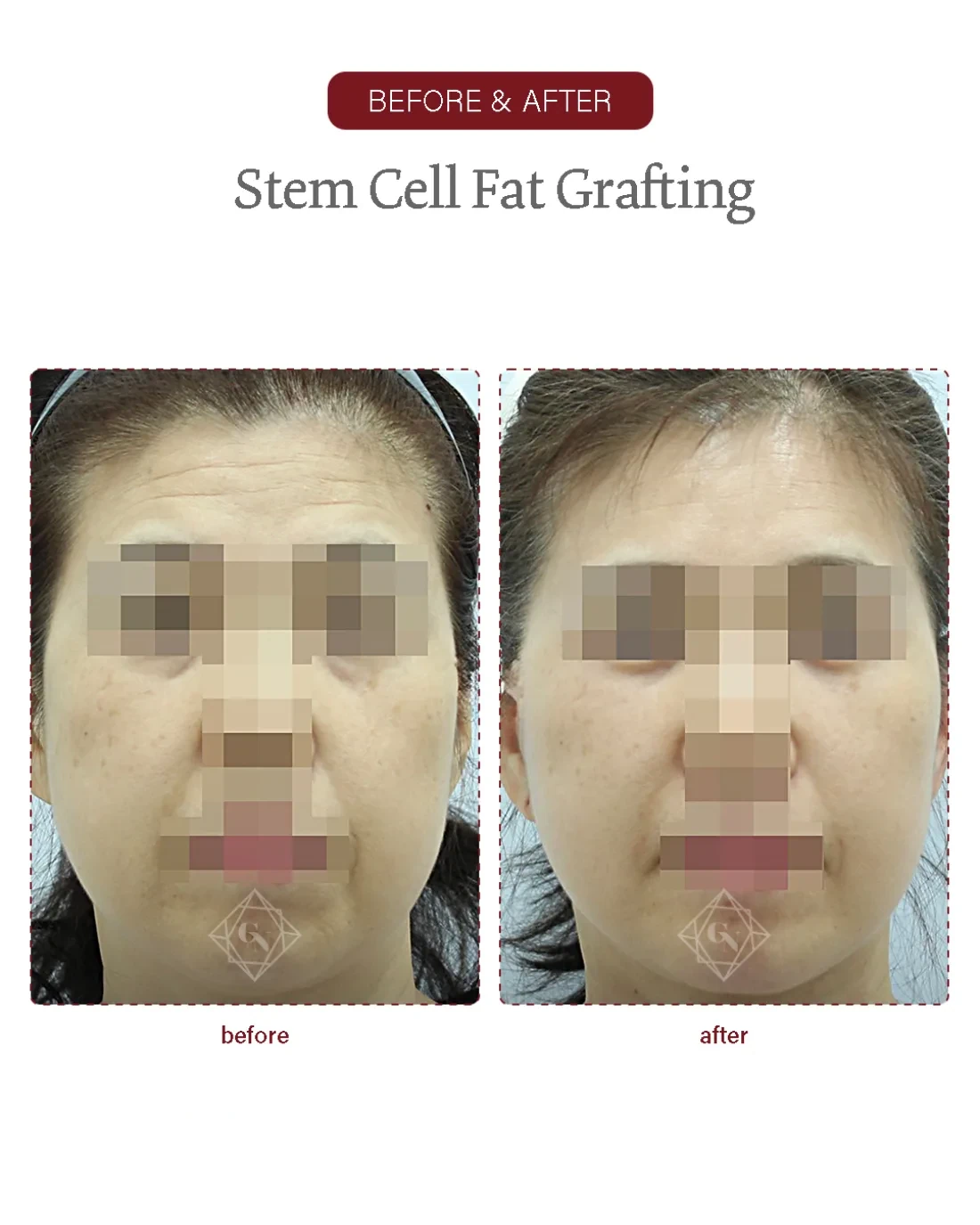
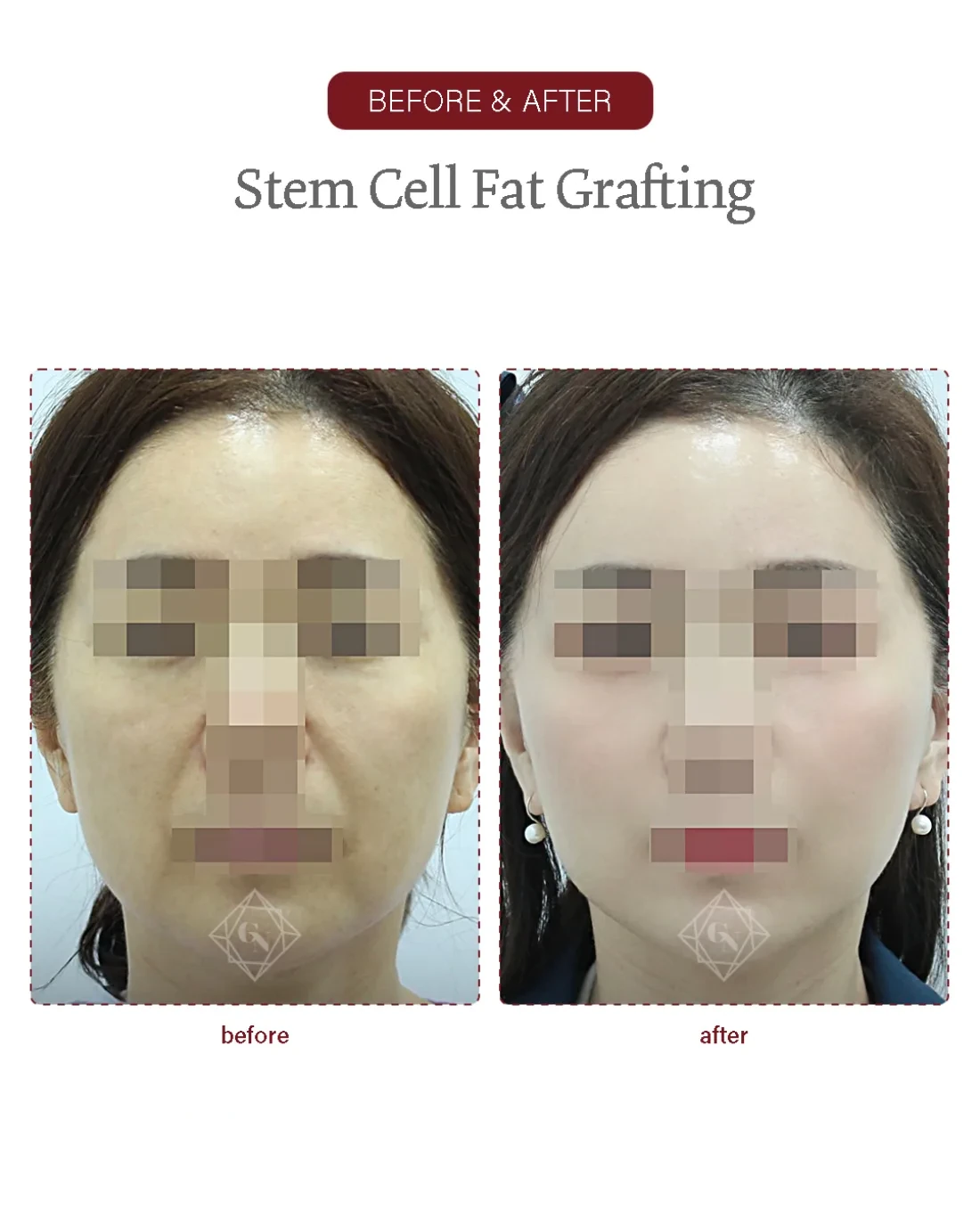
Fat-grafting and contouring results of actual Garnet patients (published with consent, with date, procedure and clinic labelled). Results, the amount of fat retained, recovery and suitability vary by individual and are not guaranteed.
Prices
Price at Garnet
Stem cell fat grafting
From₩3,500,000 + VATExcluding VAT (10% VAT is added at payment)Book now
Same price as Korean patients. Prices shown exclude 10% VAT; your written quote, issued after the in-person consultation, shows the full amount payable.
Dr. In-Soo Baek
Director & sole operating surgeon
Korean medical licence no. 77407
Operate on what you came for. Trained at Korea University Medical Center. Every case planned, performed and reviewed by the same hands.
1Operating surgeon
~2Surgeries per day
7Registered techniques
Board-certified plastic surgeon
Plastic surgery training at Korea University College of Medicine & graduate school
Korean Society of Plastic and Reconstructive Surgeons member, in its facial-contour, eye & rhinoplasty groups
Consults, operates and follows up each case himself
Peer-reviewed papers behind the facts on this page. Each describes findings in its own study group — not results at Garnet — and none predicts your own outcome.
Roshdy OH et al. Stromal vascular fraction improves the durability of autologous fat temple augmentation—A split-face randomized study using ultrasound biomicroscopy. Journal of Plastic, Reconstructive & Aesthetic Surgery. 2022. doi:10.1016/j.bjps.2021.12.005
Li M et al. The Efficacy of Cell-Assisted Lipotransfer Versus Conventional Lipotransfer in Breast Augmentation: A Systematic Review and Meta-Analysis. Aesthetic Plastic Surgery. 2021. doi:10.1007/s00266-020-02123-0
van Dongen JA et al. The Addition of Tissue Stromal Vascular Fraction to Platelet-Rich Plasma Supplemented Lipofilling Does Not Improve Facial Skin Quality: A Prospective Randomized Clinical Trial. Aesthetic Surgery Journal. 2021. doi:10.1093/asj/sjab109
FAQ
Common questions
Can stem cell fat grafting be revised or corrected?
Often, yes, depending on the concern. An area where too little of the supplemented fat survived can be topped up with a conservative graft. An over-full area can be refined with fine liposuction or, for small deposits, careful dissolving. A lump can be assessed and treated, and uneven sides can be balanced. Revision refines the existing graft in small steps, so it follows an assessment of a stabilised face instead of a quick decision in the first weeks. No revision can promise an even take.
Does the stem cell component mean my graft won't need revision?
No. A stromal fraction does not remove the unpredictability of how fat survives. Some of any graft resorbs, and the take is never fully even. Expect that a proportion of the transferred fat will not last and that the face may still need refining. No version of fat grafting can guarantee an even result, which is why an unhurried assessment and realistic expectations matter.
My graft looks too full — do I need it reduced?
Not necessarily. A stem cell graft is deliberately over-filled at first to allow for resorption, so early on the face looks fuller than the final result and often feels firm. Much of that fullness fades over 3 to 6 months as some of the fat resorbs and swelling goes down. If an area is still over-full once the graft has clearly stabilised, fine liposuction can refine it. Reducing too early risks removing volume that would have resorbed anyway.
The fat didn't take and my hollow came back — can more be added?
Yes, usually. Where a graft under-took and a hollow returned, a smaller, targeted top-up can be placed into the specific area once the first graft has stabilised. It is done conservatively, because a revision graft also partly resorbs, and there is no promise it will survive any better than the first. How many top-ups you need depends on the area and on how much of the first stem cell graft survived; a settled face shows this.
What does stem cell fat grafting revision involve?
That depends on the problem. A conservative graft through cannula entry points tops up an under-corrected area. Fine cannula liposuction, or careful dissolving for small deposits, refines an over-full one. A persistent nodule gets its own plan, and uneven sides are balanced by adjusting both. Cannula access needs no incisions, so revision does not usually add visible scars.
When is stem cell fat grafting revision needed?
Early fullness, firmness, small lumps and mild unevenness rarely need revision, because they change substantially as the supplemented graft resorbs and settles. Revision becomes reasonable for a hollow where too little fat survived, an area still over-full, a lump or contour irregularity that stays, or sides that remain uneven after the graft has stabilised. Any firm, tender or enlarging lump, redness or sign of infection after a stem cell graft is seen promptly.
How long should I wait before revising the graft?
Longer than most people expect: commonly around 3 to 6 months, until resorption has largely finished and the surviving volume is clear. Before that the final volume of a stem cell graft cannot be known, so adding or removing fat means operating on a moving target. Waiting for a stable face makes a small, accurate correction possible. Infection or a growing lump is the exception and is reviewed promptly.
Will revision leave scars?
Usually not. A top-up graft and a reduction of an over-full area both go through tiny cannula entry points, so a well-planned revision generally adds no visible scars. Expectations still need to be realistic: revision refines and balances the contour, grafted fat always survives somewhat unpredictably, and an even result cannot be promised.
My graft looks uneven side to side — can it be balanced?
Often, yes, once the graft has stabilised. Early unevenness after a stem cell graft is frequently just swelling and resorption running at different speeds, and it often evens out over 3 to 4 months. If a real imbalance remains, the surgeon adds a conservative top-up to the flatter side, refines the fuller side, or does both, planning the two sides together. Waiting until the face has settled is what makes that balancing accurate.
Can I get a revision assessment from abroad before travelling?
Yes. Send the history of your first stem cell fat graft and current photos for an online pre-assessment before committing to travel. You get a realistic view of what revision could and could not achieve, and of whether the right step is to wait, add a conservative top-up, or reduce an over-full area. Because revision is usually best timed months later, this also helps with timing.
My mom recently had a brow lift and lower blepharoplasty with Dr. Baek, and our experience has been wonderful so far. The Garnet team was incredibly kind and welcoming, with Kelly assisting us as our English consultant—she made everything…
I’m so happy I chose this clinic for my lower blepharoplasty. I was traveling from abroad by myself, so I was a little nervous, but from the beginning I felt comfortable and truly cared for. Everyone was kind, patient, and professional…
Came in for an in-person consult and ended up choosing Garnet and Dr.Baek for my non-incisional DES and tiplasty/alarplasty. I communicated with Kelly (English consultant) from the start till now (3 weeks post-op). She really help me feel…
My under-eyes have been sagging and folding for years... I tried to cover it up with makeup, but it actually got stuck in the wrinkles and made it stand out even more. While going for consultations, I noticed that the bigger the hospital…
Considering correcting or refining an earlier stem cell fat graft? Send your history and photos for a no-obligation pre-assessment. It includes a frank view on whether the graft simply needs more time to settle, and realistic expectations about how any revision graft will survive.
Send photos and your question before you travel. An English-speaking coordinator reviews every enquiry and replies with guidance on whether surgery is appropriate, the likely plan and timing.
✓ Reviewed by the clinic coordinator, not a bot
✓ Photo-based pre-assessment before you fly
✓ Foreign-patient scheduling & after-care
✓ One surgeon for consultation, surgery and follow-up
Prefer to chat now? Reach the coordinator directly:









 T S7 months ago



