Facial fat grafting moves your own fat into hollowed areas such as the temples, cheeks and under-eye, but a graft is living tissue and it never takes evenly or predictably. Some fat survives, some resorbs, and the final volume can end up too full, too flat, or slightly lumpy or uneven. Revision is its own decision: sometimes the answer is to add a little more where fat resorbed, sometimes to reduce or dissolve an over-full pocket, and very often simply to wait several months while the graft stabilises. This page sets out what fat grafting revision really involves and when patience serves you better.
The short answer
Most early concerns after a fat graft (over-fullness, firmness, small lumps and side-to-side unevenness) change substantially over three to six months as swelling resolves and part of the transferred fat resorbs.
Genuine revision reasons include a graft that over-corrected and stayed too full, an area where too little fat survived, a palpable lump or contour irregularity, or asymmetry that persists once the graft has stabilised.
The fix is matched to the problem: a top-up micro-fat graft for an area that under-took, versus reduction by fine liposuction or, for small deposits, careful dissolving for an over-full pocket.
A careful assessment may conclude that the right answer is to wait for the graft to settle, to refine one specific area, or that the volume goal was never realistic for a single session.
Facial fat grafting harvests fat from the abdomen or thigh, processes it, and reinjects it as tiny parcels through cannula entry points into hollowed areas: the temples, cheeks, under-eye, forehead or a love-band under the eye. Because a graft has to establish its own blood supply to survive, the take is never uniform: a portion of every graft resorbs over the first months, and how much survives depends on the area, the technique and how a particular face heals. When that settles unevenly, people come back with a recurring set of concerns.
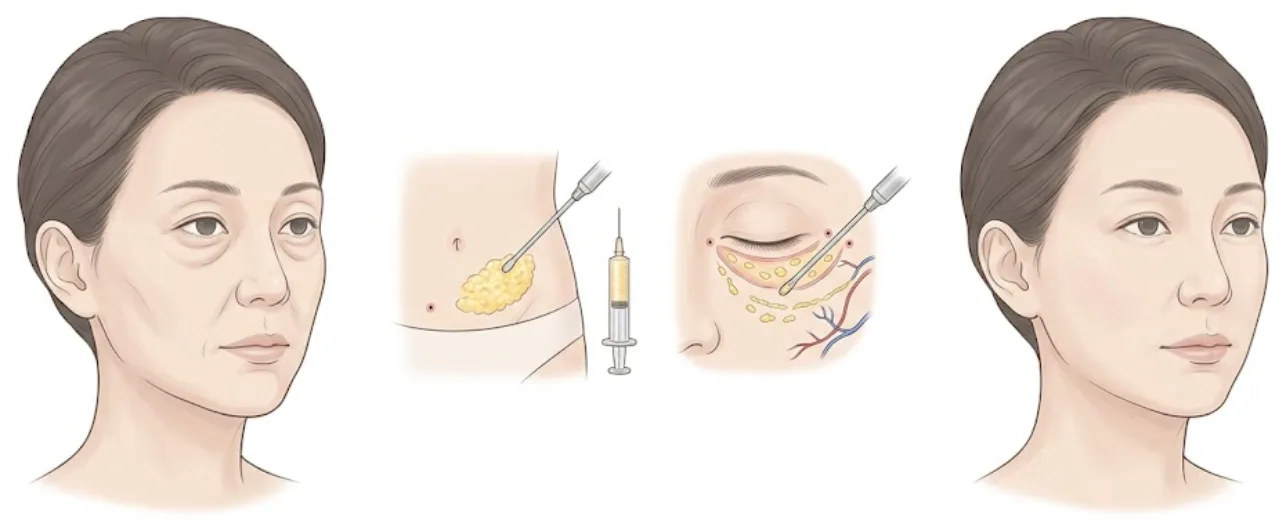
Illustration: the patient's own fat is gently taken from a donor area such as the abdomen, refined, and placed in small amounts where volume has been lost.
The most common are volume that ended up too full in one area, or too flat where the fat largely resorbed and the hollow returned. Others notice small firm lumps or nodules under the skin, a contour that looks bumpy or irregular, or an asymmetry where one side took more graft than the other. Occasionally the whole result simply looks over-done, fuller than the face wanted. That reads as heaviness, and the subtle restoration that was intended is lost.
It is worth separating these motivations, because they lead to very different plans. Early fullness and firmness usually need nothing but time, since part of the graft will resorb; a hollow that persists once the graft has stabilised may need a careful top-up; and an over-full or lumpy area needs reducing or smoothing, never more fat. Adding more fat to a face that is still resorbing is one of the most common avoidable mistakes.
What settles
What settles on its own in a fat graft, and what does not
Most of what alarms people in the first weeks and months after a fat graft is normal and temporary. In the early phase the graft is deliberately over-filled to allow for resorption, so the face looks fuller than the final result and can feel firm, slightly lumpy or uneven as swelling and the transferred fat settle. A cheek or under-eye that looks over-done at three weeks can look natural by three months as part of the graft resorbs and the swelling falls, and the page on fat grafting swelling and bruising walks through what is expected and over what timeframe.
Asymmetry in the early phase is just as misleading. Two sides of a face rarely swell or resorb at exactly the same rate, so a result that looks uneven at one month can even out by three or four. Judging the final volume before the graft has stabilised leads people to chase a problem (a hollow that has not finished filling, or a fullness that has not finished resorbing) that would have resolved on its own. That is why a careful surgeon will usually ask you to wait and reassess.
What does not reliably settle on its own is a genuine hollow where too little fat survived, a persistent firm lump or nodule, a fixed contour irregularity, or an over-full area that remains heavy once the graft has clearly stabilised. These are the concerns where revision is reasonably considered. The first step is simply telling them apart from the normal resorption and settling above, which takes months.
Add or reduce
When to add fat and when to reduce volume
Fat graft revision is not one operation but a spectrum, and matching the response to the problem is the whole skill. Where the graft under-took and a hollow returned, the answer is usually a top-up: a smaller, targeted micro-fat graft into the specific area, sometimes supplemented as in the original technique, placed conservatively because a revision graft resorbs too and over-filling again just repeats the problem. A modest under-correction can also sometimes be evened out without a full re-graft.
Where the graft over-corrected and an area stayed too full, the answer is reduction, and no more fat is added. A soft, diffuse over-fullness can often be refined with fine cannula liposuction to remove a small amount of grafted fat and smooth the contour; a small, discrete deposit may instead be reduced with careful dissolving where appropriate. A firm nodule that persists is assessed on its own terms: sometimes it softens with time, sometimes it is best removed.
Persistent asymmetry is corrected by adjusting toward balance: adding to the flatter side, reducing the fuller side, or both. Each side is judged against the other. Throughout, revision refines an existing graft in small, deliberate steps; the aim is a smooth, balanced contour without a dramatic change, and the smallest correction that solves the specific problem is preferred over another full session.
Timing
When to wait and when to act
Timing is the most important decision in fat graft revision, and for most concerns the answer is to wait, and to wait longer than people expect. Because a graft keeps resorbing for months, the final volume is simply not knowable in the first weeks. Adding fat to an area that has not finished resorbing, or removing fat from one that has not finished settling, means operating on a moving target and risks over-shooting in the opposite direction.
As a general principle, a surgeon prefers to let the graft stabilise before deciding on revision, commonly around 3 to 6 months, once resorption has largely run its course and the true surviving volume is clear. Assessing a stabilised face, and not a freshly grafted, swollen one, is what allows a small, accurate correction. This is one procedure where rushing back too soon reliably makes the outcome worse.
There are few urgent scenarios with fat grafting, but a firm, tender or growing lump, redness, or signs of infection are reviewed promptly and not left to settle. For the far more common question of whether a hollow will fill or a fullness will resolve, patience is the tool: the page on how long fat grafting lasts explains the normal arc of survival, so you can tell a graft that is still settling from one that has genuinely under- or over-delivered before deciding to touch it.
Technique
What a careful fat graft re-do involves
A careful revision begins with working out what was done before (which areas were grafted, roughly how much, whether the technique was supplemented, and how long ago), because that shapes what is safe to do next. For an under-corrected area, the surgeon harvests a small amount of fresh fat from the abdomen or thigh, processes it, and places a conservative top-up through cannula entry points into the specific hollow, respecting the fat that already took. Because fat grafting uses cannula access with no incisions, this does not usually add visible scars.
For an over-full area, the approach is reduction: fine, controlled cannula liposuction removes a measured amount of grafted fat and smooths the contour, or a small discrete deposit is reduced by careful dissolving where that is appropriate. A persistent nodule is treated on its own terms. Because grafted fat sits within tissue that has already healed once, revision is done slowly and conservatively, checking contour as it goes. A large change in one pass is avoided.
The two approaches can be combined, adding to a flat area while refining an over-full one to balance the two sides. Recovery from a revision graft resembles a smaller version of the original, with the same slow settling to allow for, and the fat grafting recovery timeline covers that pattern. Revision is more about judgement than force: the goal is to nudge an existing result toward a smooth, balanced contour with the smallest appropriate step. Aggressive re-grafting in the hope of a bigger change is avoided.
At Garnet
How Garnet approaches fat grafting revision
Garnet is a single-surgeon clinic in Apgujeong, Seoul, with extensive experience in facial fat grafting. Dr. In-Soo Baek is a board-certified plastic surgeon (Korean medical licence no. 77407) and the only operating doctor. He assesses each revision case himself, plans it himself, performs it himself and reviews every follow-up, with structured reviews at one, three and six months. For revision, that continuity matters: the surgeon who examines your earlier graft is the one accountable for the plan and the result.
Revision assessment at Garnet is deliberately unhurried and frank. That includes being willing to say that an early over-fullness will resorb and needs time, that a returned hollow can be topped up conservatively, or that a lumpy or over-full area should be refined and not re-grafted. There is no consultation or CT fee and no pressure to book same day, because a sound fat graft revision depends on assessing a stabilised face, which cannot be rushed.
If you are considering correcting an earlier facial fat graft from abroad, you can begin without travelling. Send your history and photos for a pre-assessment, and read the fat grafting international patient guide for how stay length and remote follow-up are handled, bearing in mind that revision is usually best timed several months after the original graft.
Dr. In-Soo Baek
Director & sole operating surgeon
Korean medical licence no. 77407
Operate on what you came for. Trained at Korea University Medical Center. Every case planned, performed and reviewed by the same hands.
1Operating surgeon
~2Surgeries per day
7Registered techniques
Board-certified plastic surgeon
Plastic surgery training at Korea University College of Medicine & graduate school
Korean Society of Plastic and Reconstructive Surgeons member, in its facial-contour, eye & rhinoplasty groups
Consults, operates and follows up each case himself
Peer-reviewed papers behind the facts on this page. Each describes findings in its own study group — not results at Garnet — and none predicts your own outcome.
Schultz KP et al. Fat Grafting for Facial Rejuvenation. Seminars in Plastic Surgery. 2020. doi:10.1055/s-0039-3402767
Hassan A et al. Autologous Fat Grafting Versus Facial Fillers in Facial Cosmesis: A Systematic review and Meta-analysis. Aesthetic Plastic Surgery. 2026. doi:10.1007/s00266-026-06132-3
Deane EC et al. Fat Grafting the Male Face. Facial Plastic Surgery Clinics of North America. 2024. doi:10.1016/j.fsc.2024.03.003
FAQ
Common questions
Can facial fat grafting be revised or corrected?
Often, yes, but it depends on the concern. An area where too little fat survived can be topped up with a conservative micro-fat graft; an over-full area can be refined with fine liposuction or, for small deposits, careful dissolving; a lump can be assessed and treated; and asymmetry can be balanced. Revision refines an existing graft in small steps, so it should follow assessment on a stabilised face. A quick decision in the first weeks is a mistake.
My fat graft looks too full: do I need it reduced?
Not necessarily. In the early phase a graft is deliberately over-filled to allow for resorption, so the face looks fuller than the final result and often feels firm. Much of that fullness resolves over three to six months as part of the fat resorbs and swelling falls. If an area stays genuinely over-full once the graft has clearly stabilised, it can be refined with fine liposuction, but reducing too early risks removing volume that would have resorbed anyway.
The fat didn't take and my hollow came back: can more be added?
Yes, usually. Where a graft under-took and a hollow returned, a smaller, targeted top-up graft can be placed into the specific area once the first graft has stabilised. It is done conservatively, because a revision graft also partly resorbs, so over-filling again would simply repeat the problem. Whether a single top-up is enough depends on the area and how much survived the first time, which an assessment on a settled face clarifies.
I have lumps after fat grafting: what can be done?
Small firm lumps are common in the early weeks as the graft and swelling settle, and many soften over the following months. A lump that persists once the graft has stabilised is assessed on its own terms. Some smooth out with time or massage, some are reduced or removed, and a firm, tender or growing lump is reviewed promptly. The plan depends on where it is, how deep it sits, and how long it has been there.
What does fat grafting revision involve?
It depends on the problem. An under-corrected area is topped up with a conservative micro-fat graft through cannula entry points; an over-full area is refined with fine cannula liposuction or, for small deposits, careful dissolving; a persistent nodule is treated on its own terms; and asymmetry is balanced by adjusting both sides. Because fat grafting uses cannula access with no incisions, revision does not usually add visible scars.
When is fat grafting revision needed?
For early over-fullness, firmness, small lumps and mild asymmetry, revision is rarely needed because they change substantially as the graft resorbs and settles. Genuine reasons include a hollow where too little fat survived, an area that stayed over-full, a persistent lump or contour irregularity, or asymmetry that remains once the graft has stabilised. A firm, tender or growing lump, redness or infection is reviewed promptly.
How long should I wait before revising a fat graft?
Longer than most people expect: commonly around 3 to 6 months, until resorption has largely run its course and the true surviving volume is clear. Because a graft keeps resorbing for months, the final volume simply is not knowable early, so adding or removing fat too soon means operating on a moving target. Assessing a stabilised face is what allows a small, accurate correction. Infection or a growing lump is the exception, reviewed promptly.
Will fat graft revision leave scars?
Usually not. Both adding a top-up graft and reducing an over-full area are done through tiny cannula entry points with no incisions, so a well-planned revision generally does not add visible scars. As with any procedure, realistic expectations matter: revision refines and balances the contour, it does not guarantee a perfectly even result, because grafted fat always survives to some degree unpredictably.
My fat graft looks uneven side to side: can it be balanced?
Often, yes, once the graft has stabilised. Early asymmetry is frequently just uneven swelling and resorption that evens out over three to four months. If a genuine imbalance remains, it is corrected by adjusting toward balance: adding a conservative top-up to the flatter side, refining the fuller side, or both. Each side is judged against the other. Assessing a settled face is what makes an accurate balancing correction possible.
Can I get a fat grafting revision assessment from abroad before travelling?
Yes. You can send the history of your first fat graft and current photos for a pre-assessment online before committing to travel. You get a realistic view of what revision could and could not achieve, and whether the right step is to wait for the graft to settle, add a conservative top-up, or reduce an over-full area, before planning a trip. Because revision is usually best timed months after the original, this also helps with timing.
My mom recently had a brow lift and lower blepharoplasty with Dr. Baek, and our experience has been wonderful so far. The Garnet team was incredibly kind and welcoming, with Kelly assisting us as our English consultant—she made everything…
I’m so happy I chose this clinic for my lower blepharoplasty. I was traveling from abroad by myself, so I was a little nervous, but from the beginning I felt comfortable and truly cared for. Everyone was kind, patient, and professional…
Came in for an in-person consult and ended up choosing Garnet and Dr.Baek for my non-incisional DES and tiplasty/alarplasty. I communicated with Kelly (English consultant) from the start till now (3 weeks post-op). She really help me feel…
My under-eyes have been sagging and folding for years... I tried to cover it up with makeup, but it actually got stuck in the wrinkles and made it stand out even more. While going for consultations, I noticed that the bigger the hospital…
Considering correcting or refining an earlier facial fat graft? Send your history and photos for a no-obligation pre-assessment, including a frank view on whether the graft simply needs more time to settle before any revision is even worth considering.
Send photos and your question before you travel. An English-speaking coordinator reviews every enquiry and replies with guidance on whether surgery is appropriate, the likely plan and timing.
✓ Reviewed by the clinic coordinator, not a bot
✓ Photo-based pre-assessment before you fly
✓ Foreign-patient scheduling & after-care
✓ One surgeon for consultation, surgery and follow-up
Prefer to chat now? Reach the coordinator directly:









 T S7 months ago



