A revision rhinoplasty works through scar tissue from an earlier operation and uses an open approach, so swelling tends to be more stubborn and the tip settles more slowly than after a first-time nose. If cartilage is rebuilt from your own rib, hip dermis or another site, that donor area heals on its own timeline too. Revision swelling is slower but follows a predictable course, and a few simple measures shorten the visible part. This guide maps that longer recovery and flags the signs worth an urgent call.
The short answer
Revision rhinoplasty is done through an open approach and works within scar tissue from the previous surgery, so swelling is often more stubborn and the tip refines more slowly than after a first nose.
The material is chosen per case (autologous rib, donor rib, hip dermis, temporalis fascia, or septal and ear cartilage), and if your own tissue is used, that donor site has its own recovery and stitches.
Nose sutures come out at around day 7, but donor-site sutures range from about day 7 to day 14 depending on the site; visible under-eye swelling and bruising mostly clear within two weeks.
Sleeping propped up, gentle cooling around the eyes, rest, a low-salt diet, care of any donor site, and no alcohol, blood thinners or strenuous activity all help a revised nose settle, and the surgeon reviews it at 1, 3 and 6 months.
Why revision rhinoplasty swells more and for longer
A revision rhinoplasty is a more demanding operation than a first-time nose, and the swelling reflects that. It is done through an open approach, and the surgeon works within scar tissue left by the previous surgery. Scarred tissue has a disrupted blood supply and drains fluid less efficiently, so it tends to swell more and hold that swelling longer. Because the nose sits in the middle of the face, the swelling also spreads to the eyes and upper cheeks in the first days, exactly as with any rhinoplasty.
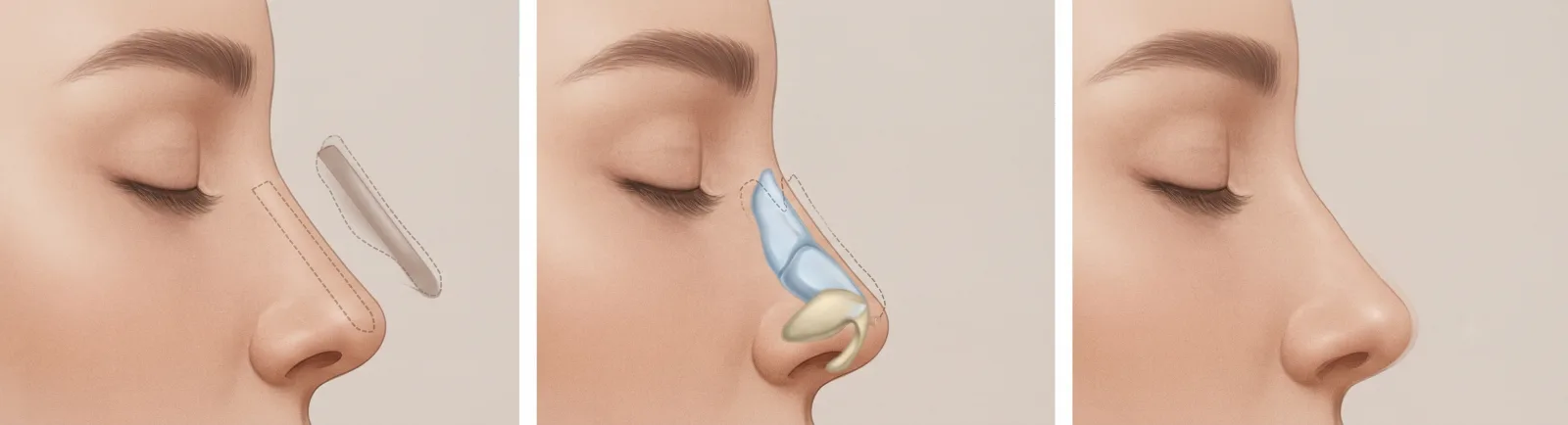
Illustration: the previous implant (outlined) is removed and the framework is rebuilt with the patient's own cartilage for support.
There is often a second recovering area too. Revision frequently needs new structural material, and at Garnet that is chosen per case. It may be cartilage from your own rib, dermis taken from the hip, temporalis fascia from the scalp, or septal and ear cartilage. Wherever your own tissue is harvested, that donor site has its own wound, its own swelling and its own stitches, and a rib or hip site in particular adds meaningfully to the overall recovery.
As with any nose, the swelling runs on two clocks (quick-clearing superficial swelling around the eyes, and slow-settling deep swelling in the tip), but in a revision both tend to run longer because of the scarring. A firm, full tip is swelling masking the final shape, which is why a revision result is judged over many months, sometimes longer than a first nose. The revision recovery timeline maps the full arc, and when you will see results covers how a revised tip refines over the long term.
Timeline
Week-by-week: how long revision swelling lasts
Days 1–7: a splint sits over the bridge and tapes hold the tip, so most nasal swelling is hidden, with a dressing changed around days 1 and 3. The visible change is under the eyes, where puffiness and bruising build to a peak by about day 3, and any rib, hip or scalp donor site is tender and swollen as well. Sleeping propped up, cooling gently and resting matter most in these first days. Splint and nasal stitches are removed at around day 7.
Days 7–14: after the splint comes off, the under-eye bruising fades and mostly clears within about two weeks. The bridge de-swells, though often a little more slowly than a first nose. Donor-site sutures come out anywhere from about day 7 to day 14 depending on where the tissue was taken: an ear or temporalis site earlier, a hip dermis site later. The tip stays visibly and palpably swollen, firm and full, which is entirely normal and, in a revision, tends to persist longer.
Months 1–18: what remains sits in the revised tip, where scar tissue lets it soften only gradually. Much resolves over the first three months, but because scar tissue refines gradually, the fine tip swelling can continue settling through twelve to eighteen months — longer than the typical first-time nose. Thicker skin holds swelling longer still. Final assessment of a revision rhinoplasty is a patient, months-long process, and it is normal for the two sides to de-swell at slightly different rates before evening out.
Bruising
Bruising after revision rhinoplasty, including donor sites
Bruising after a revision rhinoplasty concentrates around the eyes more than on the nose itself, because the work on the framework sends blood into the loose tissue of the eyelids and upper cheeks. Either or both lower lids may darken, and the discolouration drifts toward the cheeks over the first days. A harvested donor site can bruise as well; a rib or hip site typically shows more discolouration than a small ear harvest.
Under-eye bruising after a revision passes from purple through green to yellow and mostly clears within about 2 weeks, alongside the visible swelling; a rib or hip donor site can take a little longer. Elevation and gentle cooling around the eyes in the first 48 hours keep it more contained. Once it has faded enough, makeup can usually cover what remains, on your surgeon's timing.
Bruising after a revision is heavier with blood thinners and with supplements such as fish oil, high-dose vitamin E or ginkgo, with certain anti-inflammatories, with alcohol near the operation, and with straining or raised blood pressure. Listing everything you take before the revision, and following the pre-operative instructions, limits it. The comfort side of recovery is in pain and anaesthesia and how the incisions heal in scars and healing.
Reduce it
Bringing revision swelling and bruising down faster
The measures that genuinely help are simple and worth doing consistently. Keep your head elevated: sleep propped up at around 30–45 degrees for the first 1 to 2 weeks so fluid drains away from the eyes. Swelling of the revised nose and lower lids is usually worst on waking, and elevation reduces it. Cool the area gently for the first 48 hours, on the cheeks and around the eyes as directed, with no ice on bare skin and no pressure on the splint.
Rest and pace yourself. For 2 to 3 weeks after a revision, skip exercise, lifting, bending forward and blowing your nose, and anything else that raises blood pressure. Look after any donor site too: a rib site means protecting the chest and avoiding deep strain and twisting, while a hip or scalp site has its own care: keep dressings clean and dry and follow your surgeon's instructions so each wound settles cleanly. Avoid alcohol and smoking, both of which slow healing in scarred tissue and add to swelling; drink plenty of water and keep salt low.
Beyond that, follow the specifics your surgeon gives you: how to care for the splint, stitches and donor-site dressings, and when light activity and then exercise are safe. Because revision swelling is more stubborn, patience with the tip matters most. None of these measures is dramatic alone, but together they shorten the visible recovery. That matters for international patients recovering within a planned trip. If you are weighing a revision, comparing it with a first-time nose can help, which we cover in revision vs primary rhinoplasty.
What's normal
Normal revision healing, and when to call urgently
Normal, expected recovery: under-eye puffiness and bruising peaking around day three and clearing within about two weeks; a firm, full nasal tip that stays swollen for months and refines slowly, often longer than a first nose because of scarring; tenderness and swelling at any donor site that eases as its wound heals; numbness of the tip and upper lip; and a blocked, stuffy feeling from internal swelling. None of this needs intervention. It is a revision rhinoplasty healing as it should.
What warrants an urgent call is anything that breaks sharply from that path, especially given the larger surgical field of a revision: heavy or bright-red bleeding from the nose that does not settle with rest and elevation; rapidly increasing swelling or severe, escalating pain at the nose or a donor site not eased by your medication; fever, spreading redness, warmth or discharge at the nose or a donor site suggesting infection; a sudden change in the colour of the skin over the nose; or breathing difficulty beyond ordinary congestion. Any abrupt shift away from the gradual fading described above means contacting the clinic straight away.
After a revision, it helps most to reach the surgeon who rebuilt the framework. If you can send him a photo and hear whether the swelling and bruising are on track, or be asked to come in, you are not left guessing, which is especially valuable once you have travelled home.
At Garnet
How Garnet follows a revised nose after surgery
Garnet is a single-surgeon clinic in Apgujeong, Seoul. As Garnet's only operating doctor, Dr. In-Soo Baek (board-certified plastic surgeon, Korean medical licence no. 77407) performs the revision rhinoplasty and judges your swelling himself at each review. That continuity matters most in a revision, where reading swelling within scarred tissue takes the judgement of the surgeon who knows exactly what was done inside.
Aftercare covers exactly the measures above (elevation, gentle cooling, splint and donor-site care, rest and what to avoid), and the staged suture removal (nose around day 7, donor site around day 7 to day 14 depending on the site) doubles as checks that every area is settling on track. Garnet runs structured follow-up at 1, 3 and 6 months, which suits a revision's long, patient refining timeline, and for international patients much of this happens by messenger: you send a photo and the same surgeon confirms your recovery is on course or flags anything that needs attention.
If you are still deciding, start with a no-obligation online assessment: send clear photos and your history and the surgeon will give a realistic view of what recovery would look like for you, including how much swelling and bruising to expect, which donor material might suit you, and how long to stay.
Prices
Price at Garnet
Revision rhinoplasty
From₩4,000,000 + VATExcluding VAT (10% VAT is added at payment)Book now
Same price as Korean patients. Prices shown exclude 10% VAT; your written quote, issued after the in-person consultation, shows the full amount payable.
Dr. In-Soo Baek
Director & sole operating surgeon
Korean medical licence no. 77407
Operate on what you came for. Trained at Korea University Medical Center. Every case planned, performed and reviewed by the same hands.
1Operating surgeon
~2Surgeries per day
7Registered techniques
Board-certified plastic surgeon
Plastic surgery training at Korea University College of Medicine & graduate school
Korean Society of Plastic and Reconstructive Surgeons member, in its facial-contour, eye & rhinoplasty groups
Consults, operates and follows up each case himself
Peer-reviewed papers behind the facts on this page. Each describes findings in its own study group — not results at Garnet — and none predicts your own outcome.
Loyo M et al. Revision Rhinoplasty. Clinics in Plastic Surgery. 2016. doi:10.1016/j.cps.2015.09.009
Rosenberger ES et al. Controversies in Revision Rhinoplasty. Facial Plastic Surgery Clinics of North America. 2016. doi:10.1016/j.fsc.2016.03.010
Kim DY et al. Treatment Strategy for Revision Rhinoplasty in Asians. Facial Plastic Surgery. 2016. doi:10.1055/s-0036-1594254
FAQ
Common questions
How long does swelling last after revision rhinoplasty?
It runs on two clocks and tends to run longer than a first nose because of scarring. Puffiness and bruising around the eyes are mostly gone by about 2 weeks, and the bridge settles after the splint comes off at around day 7. The fine tip swelling settles slowly, often continuing to refine through twelve to eighteen months as the scarred tissue matures.
Why does a revision nose swell more than my first rhinoplasty?
A revision works within scar tissue from the earlier operation, and scarred tissue has a disrupted blood supply and drains fluid less efficiently, so it swells more and holds that swelling longer. The open approach and any donor site add to it. This is expected; the revised tip simply needs more patience to refine than after a first-time nose.
Does the rib or hip donor site swell and bruise after revision rhinoplasty?
If your own tissue is harvested, that site has its own recovery. A rib or hip donor site typically shows more swelling and bruising and its stitches come out later (around day 14 for a hip dermis site), while an ear or temporalis site settles sooner. Protect the area, keep dressings clean and dry, and follow your surgeon's specific care instructions.
How can I reduce swelling and bruising after revision rhinoplasty?
Keep your head elevated (sleeping propped up at around 30–45 degrees for the first week or two), cool gently around the eyes in the first 48 hours, rest and avoid strenuous activity, straining and nose-blowing for two to three weeks, protect any donor site, skip alcohol and smoking, stay hydrated and keep salt low. Disclosing your medications beforehand also keeps bruising down.
Is swelling after revision rhinoplasty normal?
Yes. Under-eye puffiness and bruising peaking around day three, a firm, full tip that stays swollen for months and refines slowly, swelling at any donor site, numbness of the tip and a blocked feeling are all normal, and often more prolonged than a first nose. Call urgently for heavy bleeding, swelling or pain that climbs quickly, or fever and spreading redness at the nose or donor site.
When should I urgently contact the clinic?
Call without delay if you have heavy or bright-red bleeding that does not settle with rest and elevation, rapidly increasing swelling or severe pain at the nose or a donor site not eased by your medication, a sudden change in the colour of the skin over the nose, fever, spreading redness, warmth or discharge at the nose or a donor site, or breathing difficulty beyond ordinary congestion. An abrupt change after a revision calls for a prompt review.
Why does my nose feel blocked and numb after revision rhinoplasty?
Swollen lining inside the revised nose narrows the airway, so it feels blocked for the first weeks and opens up as the swelling goes down. Numbness of the tip and upper lip comes from small sensory nerves recovering through scar tissue, which can take a little longer in a revision. It usually returns gradually over weeks to months; persistent or worsening blockage with other concerning signs is worth raising with your surgeon.
When can I wear makeup over the bruising after revision rhinoplasty?
Usually once the incisions have healed and your surgeon clears it, often a couple of weeks in, after suture removal, makeup can cover residual under-eye bruising. Avoid makeup directly on healing incisions or a donor site before then and follow your surgeon's specific timing, as applying it too early risks irritation or infection.
When is it safe to fly home after revision rhinoplasty?
Most international patients stay through the staged suture removal (nose around day 7, and any donor site from about day 7 to day 14 by site) so the surgeon can confirm every area is settling before a long flight. Tip swelling and a blocked feeling may remain and continue to soften after you land. On the flight, drink water and avoid alcohol; the timing of your departure is agreed with your surgeon.
How does Garnet check my swelling is settling normally?
Garnet runs structured follow-up at 1, 3 and 6 months with the same board-certified surgeon who performed the procedure, plus the staged suture checks (nose around day 7, donor site around day 7 to day 14). For international patients much of this is by messenger: you send a photo and the same surgeon, who knows exactly what was rebuilt, confirms your swelling and bruising are on track or asks you to come in.
My mom recently had a brow lift and lower blepharoplasty with Dr. Baek, and our experience has been wonderful so far. The Garnet team was incredibly kind and welcoming, with Kelly assisting us as our English consultant—she made everything…
I’m so happy I chose this clinic for my lower blepharoplasty. I was traveling from abroad by myself, so I was a little nervous, but from the beginning I felt comfortable and truly cared for. Everyone was kind, patient, and professional…
Came in for an in-person consult and ended up choosing Garnet and Dr.Baek for my non-incisional DES and tiplasty/alarplasty. I communicated with Kelly (English consultant) from the start till now (3 weeks post-op). She really help me feel…
My under-eyes have been sagging and folding for years... I tried to cover it up with makeup, but it actually got stuck in the wrinkles and made it stand out even more. While going for consultations, I noticed that the bigger the hospital…
Wondering how much swelling and bruising recovery would mean for you? Send clear photos and your history for a no-obligation pre-assessment before you plan a trip.
Send photos and your question before you travel. An English-speaking coordinator reviews every enquiry and replies with guidance on whether surgery is appropriate, the likely plan and timing.
✓ Reviewed by the clinic coordinator, not a bot
✓ Photo-based pre-assessment before you fly
✓ Foreign-patient scheduling & after-care
✓ One surgeon for consultation, surgery and follow-up
Prefer to chat now? Reach the coordinator directly:









 T S7 months ago



