Rib-cartilage rhinoplasty builds the nose from your own costal (rib) cartilage or prepared donor rib, which means recovery involves two sites: the nose and a small chest incision where the rib cartilage is taken. Each swells and bruises on its own schedule, and because this rebuilds a stronger framework than a standard nose job, the nasal tip settles even more slowly. Below are both timelines, nose and chest, with the signs that need an urgent call.
The short answer
Rib-cartilage rhinoplasty has two healing sites: the nose (open approach) and a small chest incision at the rib donor area. Each swells and bruises on its own clock, so recovery is followed in two places.
Nasal sutures and the splint come out at around day 7, while the chest rib-donor sutures come out at around day 10; under-eye bruising peaks in the first few days and clears within about two weeks.
Because this rebuilds a strong cartilage framework, the tip is the last area to de-swell. It can feel firm and look full for weeks and refines slowly over roughly six to twelve months or longer.
Head elevation, gentle cooling early, chest-incision care, rest, low-salt diet and avoiding alcohol, blood thinners and strenuous activity all bring swelling down faster, and the surgeon reviews progress at 1, 3 and 6 months.
Why rib-cartilage rhinoplasty swells in two places
A rib-cartilage rhinoplasty rebuilds the nasal framework using costal (rib) cartilage (either your own, harvested through a small chest incision, or prepared donor rib) via an open approach to the nose. That means the surgery creates two healing sites at once: the nose itself, where the new framework is set and the skin re-drapes over it, and the chest, where a short incision is made to take the rib cartilage. Each site is doing different work, so each swells and bruises on its own schedule.
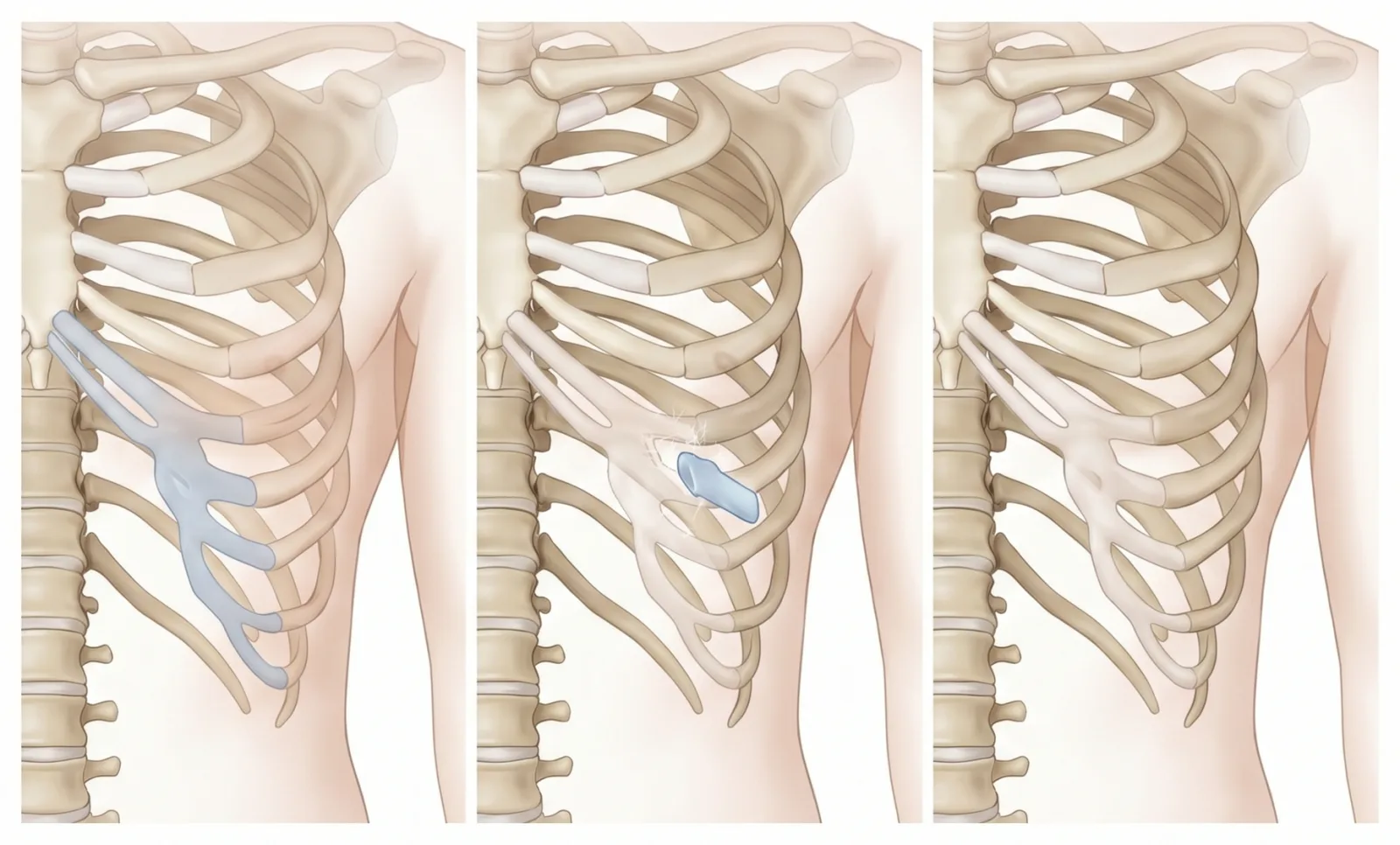
Illustration: where rib cartilage (blue) sits on the chest wall, and the small segment taken to build a stronger nasal framework.
At the nose, this is more substantial framework work than a standard nose job, so the nasal skin and the deep tissue of the tip swell firmly and the tip holds fluid the longest. At the chest, the rib-donor area is sore and a little swollen around a small incision, and it can feel tight when you breathe deeply, laugh or cough for the first week or two. That is the donor site healing and does not point to a chest problem. As with any rhinoplasty, swelling also spreads to the eyes and upper cheeks in the first days because the nose sits in the middle of the face.
Understanding this two-site split makes the early weeks far less alarming. A firm, full tip and a tender chest incision are both tissue settling, which is why the refined nose is judged over many months. The full course of both sites is set out in the recovery timeline, and why surgeons choose rib over ear cartilage in rib vs ear cartilage rhinoplasty.
Timeline
How long rib-cartilage rhinoplasty swelling lasts, week by week
Days 1–10: a splint sits over the bridge and tapes hold the tip, so most nasal swelling is hidden; what shows is around the eyes, where puffiness and bruising build and usually peak by day three. The chest donor site is sore and a little swollen, and deep breaths, laughing or coughing feel tight. The nasal splint, tapes and nose sutures come out at around day 7, and the chest rib-donor sutures come out a little later, at around day 10. This is the window to be strict about head elevation, gentle cooling, rest and careful movement to protect the chest.
Weeks 1–3: after the splint is off, the under-eye bruising fades from dark to green-yellow and most clears within about two weeks, and the bridge de-swells so the profile starts to look natural. The chest incision quietens over the same period, though it can stay tender to firm pressure and deep movement for a few weeks longer. The nasal tip, however, stays visibly and palpably swollen, firm and full, which is entirely normal at this stage, especially with a rebuilt framework.
Months 1–12+: the residual swelling is concentrated in the tip and softens slowly. Much resolves over the first three months, and the fine tip swelling continues to refine through six to twelve months, often longer than a standard rhinoplasty because the framework is more substantial and thicker skin holds swelling longer. The chest scar continues to mature and fade over months. Final assessment of a rib-cartilage rhinoplasty is a months-long process, and the tip feeling firmer than the bridge for a long while is expected.
Bruising
Bruising: nose, eyes and the chest donor site
Bruising after rib-cartilage rhinoplasty shows up in two areas. Around the face it concentrates under the eyes more than on the nose itself, because work on the bones and framework sends blood into the loose tissue of the eyelids and upper cheeks; one or both under-eye areas may bruise, and gravity carries the colour downward over the first days. Where the nasal bones are narrowed or repositioned, this facial bruising tends to be a little heavier than tip-focused work.
The chest donor site can also bruise around its small incision, usually as a localised shadow that fades over the first one to two weeks. Like any bruise, both the facial and chest bruising change colour as they clear, from dark red-purple through blue, green and yellow, and most settles within about two weeks. Keeping your head elevated and cooling gently around the eyes in the first 48 hours limits how far facial bruising spreads; the chest simply needs gentle protection and time.
Under the eyes and at the chest, bruising gets worse with fish oil, high-dose vitamin E, ginkgo, certain anti-inflammatories or other blood-thinning medication, with alcohol around the time of surgery, and with high blood pressure or straining. Listing every medication and supplement before surgery and following the pre-surgery guidance keeps both sites less bruised. The comfort side is covered in pain and anaesthesia and how both incisions heal in scars and healing.
Reduce it
Bringing nose and chest swelling down faster
The measures that genuinely help are simple and worth doing consistently. Keep your head elevated, including sleeping propped up at around 30–45 degrees for the first one to two weeks, so fluid drains from the face instead of pooling around the eyes. Nasal and under-eye swelling is almost always worse on waking, and elevation blunts that. Cool the area gently around the eyes and cheeks in the first 48 hours as your surgeon directs, never ice directly on the skin and never any pressure on the splint or the nose itself.
Protect the chest and pace yourself. The rib-donor site adds a specific rule: avoid deep bending, heavy lifting, reaching overhead and anything that strains the chest for the first weeks, and support the area gently when you cough or laugh so the incision settles. As with any rhinoplasty, avoid strenuous activity, nose-blowing and anything that raises blood pressure for two to three weeks, keep the splint clean and dry, and avoid glasses resting on the bridge until your surgeon says it is safe. Skip alcohol and smoking, which impair healing and worsen swelling, stay well hydrated and keep salt low.
Beyond that, follow the specifics your surgeon gives you for both sites: how to care for the splint, stitches and chest incision, when saline sprays or ointments help, and when light activity and then exercise are safe. Each step is small, and together they shorten the visible recovery of both the nose and the chest. That matters most for international patients recovering within a planned trip. If you are still weighing the surgery, our overview of who it is for sets expectations before you commit.
What's normal
Normal rib-cartilage healing versus an urgent call
Normal, expected recovery: under-eye puffiness and bruising peaking around day three and clearing within about two weeks; a firm, full nasal tip that stays swollen for weeks and refines slowly over six to twelve months or longer; numbness of the tip and upper lip; a blocked, stuffy feeling from internal swelling; and a sore, slightly swollen chest donor site that feels tight on deep breaths, laughing or coughing for the first week or two. None of this needs intervention. It is a rib-cartilage rhinoplasty healing as it should across both sites.
What warrants an urgent call is anything that breaks sharply from that path: heavy or bright-red bleeding that does not settle with rest and elevation; rapidly increasing swelling or severe, escalating pain at the nose or chest not eased by your prescribed medication; fever, spreading redness, warmth or discharge at either incision suggesting infection; a sudden change in the colour of the skin over the nose; or, importantly for the chest, sharp chest pain with shortness of breath or difficulty breathing that feels beyond ordinary donor-site soreness. A sudden, marked change, as opposed to the slow, steady fading described above, is the reason to contact the clinic straight away.
The reassurance that matters most is being able to reach the surgeon who actually performed the operation. If you can send a photo and get a same-person answer on whether your nose, eyes and chest incision are healing on track, or be told to come in, you are not left guessing, which is especially valuable once you have travelled home.
At Garnet
How Garnet follows both healing sites
Garnet is a single-surgeon clinic in Apgujeong, Seoul. Dr. In-Soo Baek is a board-certified plastic surgeon (Korean medical licence no. 77407) and the only operating doctor; he performs the rib-cartilage rhinoplasty, including the framework and the rib harvest, and reviews your recovery himself, so the person assessing your swelling is the person who did the surgery. For an operation with two healing sites and a tip that settles over many months, that continuity is especially valuable, and the clinic keeps the day unhurried with clear after-care for both the nose and the chest.
Aftercare covers exactly the measures above (elevation, gentle cooling, splint care, chest protection, rest and what to avoid), and the staged suture removal (the nose at around day 7, the chest rib-donor site at around day 10) doubles as a check that both incisions are settling on track. Garnet runs structured follow-up at one, three and six months, which suits a rebuilt nose's long refining timeline, and for international patients much of this happens by messenger: you send a photo and the same surgeon confirms your recovery is on course or flags anything that needs attention.
If you are still deciding, start with a no-obligation online assessment: from clear photos the surgeon can outline what recovery would look like for you, including how much swelling and bruising to expect at both sites and how long to stay.
Dr. In-Soo Baek
Director & sole operating surgeon
Korean medical licence no. 77407
Operate on what you came for. Trained at Korea University Medical Center. Every case planned, performed and reviewed by the same hands.
1Operating surgeon
~2Surgeries per day
7Registered techniques
Board-certified plastic surgeon
Plastic surgery training at Korea University College of Medicine & graduate school
Korean Society of Plastic and Reconstructive Surgeons member, in its facial-contour, eye & rhinoplasty groups
Consults, operates and follows up each case himself
Peer-reviewed papers behind the facts on this page. Each describes findings in its own study group — not results at Garnet — and none predicts your own outcome.
Cochran CS. Harvesting Rib Cartilage in Primary and Secondary Rhinoplasty. Clinics in Plastic Surgery. 2016. doi:10.1016/j.cps.2015.09.018
Fedok FG. Costal Cartilage Grafts in Rhinoplasty. Clinics in Plastic Surgery. 2016. doi:10.1016/j.cps.2015.08.002
Lee Peng G et al. Safe and Simple Costal Cartilage Harvest. Facial Plastic Surgery Clinics of North America. 2026. doi:10.1016/j.fsc.2026.02.001
FAQ
Common questions
How long does swelling last after rib-cartilage rhinoplasty?
The visible swelling and bruising around the eyes clears within about two weeks, and the bridge de-swells once the splint is off at around day seven. The tip is slower and, because the framework is rebuilt, often slower than a standard nose job: much settles over three months and it keeps refining through six to twelve months or longer with thicker skin.
Why are there two healing sites after this surgery?
Rib-cartilage rhinoplasty builds the nose from costal (rib) cartilage, so besides the nose there is a small chest incision where the rib cartilage is taken. Each site swells and bruises on its own clock: the nose sutures and splint come out at around day seven, and the chest rib-donor sutures at around day ten. The chest is sore and tight on deep breaths for the first week or two.
How long does the chest donor site take to heal?
The chest incision is sore and a little swollen at first and feels tight when you breathe deeply, laugh or cough. The sutures come out at around day ten, and the tenderness eases over the first couple of weeks, though firm pressure and deep movement can feel it a little longer. Protecting the chest, avoiding heavy lifting and supporting it when you cough all help it settle.
Why is my nasal tip still swollen months later?
The tip has thick skin and a rich blood supply, so it holds fluid longest and is the last area to de-swell, and with a rebuilt rib-cartilage framework it can take even longer than a standard rhinoplasty. A firm, full tip for weeks to months is normal and refines gradually over six to twelve months or more as the skin redrapes over the new framework. It is not a sign the surgery did not work.
How can I reduce swelling and bruising after rib-cartilage rhinoplasty?
Keep your head elevated (sleeping propped up at around 30–45 degrees for the first week or two), cool gently around the eyes in the first 48 hours, protect the chest and avoid heavy lifting, deep bending and nose-blowing for two to three weeks, keep blood pressure steady, skip alcohol and smoking, stay hydrated and keep salt low. Disclosing your medications beforehand also keeps bruising down.
Is swelling after rib-cartilage rhinoplasty normal?
Yes. Under-eye puffiness and bruising peaking around day three, a firm and full nasal tip for weeks to months, numbness of the tip, a blocked feeling, and a sore, tight chest donor site are all normal. What warrants an urgent call is heavy bleeding, rapidly increasing swelling or severe pain at either site, signs of infection, or sharp chest pain with shortness of breath.
When should I urgently contact the clinic?
Call without delay if you have heavy or bright-red bleeding that does not settle, rapidly increasing swelling or severe pain at the nose or chest not eased by your medication, a sudden change in the colour of the skin over the nose, fever, spreading redness, warmth or discharge at either incision, or, for the chest, sharp chest pain with shortness of breath. Sudden, marked change is the reason to seek prompt review.
Why does my nose feel blocked and numb after rib-cartilage rhinoplasty?
Internal swelling of the nasal lining narrows the airway, so a stuffy, blocked feeling is expected for the first weeks and eases as swelling settles. Numbness of the tip and upper lip comes from small sensory nerves recovering and usually returns gradually over weeks to months. Persistent or worsening blockage with other concerning signs is worth raising with your surgeon.
When is it safe to fly home after rib-cartilage rhinoplasty?
Most international patients stay through both suture removals, the nose at around day seven and the chest at around day ten, so the surgeon can confirm both sites are settling before a long flight. Some tip swelling, a blocked feeling and chest tenderness may remain and keep softening after you land. Stay hydrated, avoid alcohol and heavy lifting; your surgeon confirms the right timing for you.
How does Garnet check my swelling is settling normally?
Garnet runs structured follow-up at one, three and six months with the same board-certified surgeon who performed the procedure, plus the staged splint and suture checks (nose around day seven, chest around day ten). For international patients much of this is by messenger: you send a photo and the same surgeon confirms your nose, eyes and chest incision are on track or asks you to come in.
My mom recently had a brow lift and lower blepharoplasty with Dr. Baek, and our experience has been wonderful so far. The Garnet team was incredibly kind and welcoming, with Kelly assisting us as our English consultant—she made everything…
I’m so happy I chose this clinic for my lower blepharoplasty. I was traveling from abroad by myself, so I was a little nervous, but from the beginning I felt comfortable and truly cared for. Everyone was kind, patient, and professional…
Came in for an in-person consult and ended up choosing Garnet and Dr.Baek for my non-incisional DES and tiplasty/alarplasty. I communicated with Kelly (English consultant) from the start till now (3 weeks post-op). She really help me feel…
My under-eyes have been sagging and folding for years... I tried to cover it up with makeup, but it actually got stuck in the wrinkles and made it stand out even more. While going for consultations, I noticed that the bigger the hospital…
To see how much swelling and bruising a rib-cartilage rhinoplasty would mean for you, send clear photos for a no-obligation pre-assessment before you plan a trip.
Send photos and your question before you travel. An English-speaking coordinator reviews every enquiry and replies with guidance on whether surgery is appropriate, the likely plan and timing.
✓ Reviewed by the clinic coordinator, not a bot
✓ Photo-based pre-assessment before you fly
✓ Foreign-patient scheduling & after-care
✓ One surgeon for consultation, surgery and follow-up
Prefer to chat now? Reach the coordinator directly:









 T S7 months ago



